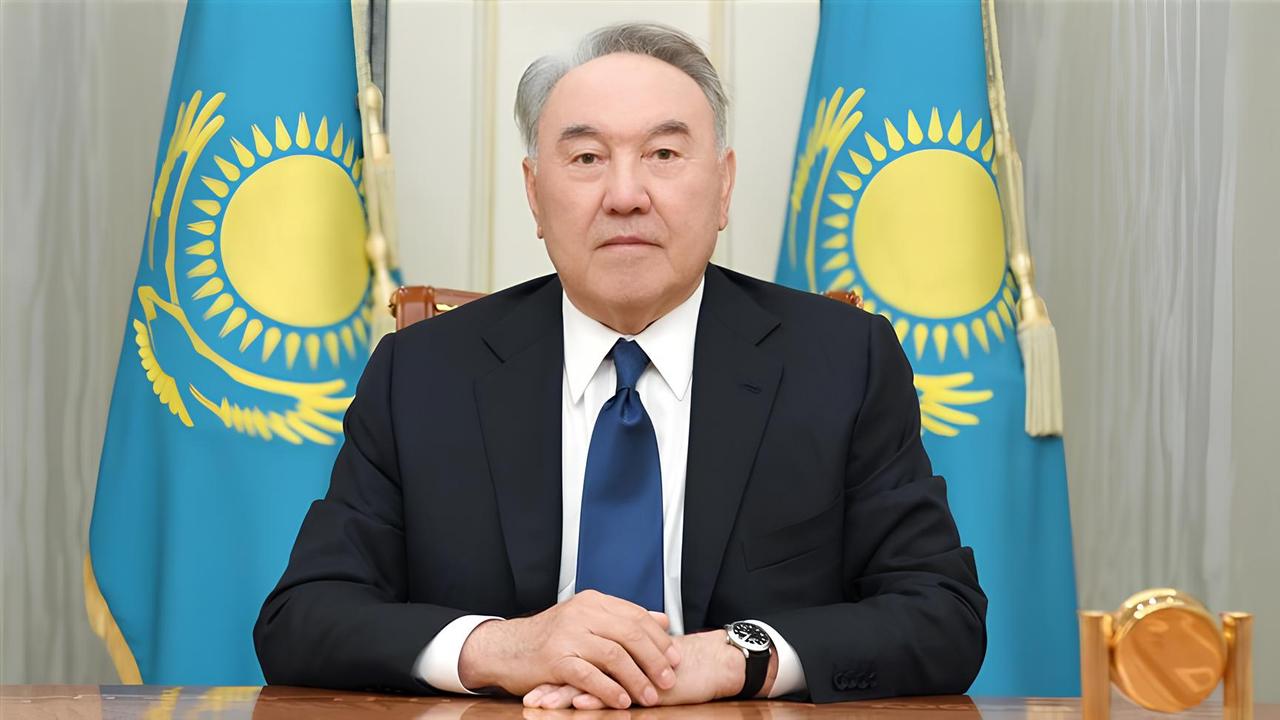


Eş | Sara Alpysowna Nazarbayeva | ||||||||
|---|---|---|---|---|---|---|---|---|---|
Full Name | Nursultan Abishevich Nazarbayev | ||||||||
Birth | 6 July 1940, Chemolgan (Almaty Region) | ||||||||
Education | Karaganda Higher Technical Education Institute | ||||||||
Profession(s) | Statesman | ||||||||
Çocuk | Aliya Nazarbayeva Dinara Nazarbayeva Dariga Nazarbayeva | ||||||||
First Appointment as President | 24 April 1990 | ||||||||
First Election as President | 1 December 1991 | ||||||||
Resignation from Presidency | 19 March 2019 | ||||||||
Nursultan Abishevich Nazarbayev (6 July 1940, Chemolgan) is the first president of Kazakhstan following its independence. During his tenure from 1991 to 2019, he played a central role in foundational processes such as the establishment of the state structure, the shaping of the presidential system, the relocation of the capital, economic restructuring, nuclear disarmament, and the development of a multivector foreign policy doctrine. Kazakhstan’s institutionalization as an independent state and its strengthened international position are largely linked to the choices and policies implemented during his leadership.
Nursultan Nazarbayev was born on 6 July 1940 in the village of Chemolgan, located in the Almaty region, to Abish and Alcan Nazarbayev. His family lived in a rural environment deeply rooted in traditional Kazakh culture and oral storytelling. His grandmother, Myrzabala, stood out within the family for her role in transmitting cultural knowledge; it is also attributed to her that the name “Nursultan” was suggested.
His father, Abish Nazarbayev, was born in 1903 at the foot of the Alatau Mountains, spoke multiple languages, and had an interest in music. His mother, Alcan Nazarbayeva (born 1910), was known for singing traditional Kazakh songs and played an influential role in domestic cultural transmission. The singing of his parents, along with folk tales and proverbs, are remembered as significant elements of his childhood memories.
Nazarbayev’s childhood years unfolded against the backdrop of World War II and the economic hardships of the postwar period. Conditions of scarcity and reconstruction also affected life in Chemolgan.
The multiethnic composition of Chemolgan and its surroundings shaped his early social environment. The village was home to Kazakhs, Ukrainians, Chechens, Germans, Meskhetian Turks, and other communities. Children’s social groups were primarily formed along neighborhood lines rather than ethnic identity. His family hosted Balkar deportees resettled in the region, provided them with assistance, and his father learned the Balkar language during this period.
Diligence in work became a defining trait during his youth. From an early age, Nazarbayev participated in household chores, garden work, and the maintenance of the family’s orchard. He also engaged in physically demanding labor such as haymaking in the mountains. Despite ongoing economic difficulties, the desire for education and self-improvement remained prominent features of his youth.
Information regarding Nazarbayev’s early and secondary education is limited. In the later stages of his youth, he turned toward a technical specialization and completed his higher education at a technical institution in Karaganda. This institution was part of the Soviet vocational-technical education system designed to train skilled labor for the heavy industry sector.
The field of study was closely linked to metallurgy and industrial production, and this training directly prepared him for his professional career at the Karaganda Metallurgical Plant.
After completing his technical education, Nursultan Nazarbayev began his professional life in the heavy industrial facilities of Karaganda. He worked as a steelworker at the Karaganda Metallurgical Plant and gained firsthand experience with the core production processes of the Soviet industrial system. This period marked a time of deep familiarity with the functioning of industry and the lives of workers.
The factory environment also introduced him to his first institutional contacts with the political structure. Nazarbayev joined the Communist Party organization and served as secretary of the party committee at his workplace from 1973 to 1977. This role increased his visibility within the party and provided him with managerial experience.
In 1979, his appointment as secretary of the Central Committee of the Communist Party of Kazakhstan marked a new phase in his career. This step represented a transition from regional activities to involvement in party and administrative mechanisms at the republic level.
In 1984, he was appointed Chairman of the Council of Ministers of the Kazakh Soviet Socialist Republic, one of the highest positions in his Soviet-era political career. This role entailed comprehensive responsibilities in industry, economy, and public administration within the republic.
By the late 1980s, as the Soviet Union entered its dissolution process, Nazarbayev emerged as one of the leading figures in national governance as First Secretary of the Central Committee of the Communist Party of Kazakhstan. During this period, he held a crucial position in managing relations with Moscow and maintaining internal stability in Kazakhstan.
Nursultan Nazarbayev was appointed president on 24 April 1990 and became the first directly elected president of independent Kazakhstan following elections held on 1 December 1991. Throughout his presidency, he participated in six elections, winning in 1991, 1995, 1999, 2005, 2011, and 2015, and remained in office continuously for nearly thirty years. In his final election on 26 April 2015, he received 97.5 percent of the vote.
During Nazarbayev’s presidency, a strong presidential system was established. Constitutional amendments in 1993 and 1995 granted the president extensive executive powers and decisive authority over judicial and government appointments. In 2000, a law conferred upon him the title of “First President”, which continued to grant him various privileges and authorities even after leaving office. The 2007 constitutional amendment removed term limits for the First President only.
During his presidency, domestic politics were built on a centralized governance model. Nazarbayev was appointed lifetime chairman of the Security Council and lifetime member of the Constitutional Council. As president of the ruling party Nur Otan, he maintained dominance over the legislative body. This structure created a comprehensive power balance supported by three pillars: the executive, the party structure, and security institutions.
Key developments during his tenure included the country’s nuclear disarmament, the closure of the Semipalatinsk nuclear test site, the establishment of a multivector foreign policy, and the relocation of the capital from Almaty to Astana. Nazarbayev’s decisions to abandon nuclear weapons and integrate into the international nuclear regime are regarded as critical state policies of the independence era.
In the later years of his presidency, constitutional reforms aimed at transferring some powers within the government system were introduced. However, the 2017 constitutional reform, while transferring certain executive powers, preserved the president’s control over foreign policy, national security, and defense.
Nazarbayev abruptly resigned from office on 19 March 2019. In accordance with the Kazakh Constitution, Senate Chairman Kassym-Jomart Tokayev assumed the role of interim president. This transition occurred with Nazarbayev’s approval and guidance; Tokayev was chosen due to his extensive state experience.
After his resignation, Nazarbayev continued to exert political influence under the title of “National Leader” (Elbasy). He retained his lifetime chairmanship of the Security Council and other lifelong authorities as part of his official status.
However, following the January 2022 events, political balances in the country shifted, and all of Nazarbayev’s lifelong authorities were revoked, and senior positions held by his family members were terminated.
Following independence, the creation of state institutions, the adoption of new constitutional arrangements, the strengthening of the presidential system, and the relocation of the capital from Almaty to Akmola were key steps in Kazakhstan’s modernization process. The reorganization of public administration, the establishment of a legal framework, and the reinforcement of administrative structures were central elements of this period.
During Nazarbayev’s tenure, Kazakhstan transitioned to a market economy, restructured its banking and pension systems, implemented fiscal reforms, and pursued policies to preserve its industrial legacy. Steps were taken to attract foreign investment, and international cooperation was developed in the energy, infrastructure, and finance sectors.
Pipeline projects and energy agreements were implemented to transport the country’s oil and natural gas resources to international markets, with cooperation established with foreign investors. The energy sector became one of the central pillars of economic growth and foreign relations.
Kazakhstan’s foreign policy was based on a multivector approach, maintaining simultaneous relations with Russia, China, the United States, and European countries. The country voluntarily abandoned its nuclear arsenal, removing its former Soviet nuclear capabilities abroad. Kazakhstan actively participated in international organizations and engaged in regional cooperation initiatives.

Kazakhstan President Nursultan Nazarbayev, Kyrgyzstan President Sooronbay Jeenbekov, Türkiye President Recep Tayyip Erdoğan, Azerbaijan President Ilham Aliyev at the 6th Summit of Heads of State of the Turkic Council, 2018 (Anadolu Agency)
Honorary Chairman of the Eurasian Economic Council (2019): On 29 May 2019, Nursultan Nazarbayev was awarded the title of Honorary Chairman of the Eurasian Economic Council for his role as the originator of the idea of Eurasian integration and his contributions to the formation of the Eurasian Economic Union. The title was decided upon by Belarus, Kazakhstan, Kyrgyzstan, Russia, and Armenia.
Honorary Chairman of the Organization of Turkic States (2019): On 15 October 2019, at a summit held in Baku, Nazarbayev was granted the title of Honorary Chairman of the Organization of Turkic States (formerly Turkic Council) for his contributions to the development of Turkic-world cooperation frameworks. The decision was signed by Azerbaijan, Kazakhstan, Kyrgyzstan, Türkiye, and Uzbekistan.
Honorary Chairman of the Consultative Meetings of Central Asian Heads of State (2019): On 29 November 2019, at a meeting in Tashkent, Nazarbayev was awarded the title of Honorary Chairman of the Consultative Meetings of Central Asian Heads of State. The decision was endorsed by the presidents of Kazakhstan, Kyrgyzstan, Tajikistan, Turkmenistan, and Uzbekistan.
Chairman of the CICA Council of Eminent Persons (2021): On 27 October 2021, CICA member states decided to appoint Nazarbayev as Chairman of the CICA Council of Eminent Persons in recognition of his role as the founder of the organization.
CTBTO – Champion for a Nuclear-Test-Free World (2020–2022): On 26 August 2020, under the auspices of the UN General Assembly, the CTBTO awarded Nazarbayev the title of “Champion for a Nuclear-Test-Free World” in recognition of Kazakhstan’s contributions to nuclear disarmament.
Nazarbayev’s wife is Sara Alpysowna Nazarbayeva. The couple has three daughters: Dariga, Dinara, and Aliya.
Sara Alpysowna Nazarbayeva is a public figure known in Kazakhstan for her social welfare activities focused on children. In 1992, she founded and became president of the international charitable fund “Bobek.” She has also led organizations such as “SOS – Children’s Villages of Kazakhstan” (since 1994) and the “Demographics” Charity Fund (since 1999). She has been honored with various international awards for her work in child welfare.
More recent family-related information includes the death of her son-in-law Rakhat Aliyev in an Austrian prison in 2015 and the death of her grandson Aysultan Nazarbayev in London, both of which received international media attention.
Nazarbayev’s hobbies include spending time in nature, music, sports, and reading. His childhood years spent in the pastures of the Zailiyskiy Alatau region left a lasting impression on his memory, particularly the scents of mountain flora and steppe vegetation. He continues to visit Kazakhstan’s natural areas whenever possible.
In music, he is known to play the dombra and sing, influenced by the traditional musical culture of his family. He composed three songs and is credited as a co-author of the lyrics of the National Anthem of Kazakhstan.
Sports hold a prominent place among his interests. He is particularly engaged in tennis, golf, and skiing. He was an active tennis player for many years and is recorded as having frequently played tennis with former Russian President Boris Yeltsin. He prefers ski centers such as Shymbulak. Reading is described as a means of rest and mental renewal amid his demanding work schedule.
Nursultan Nazarbayev transferred his presidential duties to Senate Chairman Kassym-Jomart Tokayev on 19 March 2019. Despite stepping down, he continued to hold the positions of Chairman of the Security Council and Chairman of the Assembly of the People of Kazakhstan, as permitted by existing legal provisions, and retained a privileged position within the political system under the status of “First President – Elbasy.”
Following the protests of 2022, comprehensive reforms were undertaken in Kazakhstan’s political structure. These reforms significantly curtailed Nazarbayev’s lifelong authorities. His privileges as Chairman of the Security Council were terminated, his institutional position within the Assembly of the People of Kazakhstan was altered, and the privileges granted under the “First President” status were restructured. During this process, the political roles of the Nazarbayev family within the state also diminished.
After leaving office, his visibility on national and international platforms declined compared to previous periods. Nevertheless, his role in the founding and state-building process of independent Kazakhstan continues to be referenced in official discourse as a historical benchmark.
Nursultan Nazarbayev continues to be recognized in official memory as the leader who laid the institutional foundations of independent Kazakhstan.
In Kazakhstan, is an official holiday commemorating the date in 1991 when Nursultan Nazarbayev was elected the first president of the Kazakh Soviet Socialist Republic. It was designated a national holiday by parliamentary decision in 2012.
The documentary Nursultan Nazarbayev – A Great Personality of the Turkic World, produced in cooperation between the Turkish Cooperation and Coordination Agency (TİKA) and the Kazakh Presidential Television and Radio Complex, is a 34-minute film focusing on Nazarbayev’s role and activities within the Turkic world. The screening was held at the Nazarbayev Cultural Center with participation from high-level representatives from Türkiye and Kazakhstan.
The documentary examines Nazarbayev’s role in fostering cooperation among Turkic-speaking countries following Kazakhstan’s independence and includes assessments by political leaders from Türkiye and other Turkic-world nations. After its screening, the documentary was broadcast on Kazakh state television and presented as a symbolic expression of friendship between the two countries and as a joint cultural heritage initiative.
Anadolu Ajansı. "Kazakistan’ın atılımı: Nazarbayev’in ülke tarihindeki rolü." Accessed November 28, 2025. https://www.aa.com.tr/tr/analiz/kazakistan-in-atilimi-nazarbayev-in-ulke-tarihindeki-rolu/1901046
Anadolu Ajansı. "Türk konseyi 6. devlet başkanları zirvesi toplandı." Accessed November 28, 2025. https://www.aa.com.tr/tr/pg/foto-galeri/turk-konseyi-6-devlet-baskanlari-zirvesi-toplandi-/146
Cornell, Svante E. and S. Frederick Starr. *Kazakhstan’s Role in International Mediation under First President Nursultan Nazarbayev.* Washington, D.C. November 2020. Accessed November 28, 2025. https://www.isdp.eu//wp-content/uploads/2020/12/Kazakhstan-mediation-04.12.20-Final-for-Print-wCover.pdf
Official Website Of The First President Of The Republic Of Kazakhstan Nursultan Nazarbayev. "Family." *nazarbayev.kz*. Accessed November 28, 2025. https://nazarbayev.kz/en/family
Official Website Of The First President Of The Republic Of Kazakhstan Nursultan Nazarbayev. "Hobby." *nazarbayev.kz*. Accessed November 28, 2025. https://nazarbayev.kz/en/hobby-13111739
Official Website Of The First President Of The Republic Of Kazakhstan Nursultan Nazarbayev. "International statuses of N. Nazarbayev." Accessed November 28, 2025. https://nazarbayev.kz/en/international-statuses-of-n-nazarbayev
Official Website Of The First President Of The Republic Of Kazakhstan Nursultan Nazarbayev. "Juvenility." *nazarbayev.kz*. Accessed November 28, 2025.
Official Website Of The First President Of The Republic Of Kazakhstan Nursultan Nazarbayev. "Mature Years." nazarbayev.kz. Accessed November 28, 2025.
Official Website Of The First President Of The Republic Of Kazakhstan Nursultan Nazarbayev. "Nursultan Nazarbayev, Childhood." nazarbayev.kz. Accessed November 28, 2025.
Official Website Of The First President Of The Republic Of Kazakhstan Nursultan Nazarbayev. "Sports and Hobbies." *nazarbayev.kz*. Accessed November 28, 2025. https://nazarbayev.kz/en/sports-and-hobbies-13113729
Official Website Of The First President Of The Republic Of Kazakhstan Nursultan Nazarbayev. "Youth." *nazarbayev.kz*. Accessed November 28, 2025.
TRT AVAZ. "Kazakistan'da İlk Cumhurbaşkanı Günü kutlanıyor." Accessed November 28, 2025. https://www.trtavaz.com.tr/haber/tur/turkistandan/kazakistanda-ilk-cumhurbaskani-gunu-kutlaniyor/5c036f1a01a30a6140e00844
TİKA. "Nursultan Nazarbayev Belgeseli'nin Gösterimi Yapıldı." Türk İşbirliği ve Koordinasyon Ajansı. Accessed November 28, 2025. https://tika.gov.tr/detail-nursultan_nazarbayev_belgeselinin_gosterimi_yapildi/
Yalçın, Resul. "Kassym Jomart Tokayev’s Presidential Transition Period and Its Impact on Turkey-Kazakhstan Relations." International Journal of Economics, Politics, Humanities & Social Sciences 8, no. 2 (Spring 2025): 160-178. Accessed November 28, 2025. https://dergipark.org.tr/en/pub/ijephss/issue/91205/1643397
Yedgina, G.T., and Khaled Abou Taam. "Nursultan Nazarbayev - Leader and Diplomat." Bulletin of the Karaganda University History. Philosophy Series (90) 2 (2018): 69-75. Accessed November 28, 2025. https://history-philosophy-vestnik.buketov.edu.kz/index.php/history-philosophy-vestnik/article/view/259
Yılmaz, Serdar. "The Role of The Leadership of Nursultan Nazarbayev in Kazakhstan’s Stability." *International Journal of Liberal Arts and Social Science* 5, no. 2 (March 2017): 61-72. Accessed November 28, 2025. https://www.researchgate.net/publication/316191541_The_Role_of_The_Leadership_of_Nursultan_Nazarbayev_in_Kazakhstan's_Stability

Eş | Sara Alpysowna Nazarbayeva | ||||||||
|---|---|---|---|---|---|---|---|---|---|
Full Name | Nursultan Abishevich Nazarbayev | ||||||||
Birth | 6 July 1940, Chemolgan (Almaty Region) | ||||||||
Education | Karaganda Higher Technical Education Institute | ||||||||
Profession(s) | Statesman | ||||||||
Çocuk | Aliya Nazarbayeva Dinara Nazarbayeva Dariga Nazarbayeva | ||||||||
First Appointment as President | 24 April 1990 | ||||||||
First Election as President | 1 December 1991 | ||||||||
Resignation from Presidency | 19 March 2019 | ||||||||
No Discussion Added Yet
Start discussion for "Nursultan Nazarbayev" article
Childhood and Youth
Education and Professional Orientation
Soviet-Era Career
Presidency of Independent Kazakhstan
Modernization and State Building
Economic Reforms
Energy Policy
Foreign Policy
Honorary Presidencies and Titles
Personal Life
Family
Daughters
Hobbies and Interests
Later Years and the Recasting of His Political Position
Legacy
Day of the Founder and First President of Kazakhstan
Documentary: “Nursultan Nazarbayev – A Great Personality of the Turkic World”