


This article was automatically translated from the original Turkish version.
+1 More
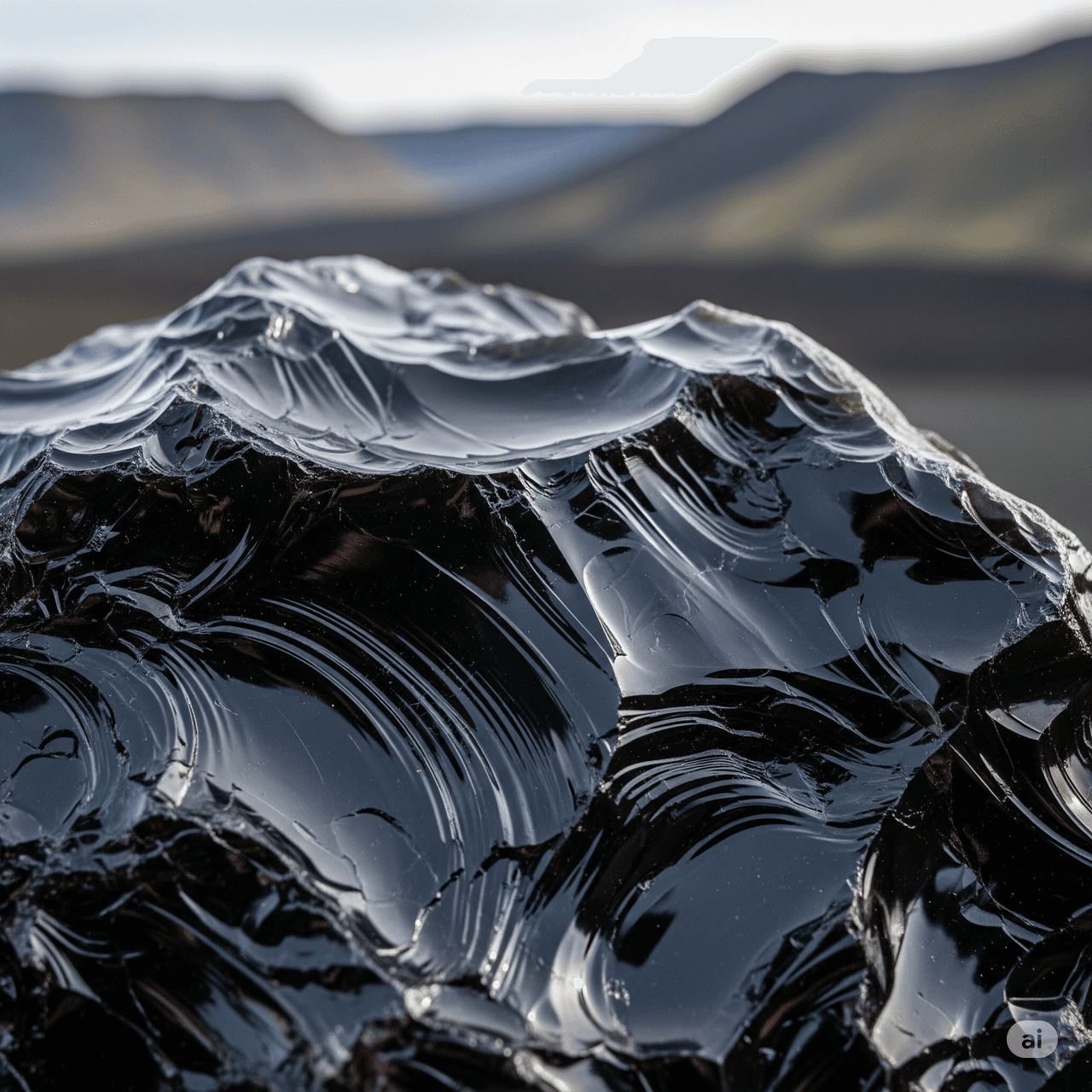
Obsidian
Rock Type | Volcanic glass (amorphous structure) | ||||||||
|---|---|---|---|---|---|---|---|---|---|
Color | Black, brown, green, red | ||||||||
Hardness (Mohs) | 5 - 6 | ||||||||
Density | 2.4 - 2.6 g/cm³ | ||||||||
Chemical Composition | High silica (%70+), Al, Fe, Mg, Na, K | ||||||||
Formation Process | Rapid cooling of silica-rich magma | ||||||||
Area(s) of Use | Cutting tools archaeological analyses jewelry decorative items | ||||||||
Obsidian is a natural rock formed by the rapid cooling of magma with high silica content, also known as volcanic glass. This rapid cooling prevents the development of a crystalline structure, resulting in obsidian's amorphous composition.
Since prehistoric times, obsidian has been used in the manufacture of cutting tools and has also been favored for the production of ornaments and jewelry. Archaeological findings demonstrate that obsidian provides significant insights into ancient trade routes and cultural interactions.
Obsidian forms when highly viscous, silica-rich magma rises to the surface and cools rapidly. This rapid cooling inhibits crystal formation, producing an amorphous, glass-like structure. While obsidian is typically black, it can also occur in brown, green, and red tones depending on the presence of elements such as iron and magnesium. The characteristic concoidal fractures observed on its surface are a defining feature of obsidian.
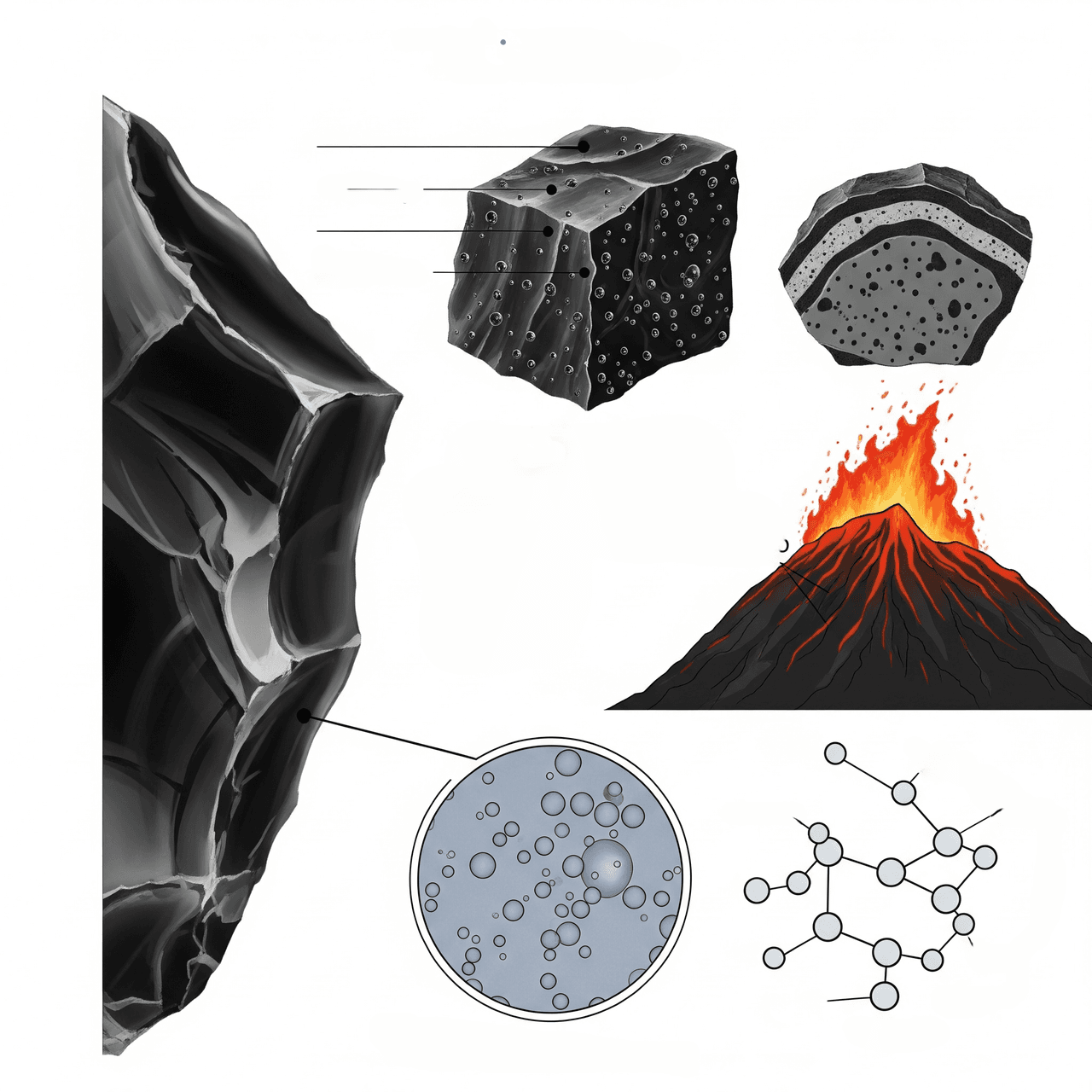
Obsidian Formation (Generated by Artificial Intelligence)
The physical properties of obsidian are a key factor in determining its applications. With a hardness of 5 to 6 on the Mohs scale, obsidian was preferred for making cutting tools. Its density ranges approximately between 2.4 and 2.6 g/cm³. Chemically, obsidian contains a high proportion of silica (SiO₂), typically exceeding 70 percent. It also includes elements such as aluminum, iron, magnesium, sodium, and potassium.
Obsidian was widely used by prehistoric societies to produce cutting and piercing tools. Due to its sharpness and durability, it became an essential material for hunting and daily life. Furthermore, studies identifying the sources of obsidian provide archaeologists with valuable information about ancient trade networks and cultural exchanges. Analyzing the chemical composition of obsidian from different regions helps determine its origin.
Due to its aesthetic qualities, obsidian has also been used in the production of ornaments and jewelry. In ancient Mexico, particularly during the Aztec period, lapidary work with obsidian held significant importance. Excavations at Otumba have revealed that obsidian was used to make earrings, lip plugs, and beads. Additionally, within the Teuchitlán tradition, unpolished obsidian jewelry was produced and is recognized as a unique technological practice in Mesoamerica.
Different varieties of obsidian offer diverse aesthetic options in jewelry design. For example, rainbow obsidian displays colorful iridescence under light, while snowflake obsidian features white crystalline patterns against a black background. This variety has ensured obsidian’s continued popularity in modern jewelry design.

Use of Obsidian in Ornaments (Generated by Artificial Intelligence)
Dillian, Carolyn. "Current Questions and New Directions in Archaeological Obsidian Studies." In The Oxford Handbook of Topics in Archaeology. Oxford Academic, 2016. Accessed May 24, 2025. https://academic.oup.com/edited-volume/43506/chapter/364131880
Healey, Elizabeth. "Not only a tool-stone: Other ways of using obsidian in the Near East." *Journal of Lithic Studies* 8, no. 3 (2021). Accessed May 24, 2025. https://journals.ed.ac.uk/lithicstudies/article/view/5739/
Otis Charlton, Cynthia L. “Obsidian as Jewelry: Lapidary Production in Aztec Otumba, Mexico.” *Ancient Mesoamerica* 4, no. 2 (1993): 231–243. Accessed May 24, 2025. https://doi.org/10.1017/s0956536100000924
Williams, Eduardo, and Maldonado, Blanca. "The Obsidian Jewelry of the Teuchitlán Tradition: Study and Analysis of an Unknown Lithic Technology." *The Obsidian Jewelry of Teuchitlán*, 2016. Accessed May 24, 2025. Accessed adresi

Obsidian
Rock Type | Volcanic glass (amorphous structure) | ||||||||
|---|---|---|---|---|---|---|---|---|---|
Color | Black, brown, green, red | ||||||||
Hardness (Mohs) | 5 - 6 | ||||||||
Density | 2.4 - 2.6 g/cm³ | ||||||||
Chemical Composition | High silica (%70+), Al, Fe, Mg, Na, K | ||||||||
Formation Process | Rapid cooling of silica-rich magma | ||||||||
Area(s) of Use | Cutting tools archaeological analyses jewelry decorative items | ||||||||
Geological Properties and Formation
Physical and Chemical Properties
Archaeological Significance and Uses
Use in Ornaments and Jewelry