


This article was automatically translated from the original Turkish version.
+2 More
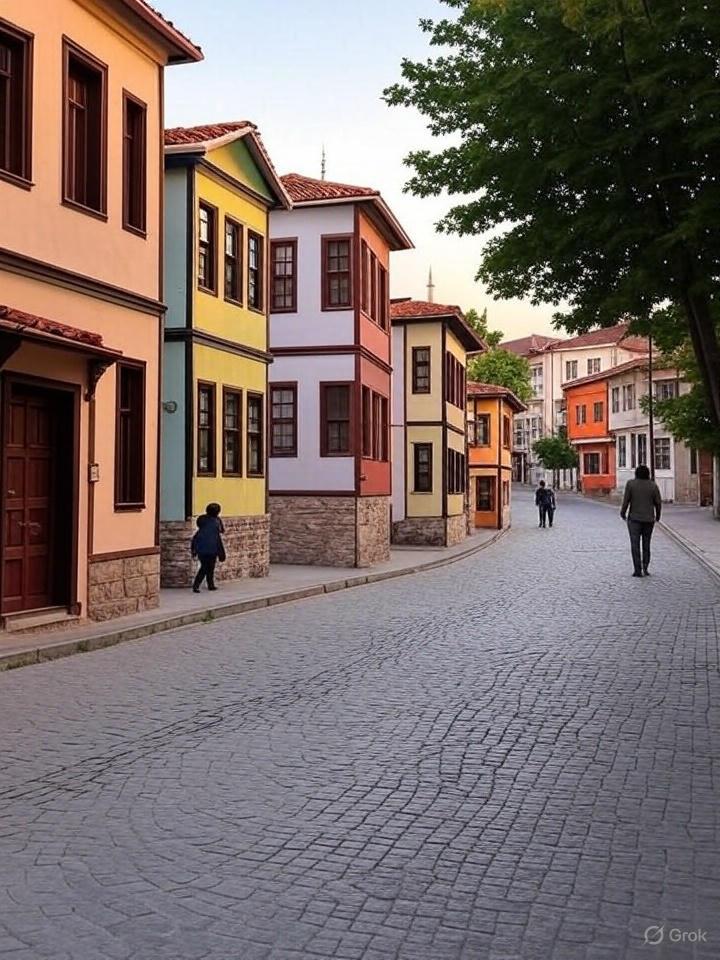
Prepared by visual artificial intelligence.
Eskişehir Odunpazarı Houses
Cultural Importance of Odunpazarı Houses | Role in Cultural Tourism and Education Preservation of Social Memory and Identity Carrier of Intangible Cultural Heritage Listed on UNESCO's Tentative World Heritage List Representative of Historical and Architectural Heritage | ||||||||
|---|---|---|---|---|---|---|---|---|---|
Odunpazarı Houses are historic residential structures located in the Odunpazarı district of Eskişehir, Türkiye, embodying characteristic features of Ottoman civil architecture and reflecting traditional Anatolian settlement patterns. This area holds significant architectural, cultural, and historical value, in addition to being Eskişehir’s oldest settlement site. Today, Odunpazarı is a popular destination for both domestic and international tourists and is listed on UNESCO’s Tentative World Heritage List.

Eskişehir Odunpazarı Houses Türkiye Culture Portal
Eskişehir was known as Dorylaion in antiquity. After the Turkish settlement in Anatolia, the city was reestablished following the victory of II. Kılıçarslan over the Byzantines in 1176. During the Ottoman period, it was also referred to as “Sultan Önü.” The original settlement area, Odunpazarı, is known as “Yukarı Şehir,” located above the Porsuk River.
The area derives its name from a market where villagers came during the Ottoman period to sell firewood to the city. The Odunpazarı settlement developed after Seljuk Sultan II. Kılıçarslan established himself in Karacaşehir Castle. Şarkiye Mahallesi is recorded as the first neighborhood in this region.

Odunpazarı Houses Türkiye Culture Portal
Odunpazarı Houses are predominantly two- or three-story wooden structures with overhanging upper floors, gabled roofs, and ornamental woodwork, reflecting 19th-century Ottoman civil architecture. These buildings are situated within an organic street network characterized by narrow, winding alleys. Typically, the ground floor housed service areas such as kitchens, storage rooms, and stables, while the upper floors served as living quarters.
The exterior facades are simple yet architecturally significant. Window placement follows the principle of privacy; opposite windows are often aligned horizontally. Overhangs are designed with consideration for neighborly relations and visual connections to the street. Gardens and courtyards are enclosed by high walls to ensure privacy.

Odunpazarı Houses and Streets Türkiye Culture Portal
From the 19th century onward, migrations from Crimea and the Balkans diversified the demographic and cultural fabric of Odunpazarı. The arrival of the railway boosted economic vitality, introducing country mansions and rich architectural elements to the neighborhood. However, during the occupation years, extensive damage occurred; mansions were abandoned and deteriorated. During the Republican period, as urban development continued along the Porsuk River, Odunpazarı lost its former prominence and was largely forgotten for a time.
In 1981, Odunpazarı was declared a “historical and urban site” by the High Council for Immovable Cultural Heritage and Monuments. In 1986, it gained the status of an Urban Conservation Area. In 2005, the “Odunpazarı Houses Revitalization Project” was launched to rejuvenate the area. Under this project, 300 houses across 30 streets, three mosques, one külliye, two caravanserais, 15 fountains, and one han were restored. The project received support from the Ministry of Culture and Tourism, Anadolu University, the General Directorate of Foundations, and various civil society organizations.
As a result of these efforts, abandoned buildings have been reintegrated into urban life through new functions such as hotels, restaurants, and cafés, transforming the area into one of Eskişehir’s most important cultural and tourism centers.
Today, Odunpazarı remains a vibrant element of Eskişehir’s cultural memory. The streets praised by Evliya Çelebi in his Seyahatnâme still retain their original names. Structures such as the Lületaşı Museum, Atlıhan Handicrafts Bazaar, Kurşunlu Camii and Külliyesi are among Odunpazarı’s key attractions.
In addition, the neighborhood preserves traditional crafts such as coppersmithing, tinning, and wood carving, attracting visitors to its antique shops and artisan workshops.
Odunpazarı Houses represent an exemplary urban heritage site in terms of architectural sustainability, cultural continuity, and socio-economic transformation. The organic street structure, integration with nature, and balanced distinction between public and private spaces reflect both historical and contemporary sustainable living practices of this traditional settlement.
Apak, Şule, Derya Ülken, and Ahu Ünlü. “Kentsel Morfolojik Analizlerde Kullanılan Yöntemlere İlişkin Bir Derleme.” *Gazi Üniversitesi Mühendislik-Mimarlık Fakültesi Dergisi* 17, no. 4 (2002): 59–75. https://dergipark.org.tr/en/download/article-file/298264. Accessed June 25, 2025.
Baraz, Hülya. “Geleneksel Türk Konutlarında Biçimsel Gelişim.” *Gazi Üniversitesi Mühendislik-Mimarlık Fakültesi Dergisi* 14, no. 2 (1999): 245–256. https://dergipark.org.tr/tr/download/article-file/1263288. Accessed June 25, 2025.
Culture Portal. "Odunpazarı." Ministry of Culture and Tourism of the Republic of Türkiye. https://www.kulturportali.gov.tr/medya/fotograf/fotodokuman/4233/odunpazari. Accessed June 25, 2025.
Eskişehir Büyükşehir Municipality. “Odunpazarı Evleri.” Accessed June 25, 2025.
Eskişehir İl Directorate of Culture and Tourism. "Odunpazarı Evleri." Ministry of Culture and Tourism of the Republic of Türkiye. https://eskisehir.ktb.gov.tr/TR-336894/odunpazari-evleri.html. Accessed June 25, 2025.
Odunpazarı Belediyesi. "Odunpazarı Evleri Yaşatma Projesi." Accessed June 25, 2025. https://odunpazari.bel.tr/projeler/kultur-sanat-ve-turizm-projeleri/odunpazari-evleri-yasatma-projesi.
Uçkan, Yelda, and Erkan Uçkan. “Odunpazarı Evleri: Geleneksel Türk Konutlarında Cephe Tasarımı.” *Gazi Üniversitesi Mühendislik-Mimarlık Fakültesi Dergisi* 25, no. 2 (2010): 23–38. https://dergipark.org.tr/tr/download/article-file/1218596. Accessed June 25, 2025.

Prepared by visual artificial intelligence.
Eskişehir Odunpazarı Houses
Cultural Importance of Odunpazarı Houses | Role in Cultural Tourism and Education Preservation of Social Memory and Identity Carrier of Intangible Cultural Heritage Listed on UNESCO's Tentative World Heritage List Representative of Historical and Architectural Heritage | ||||||||
|---|---|---|---|---|---|---|---|---|---|
History
Architectural Features
Cultural and Socio-Cultural Life
Conservation and Restoration Efforts
Odunpazarı Today
Significance from a Sustainability Perspective