


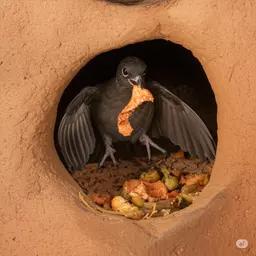
Oilbird (Steatornis caripensis)
Scientific Name(s) | Steatornis Caripensis | ||||||||
|---|---|---|---|---|---|---|---|---|---|
Order | Steatornithiformes | ||||||||
Family | Steatornithidae | ||||||||
Average Length | 40–49 cm | ||||||||
Weight(s) | 350–475 g | ||||||||
Distribution(s) | Caribbean Northern Regions of South America | ||||||||
Habitat | Caves Moist tropical forests | ||||||||
Diet(s) | Fruit | ||||||||
Reproduction(s) | Breeds in Colonies within Caves | ||||||||
The Oilbird (Steatornis caripensis) is the only known nocturnal, frugivorous bird species inhabiting northern South America and the Caribbean. It is the sole representative of both the family Steatornithidae and the order Steatornithiformes. Notable for its colony-based cave dwelling, echolocation ability, and long-distance seed dispersal, the oilbird plays an essential role in tropical forest ecosystems.
The oilbird, Steatornis caripensis, is the only species in the family Steatornithidae and the order Steatornithiformes, which underscores its evolutionarily isolated position. Fossil records indicate that the lineage dates back at least to the Late Miocene.
Oilbirds measure approximately 40–49 cm in length and weigh between 350–475 grams. Their feathers are brown with white spots. Wide wings and a long tail provide agility during nocturnal flights. The species’ eyes have evolved to offer exceptional vision even in low-light environments.
Due to their life in completely dark caves, oilbirds possess a highly developed visual system. Their retinal structures are specialized for maximum sensitivity in low-light conditions. Additionally, they are capable of echolocation, a rare adaptation among birds, which enables them to navigate through dark caves with remarkable accuracy.

Oil bird Eco Feature (Created by Artificial Intelligence)
Oilbirds are nocturnal frugivorous birds. They particularly favor fruits from the Lauraceae and Burseraceae families. They swallow the fruits whole and later disperse the seeds through defecation after digestion.
Oilbirds play a crucial role in seed dispersal within tropical forests. By traveling long distances at night to consume fruit, they transport seeds to different regions. This behavior is critical for forest regeneration and the preservation of plant diversity.
Oilbirds breed in large colonies within caves. Females typically lay 1–2 eggs, and the incubation period lasts about 30–35 days. Chicks are fed by their parents for approximately 120 days. Colony life fosters a socially interactive environment.
Cárdenas, S., Echeverry‐Galvis, M. Á., & Stevenson, P. R. (2021). Seed dispersal effectiveness by oilbirds (Steatornis caripensis) in the Southern Andes of Colombia. Biotropica, 53(2), 671–680. Accessed May 24, 2025. https://doi.org/10.1111/btp.12908.
Holland, R. A., Wikelski, M., Kümmeth, F., & Bosque, C. (2009). The Secret Life of Oilbirds: New Insights into the Movement Ecology of a Unique Avian Frugivore. PLoS ONE, 4(12), e8264. Accessed May 24, 2025. https://doi.org/10.1371/journal.pone.0008264.
Martin, Graham R., Luz Marina Rojas, Yleana Ramírez, and Raymond McNeil. "The Eyes of Oilbirds (Steatornis caripensis): Pushing at the Limits of Sensitivity." Naturwissenschaften 91, no. 1 (2004): 26–29. Accessed May 24, 2025. https://link.springer.com/article/10.1007/s00114-003-0495-3.
Suthers, R. A., & Hector, D. H. (1985). The physiology of vocalization by the echolocating oilbird,Steatornis caripensis. Journal of Comparative Physiology A, 156(2), 243–266. Accessed May 24, 2025. https://doi.org/10.1007/bf00610867.


Oilbird (Steatornis caripensis)
Scientific Name(s) | Steatornis Caripensis | ||||||||
|---|---|---|---|---|---|---|---|---|---|
Order | Steatornithiformes | ||||||||
Family | Steatornithidae | ||||||||
Average Length | 40–49 cm | ||||||||
Weight(s) | 350–475 g | ||||||||
Distribution(s) | Caribbean Northern Regions of South America | ||||||||
Habitat | Caves Moist tropical forests | ||||||||
Diet(s) | Fruit | ||||||||
Reproduction(s) | Breeds in Colonies within Caves | ||||||||
No Discussion Added Yet
Start discussion for "Oilbird (Steatornis caripensis)" article
Morphological and Physiological Characteristics
Taxonomy and Evolutionary Position
Physical Features
Vision and Echolocation
Behavioral Characteristics and Ecological Role
Feeding Habits
Seed Dispersal and Ecological Impact
Reproduction and Social Behavior
This article was created with the support of artificial intelligence.