

This article was automatically translated from the original Turkish version.
+1 More
Author(s) | Mehmet Erdoğan | ||||||||
|---|---|---|---|---|---|---|---|---|---|
Publisher(s) | Dergâh Yayınları | ||||||||
Publication Year | April 2004 | ||||||||
Number of Pages | 202 | ||||||||
Type(s) | Literary Studies / Poetry Theory | ||||||||
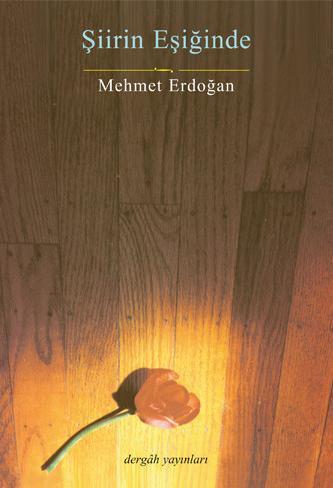
On the Threshold of Poetry is a comprehensive study and essay volume by Mehmet Erdoğan, published under the “Turkish Literature” series by Dergâh Publications. It examines the ontological and epistemological dimensions of poetry and art. The work engages with the purpose of art, the linguistic bridge between divine will and humanity, and the position of the artistic work as a search for meaning, all with philosophical depth. Published in April 2004, the book consists of 202 pages.
The work On the Threshold of Poetry investigates the fundamental functions and philosophical foundations of art, particularly poetry. It opens with T.S. Eliot’s definition of art as “revealing ordinary reality within a believable order, allowing the reader to experience this sense of order, enabling them to live in peace and tranquility with themselves, and then abandoning them on a line where no one but oneself can assist in the journey toward divine truth.” This quotation establishes the overarching framework of the book, emphasizing that art is not merely an aesthetic phenomenon but also a spiritual quest and a mode of relating to truth.
Mehmet Erdoğan asserts in his work that there exists a “linguistic bridge” (revelation/call) between human beings and divine will, and that a “flow of mercy” emanates from this divine will toward humanity. At the same time, he notes the existence of a movement from humanity toward absolute truth and divine will—expressed as prayer and response.
The author positions the utterance emerging along this path as a manifestation of the divine will’s attribute of speech. He argues that within this manifestation lies a process of “assimilation: understanding, interpreting, articulating, and supplicating.” The book centers on the ideal of the perfect human and the artistic work that represents this quest, presenting an idealized figure who is purified, purifying, and enveloping, whose reactivity does not override their essential nature. Viewing every work as a book of the cosmos, the author contends that the reader must approach the work as one approaches the universe, capable of finding oneself within the work and the work within oneself. In this context, the book interrogates the metaphysical dimensions of poetry and art, their relationship to creation, and the role of the human being in the journey of self-understanding.
The language and style of the work are academic, descriptive, and objective, befitting the philosophical and theoretical subjects it addresses. While enriched with conceptually dense expressions, the text makes a deliberate effort to render complex ideas comprehensible. When treating the abstract dimensions of poetry and art, the author adopts an essayistic tone that invites reflection. The book contains no promotional or laudatory language; instead, it offers an analytical perspective on the essence of poetry and art.
Mehmet Erdoğan is recognized as a writer and thinker in Turkish literature, particularly for his studies and essays on poetry. His works are known for their focus on the philosophical, religious, and aesthetic dimensions of literature. On the Threshold of Poetry is a significant work that reflects Erdoğan’s approach to poetic and artistic theory and his intellectual accumulation in this field. The book holds considerable importance for Turkish literary scholarship, contributing substantially to academic studies on poetic theory and aesthetics. It serves as a fundamental reference for researchers, literature students, and general readers interested in the meaning, function, and divine relationship of poetry.
Erdoğan, Mehmet. *Şiirin Eşiğinde*. İstanbul: Dergah Yayınları, 2004. Accessed July 8, 2025. https://www.dergah.com.tr/kitaplar/siirin-esiginde.
Author(s) | Mehmet Erdoğan | ||||||||
|---|---|---|---|---|---|---|---|---|---|
Publisher(s) | Dergâh Yayınları | ||||||||
Publication Year | April 2004 | ||||||||
Number of Pages | 202 | ||||||||
Type(s) | Literary Studies / Poetry Theory | ||||||||
No Discussion Added Yet
Start discussion for "On the Threshold of Poetry (Book)" article
Content and Thematic Structure
Language and Style
The Author’s Position and the Significance of the Work