

This article was automatically translated from the original Turkish version.
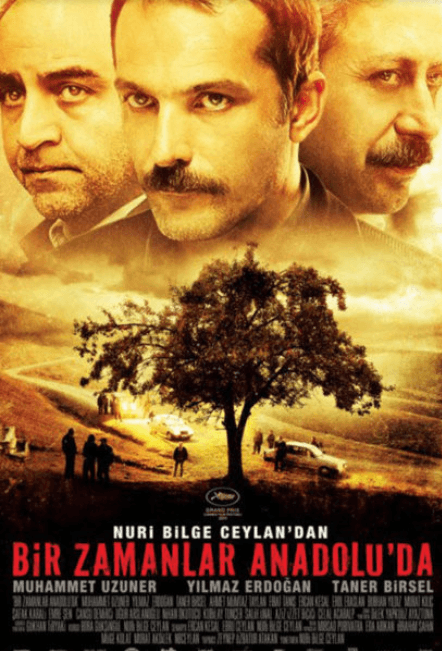
Once Upon a Time in Anatolia is a 2011 dramatic feature film directed by Nuri Bilge Ceylan and produced by Turkish. The film, shot in a slow-paced, contemplative style, explores philosophical and social themes centered on human nature, bureaucratic inertia, and the concept of conscience through the lens of a judicial investigation set in the rural geography of Anatolia. Renowned for its cinematography, dialogue structure, and deliberate pacing, the film garnered widespread acclaim in international cinema circles and was awarded the Grand Prix at the Cannes Film Festival.

Team Attempting to Illuminate the Murder on a Desolate Mountain Road (Source: )
The film centers on the investigation following a murder in a small town in Anatolia. A team composed of a police commissioner, a prosecutor, and soldiers spends the night searching the countryside for the burial site of the suspect’s victim, as the suspect cannot recall the exact location where he buried the body. The investigation reveals not only the complexities of solving a single crime but also the psychological unraveling, moral questioning, and structural limitations of rural bureaucracy. The film places emphasis not on resolving the case but on the process itself and the inner worlds of its characters.
Trailer (Source: YouTube)
The murder is not treated merely as a legal matter but also as a matter of conscience within the characters’ internal struggles. Beyond the suspect’s guilt, each participant in the investigation carries their own inner burdens and vulnerabilities.
The film exposes the clumsiness of rural bureaucracy, the stagnation in decision-making processes, and the lack of communication between institutions. The characters strive to fulfill their duties while being trapped within the constraints of this system.
Departing from a conventional plot-driven narrative, the film focuses on the slow passage of time, the darkness of night, and the emptiness of the Anatolian steppe. This visual and temporal emptiness reinforces the characters’ inner sense of alienation and meaninglessness.
All characters in the film embody not only physical exhaustion but also a profound spiritual depletion. This exhaustion evolves into a philosophical inquiry into the meaninglessness of life rather than a routine investigation. Particularly through the doctor character, existential questions about individual identity, social roles, and professional purpose emerge.
The silences in the film are not merely a narrative technique but also a reflection of the indirect communication and unspoken understanding deeply rooted in Anatolian culture. Long pauses and dialogues conveyed through implication reveal this cultural code.
The visible functioning of the legal system is shadowed by underlying moral ambiguities. A revelation about the prosecutor’s past illustrates how even those who enforce the law can be caught in internal moral conflicts. In this context, the film draws attention to how justice is not mechanical but shaped by human frailty.

Doctor (Source: )
Once Upon a Time in Anatolia is not only a murder investigation but also a profound reflection of Anatolia’s socio-cultural structure. The film examines the relationship between tradition and modernity, the tensions between customary values and institutional mechanisms, and the daily lives of rural Anatolians from an observational perspective. In this way, the film bears witness to a cultural fabric beyond individual characters.
Clip from the Film (Source: YouTube)
The meal and temporary lodging offered during the night journey to a local home reflect the culture of Anatolian hospitality. Yet this gesture also reveals the spatial limitations and quietude of rural life.
Throughout the film, stories from the past are recounted, particularly by the prosecutor and villagers, demonstrating the continued vitality of oral culture. These narratives serve not only to pass time but also as carriers of cultural memory and existential inquiry.
The relationships between the commissioner, prosecutor, doctor, and gendarmerie unfold within the boundaries defined by local hierarchies and professional statuses. This structure mirrors traditional Anatolian notions of respect and authority. Age, musical mode, and professional title directly influence modes of communication.
The characters in the film communicate indirectly, avoiding direct confrontation. Long silences, implied speech, and averted glances reflect the Anatolian preference for indirect communication in social interactions. This cultural pattern also manifests in relation to authority figures, where individuals express their thoughts not openly but through subtle means.
An authoritarian commissioner at the head of the investigation. He favors practical methods but reveals impatience as the case progresses.
Follows the legal dimensions of the case throughout the film. A revelation near the end about his past provides a powerful insight into his personal history. The tension between law and conscience is clearly evident in this character.
A young newly appointed state doctor. He occupies an observational role throughout the events and is the character who engages in the most profound internal reflection. He embodies the film’s ethical and philosophical dimensions.
The suspect accused of committing the murder. His speech and contradictory behavior reflect both guilt and remorse. Though central to the case, his silence contributes significantly to the narrative.
A government driver operating the official vehicle. He represents the practical wisdom and local humor of rural Anatolian life.
The film was produced by Zeyno Film and NBC Film common. The screenplay was written by Nuri Bilge Ceylan, Ebru Ceylan, and Ercan Kesal. Filming took place in 2009 in the Çifteler district of Eskişehir. The production favored wide landscape shots, limited lighting sources, and natural sound. Cinematographer Gökhan Tiryaki's work is notable for the balance it establishes between natural darkness and visual storytelling, particularly in night scenes.
Once Upon a Time in Anatolia received widespread attention at national and international festivals and was honored with numerous important awards. Particularly noted for its direction, cinematography, and screenplay, the film stands among the most significant productions representing Turkish cinema on the global stage.
The film was screened in the Official Competition of the 64th Cannes Film Festival and won the Grand Prix, the festival’s second most prestigious award. The international jury recognized the film for its narrative intensity, atmospheric creation, and character analysis.
Nuri Bilge Ceylan chose not to premiere the film at the Antalya Golden Orange Film Festival; as a result, the film did not enter the official competition. However, it has since been featured in various special screenings at local cinema events in subsequent years.

No Discussion Added Yet
Start discussion for "Once Upon a Time in Anatolia (Film)" article
Plot
Themes
Conscience and Guilt
Rural Bureaucracy and Communication Breakdown
Time, Space, and the Void of Meaning
Tiredness and Existential Inquiry
Anatolian Culture and Silence
Invisible Law and Moral Contradiction
Reflections in Anatolian Culture
Hospitality and Village Life
Collective Memory and Narrative Tradition
Hierarchical Structure and Respect
Culture of Silence and Indirect Communication
Main Characters and Actors
Commissioner Naci (Yılmaz Erdoğan)
Prosecutor Nusret (Taner Birsel)
Doctor Cemal (Muhammet Uzuner)
Suspect Kenan (Fırat Tanış)
Driver Arap (Ahmet Mümtaz Taylan)
Production and Filming Process
Awards and Nominations
Cannes Film Festival (2011)
Asia Pacific Screen Awards (2011)
Antalya Golden Orange Film Festival (2011)