


This article was automatically translated from the original Turkish version.

OpenStack
Field | Cloud Computing | ||||||||
|---|---|---|---|---|---|---|---|---|---|
Category | Open Source Infrastructure Software | ||||||||
License | Apache License 2.0 | ||||||||
Developer(s) | Open Infrastructure Foundation | ||||||||
Initial Release | 21 July 2010 | ||||||||
Website(s) | https://www.openstack.org | ||||||||
OpenStack is a cloud computing infrastructure software distinguished by its open-source nature and modular architecture. By providing infrastructure-as-a-service (IaaS), it enables the automated management of virtual machines, networks, and storage resources. Originally developed by NASA and Rackspace, the system is now actively used in numerous private and public cloud infrastructures worldwide.
This diagram visualizes the core components of OpenStack and their interactions. OpenStack integrates computing, networking, and storage services in a cloud environment to deliver a modular, API-driven cloud operating system.
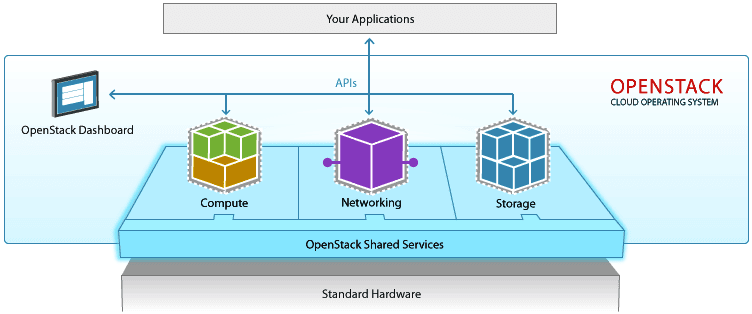
General Architecture of OpenStack Components (Mshowto)
Standard Hardware (Bottom Layer): OpenStack is designed to operate independently of hardware. Physical servers and disks form this foundational layer.
OpenStack Shared Services: Common services such as identity management, telemetry, and image services reside at this layer and are shared across all OpenStack components.
Core Components:
OpenStack Dashboard (Horizon): Provides a web-based interface for users to manage resources.
APIs: All components communicate with each other and with external applications via APIs.
Your Applications: At the top layer, user applications utilize the infrastructure services provided by OpenStack. This layer fulfills the primary purpose of the cloud infrastructure.
OpenStack is used across a broad range of applications:
This diagram highlights OpenStack’s flexible and extensible architecture, demonstrating its ability to support diverse environments—bare metal, virtual machines, and containers—as well as its integration capabilities with third-party services.
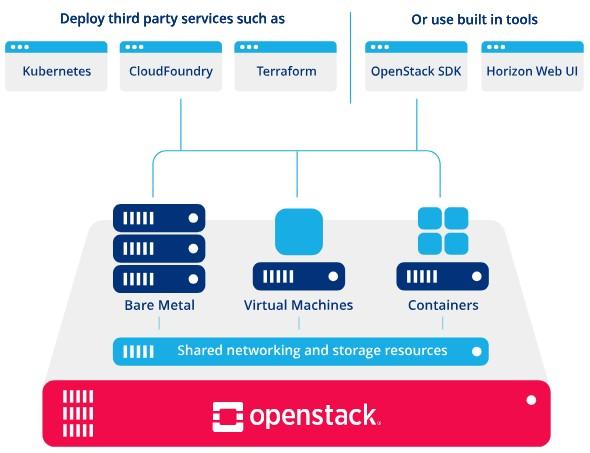
Comprehensive Infrastructure Diagram of the OpenStack Platform (OpenStack)
OpenStack is a flexible platform capable of managing bare metal, virtual machines, and container-based infrastructures in an integrated manner. By leveraging shared network and storage resources, it enables resource sharing across these infrastructure types. Users can manage resources through built-in tools such as the OpenStack SDK or Horizon Web UI, while also integrating external services like Kubernetes, CloudFoundry, and Terraform. This architecture allows diverse workloads to be managed on the same infrastructure.
The installation and configuration process of OpenStack can be more complex than that of other solutions. However, automation tools such as Ansible, Terraform, and Kolla can simplify these tasks. Additionally, centralized monitoring systems like Prometheus and Grafana are required to ensure consistency between components and to track performance.
OpenStack has become a widely adopted solution in modern cloud infrastructures due to its flexibility, scalability, and full customizability. Its development model, grounded in free software principles, has led to its adoption by numerous organizations in both the public and private sectors.
Cloud Infrastructure Team. “OpenStack Operations Guide.” OpenStack Foundation. https://docs.openstack.org/operations-guide/. Accessed May 8, 2025.
Open Infrastructure Foundation. “What is OpenStack?” OpenStack.org. https://www.openstack.org/software/. Accessed May 8, 2025.
Red Hat. “Deploying OpenStack with Director.” Red Hat. Accessed May 8, 2025.
TACC. “Deploying Private Clouds with OpenStack.” Texas Advanced Computing Center. https://portal.tacc.utexas.edu/user-guides/openstack/. Accessed May 8, 2025.

OpenStack
Field | Cloud Computing | ||||||||
|---|---|---|---|---|---|---|---|---|---|
Category | Open Source Infrastructure Software | ||||||||
License | Apache License 2.0 | ||||||||
Developer(s) | Open Infrastructure Foundation | ||||||||
Initial Release | 21 July 2010 | ||||||||
Website(s) | https://www.openstack.org | ||||||||
General Architecture of OpenStack Components
Use Cases
Features and Capabilities
Comprehensive Infrastructure Support of the OpenStack Platform
Bottom Layer (OpenStack Platform)
Middle Layer – Deployment Options
Top Layer – Integration and Management Tools
Managing Different Infrastructures and Services with OpenStack
Comparison of OpenStack with Other Systems
Challenges and Areas for Development