
badge icon

This article was automatically translated from the original Turkish version.
Article

Orange Peel Appearance on Paint Surface

Quote
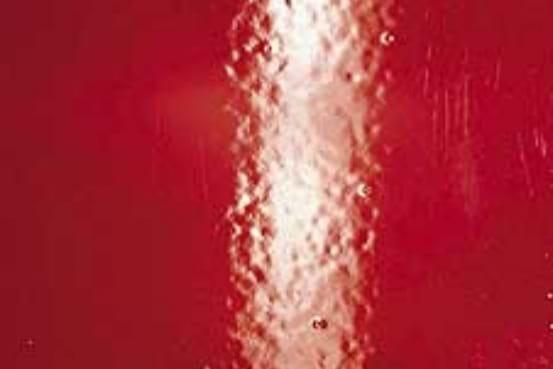
portakal.jpg
Orange Peel Appearance
Fault Name
Orange Peel Appearance
Appearance
Wavytextured and matte areas
Cause
Low atomizationhigh viscosityimproper application
Prevention
Diluted thinningcorrect spray gun settingenvironmental control
Remediation
Sandingpolishing pastereapplication

Orange peel is a type of surface defect observed in wet paint systems, particularly after the final coat application, characterized by an uneven, slightly raised, and irregular texture on the painted surface. The term derives from the resemblance of this appearance to the outer skin of an orange. This defect arises due to various physical and process-related factors, including inadequate film flow, loss of fluidity, and insufficient atomization. It negatively impacts aesthetic appearance and reduces performance in terms of surface reflectivity, gloss, and coating uniformity.

Microstructure and Physical Properties

When evaluated at the microscopic level, orange peel manifests as deviations from the intended smooth film profile, resulting in peak and valley regions. These irregularities cause light to refract at varying angles across the surface. Analysis of the surface profile using laser scanners or interferometric microscopes reveals an increase in surface roughness parameters (Ra, Rz). This microstructural variation is especially pronounced in high-gloss paint systems.

Mechanism of Formation

During the coating process, the paint sprayed onto the surface undergoes a brief flow phase. If paint particles begin to dry before spreading evenly across the surface, or if surface energy impedes flow, a uniform film layer cannot form. This condition results from a combination of factors such as viscosity, solvent evaporation rate, environmental conditions, spray gun and nozzle selection, and application angle. Once the film has hardened, unevenly distributed paint forms irregular protrusions on the surface.

Main Causes of Orange Peel

Material-Related:

  • Use of high-viscosity paint
  • Inappropriate thinner (low volatility or chemically incompatible)
  • Improperly mixed two-component systems

Equipment-Related:

  • Inadequate atomization (low pressure, small nozzle orifice)
  • Incorrect distance between spray gun and surface
  • Non-optimal spray angle (deviations from 90°)
  • Dirty or worn nozzle tip

Application Conditions:

  • Excessively high ambient temperature (rapid solvent evaporation)
  • Failure to observe recommended intercoat drying times
  • Application of excessively thick paint layers
  • Drying before flow occurs on vertical surfaces

Impact on Application Areas

The effects of orange peel vary depending on the industry and substrate involved.

  • In automotive refinishing, loss of gloss on exterior surfaces directly affects customer perception and product classification.
  • In aerospace, film irregularities on composite surfaces may alter aerodynamic performance.
  • In furniture and interior decoration, surface texture negatively influences perceived quality.
  • In industrial coatings, orange peel typically has limited impact, primarily considered a visual issue.

Detection and Evaluation Methods

  • Visual Inspection: Reflection control under light at 45° or 60° angles as per ISO 13076
  • Surface Roughness Measurement: Comparison of Ra and Rz values using tactile or optical profilometers
  • Laser Profilometry (ASTM D7127): Generation of a digital map of the film surface texture
  • Glossmeter Measurement: Numerical quantification of gloss loss in affected areas

Prevention Strategies

In professional applications, prevention of orange peel requires integrated control of manufacturer technical data sheets, equipment parameters, and environmental conditions:

  • Paint should be diluted in accordance with technical data sheets (thinner ratio between 10% and 25%)
  • Application temperature should be maintained between 20–25 °C, with relative humidity between 40% and 60%
  • Spray pressure must be sufficient (1.5–2.0 bar for HVLP systems)
  • Nozzle orifice size must be selected according to paint type (e.g., 1.3–1.5 mm for polyurethane)
  • Paint film thickness should be applied between 30–50 µm, with strict adherence to intercoat drying times
  • The spray gun must be held perpendicular to the surface and moved at a constant, uniform speed

Remediation Methods

  • For mild textural defects, the surface is smoothed using water sandpaper (P1000–P1500 grit), followed by polishing compound to restore gloss.
  • For moderate to severe orange peel, the entire surface must be sanded with P600–P800 grit and repainted.
  • In some cases, reapplication of primer and controlled layer transition is recommended.
  • In curing ovens, low-temperature re-baking (60–80 °C) can improve surface flow and reduce the defect.

Quality Standards and Industrial References

  • ISO 4628-4: Classification of paint defects – evaluation of orange peel appearance
  • ASTM D7127: Surface texture measurement using laser profilometry
  • DIN EN ISO 2813: Method for gloss measurement
  • OEM Paint Standards: Major manufacturers such as Ford, VW, and Airbus define orange peel thresholds (e.g., Ford ESX-M2P 114-A)

Bibliographies


Millî Eğitim Bakanlığı (MEGEP). *Kimya Teknolojisi: Boya Kusurlarının Giderilmesi*. Ankara: MEB Yayınları, 2013. Accessed June 17, 2025. https://megep.meb.gov.tr/mte_program_modul/moduller_pdf/Boya%20Kusurlar%C4%B1n%C4%B1n%20Giderilmesi.pdf.

Millî Eğitim Bakanlığı (MEGEP). *Kimya Teknolojisi: Yaş Boya Testleri*. Ankara: MEB Yayınları, 2012. Accessed June 17, 2025. https://megep.meb.gov.tr/mte_program_modul/moduller_pdf/Ya%C5%9F%20Boya%20Testleri.pdf.

Author Information

Avatar
AuthorUfuk YararDecember 5, 2025 at 8:15 AM

Tags

Discussions

No Discussion Added Yet

Start discussion for "Orange Peel Appearance on Paint Surface" article

View Discussions

Contents

  • Microstructure and Physical Properties

  • Mechanism of Formation

  • Main Causes of Orange Peel

    • Material-Related:

    • Equipment-Related:

    • Application Conditions:

  • Impact on Application Areas

  • Detection and Evaluation Methods

  • Prevention Strategies

  • Remediation Methods

  • Quality Standards and Industrial References

Ask to Küre