

This article was automatically translated from the original Turkish version.
Original Title | Oslo, 31 August | ||||||||
|---|---|---|---|---|---|---|---|---|---|
Year / Country | 2011 / Norway | ||||||||
Type(s) | Dram | ||||||||
Director(s) | Joachim Trier | ||||||||
Screenplay(s) | Joachim Trier Eskil Vogt | ||||||||
Main Actors | Anders Danielsen Lie (Anders), Hans Olav Brenner (Thomas), Ingrid Olava (Rebecca) | ||||||||
Cinematographer(s) | Jakob Ihre | ||||||||
Duration | 95 minutes | ||||||||
Language(s) | Norwegian (some sources also record English dialogues) | ||||||||
Premiere | 18 May 2011, Cannes Film Festival | ||||||||
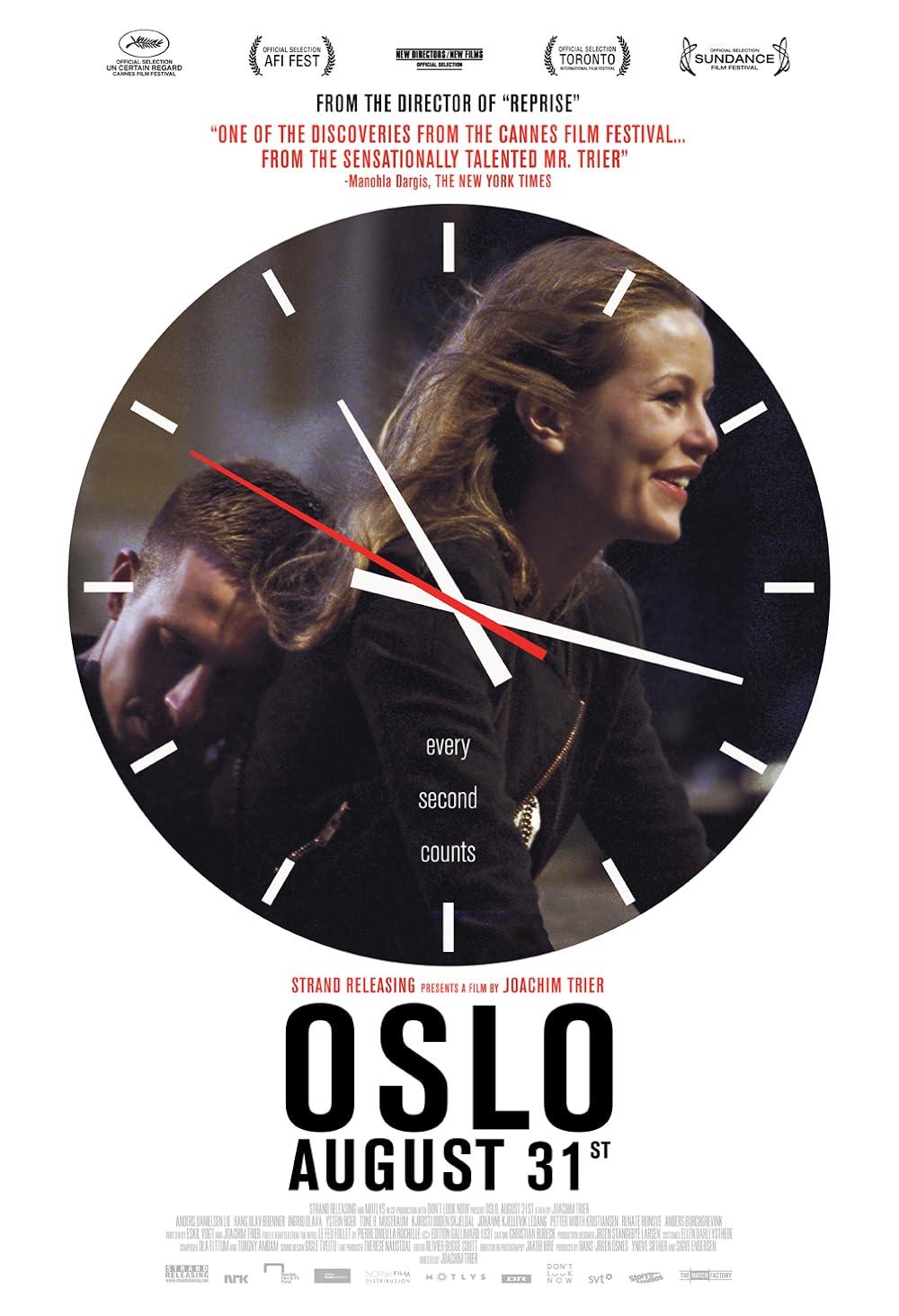
Oslo, 31 August, is a Norwegian drama film directed by Joachim Trier. The screenplay was written by Joachim Trier and Eskil Vogt. The lead roles are played by Anders Danielsen Lie, Hans Olav Brenner, and Ingrid Olava. The film adopts a narrative structure centered on the flow of a single day. It has a runtime of 95 minutes and was shot in color. The framing and editing choices make the timing and spatial transitions throughout the day clearly perceptible. The production is situated among the director’s works that focus on modern urban life.
The film has reached a broad audience through international festival selections and limited theatrical releases. Its screening circuit includes major festivals in Europe and North America. Following its local release in Norway, it opened sequentially in various countries. Promotional materials follow a strategy that highlights the character-driven approach and urban imagery. The work centers on the theme of returning to life after addiction. Public spaces of the city serve as narrative carriers. These features define the film’s place within its genre.
The story focuses on a single day in which Anders, a character residing in a rehabilitation center, re-engages with the city. The journey begins early in the morning and continues with job interviews and meetings with former friends. The character weighs his past relationships and potential new beginnings within the same day. Phone conversations brief encounters and moments of silence determine the rhythm of the plot. The narrative progresses not through sharp turns but through subtle observations and dialogue. As sunset approaches the story reaches its decisive moments and closes within the framework of a single day. The ending concludes in harmony with the temporal unity established by the narrative.
The film’s building blocks include monologue-like dialogues spatial transitions and editing choices that reinforce a sense of continuity. Urban walks public transportation scenes and interior dialogues are used in combination. Information about the character’s past emerges piecemeal during encounters. Instead of flashbacks the film favors associative references embedded within the present day. These choices enhance the narrative’s clarity and accessibility. The central tension lies between the possibility of renewal and the inclination toward withdrawal. Thus a comprehensive portrait of a personal condition is captured within the boundaries of a single day.

A frame from the film (IMDb)
Jakob Ihre is responsible for cinematography with natural lighting prominently featured. Olivier Bugge Coutté serves as editor and ensures transitions between scenes follow a rhythmic flow. The music is composed by Ola Fløttum and Torgny Amdam. Filming took place in real locations in and around Oslo. The color palette shifts in accordance with different times of the day. Ambient sounds are deliberately preserved in the sound design to enhance realism. The technical crew consists entirely of Norwegian-based teams.
The relationship between image and form establishes a movement pattern aligned with the city’s topography. The camera moves fluidly between narrow interior spaces and expansive exterior ones. Framing measures the distance between the character and the city using both static shots and handheld sequences. Color grading and mixing create a smooth continuity between day and night. Editing arranges scene blocks sequentially without disrupting the sense of a single day. This approach supports the narrative’s temporal economy. Ultimately the technical elements form a cohesive whole aligned with the dramatic objectives.
Anders Danielsen Lie is prominently present in all scenes as the character Anders. Hans Olav Brenner portrays Thomas revealing the character’s past connections and divergent life choices. Ingrid Olava contributes to the day’s encounters as Rebecca. Supporting cast members include Malin Crépin Kjærsti Odden Skjeldal Øystein Røger and Renate Reinsve. Roles are positioned through brief encounters and a network of dialogue. Relationships between characters are defined not by lengthy explanations but by everyday conversations. Performances are supported by natural speech rhythms and minimal gestures.
The casting distribution is arranged to complete the scene flow without interrupting the protagonist’s trajectory. Dialogue durations and cuts align with the editing strategy. Interior scenes establish an intimate atmosphere while exterior scenes create a public encounter space. Supporting characters appear and disappear across different time segments of the single-day structure. This method serves to portray the character’s environment as a sociological texture. The breadth of the relational network emerges through the accumulation of short scenes. Thus a personal story becomes readable within an urban context.
The world premiere took place on 18 May 2011 at the Cannes Film Festival. The Norwegian general release occurred on 31 August 2011. The United Kingdom release was on 4 November 2011 and the French release on 29 February 2012. Limited theatrical release in the United States began on 25 May 2012. The festival circuit continued throughout 2011–2012 with screenings in programs across Europe and North America. Exhibition schedules varied by country. Distribution proceeded through art house cinemas and selected chains.
Festival selections include major city festivals and thematic programs. Press screenings and panel discussions were organized during the tour. Home video and digital platform access became available after the theatrical release schedule. Posters and trailers continue to emphasize the single-day focus and urban imagery. Press kits present the credits and brief synopses in standard format. International marketing language highlights the themes of renewal and urban experience. This approach provides a clear framework for the film’s target audience.
Critics have identified the single-day structure the relationship with the city and the character-driven narrative as central themes. Reviews draw attention to the film’s rhythm which advances through minor encounters. The lead performance the natural flow of dialogue and the function of silence are frequently highlighted. The balance between visual aesthetics and urban planning is positively noted. Editing choices are recognized as supporting the narrative’s continuity. The equilibrium between music and ambient sound is considered a technical decision that enhances realism. The overall approach emphasizes the harmony between form and content.
Critics discuss the film’s method of making a personal experience visible within public spaces. The parallel between the city’s daily rhythm and the character’s inner rhythm is observed. Dialogue economy and scene durations are evaluated in terms of narrative effectiveness. The function of supporting characters is defined by their ability to add variety without disrupting the main thread. Visual choices are exemplified through distinctions in the use of daylight and nighttime lighting. The sound design’s partial masking of dialogue in crowded environments is interpreted as a deliberate choice. These analyses point to the alignment between the production’s narrative goals and its technical decisions.
The film has won a total of nine awards and received 21 nominations across various categories. One of its most notable achievements was at the 2011 Stockholm Film Festival where director Joachim Trier received the Best Film (Bronze Horse) and Best Cinematography awards. In the same year the film was nominated in the Un Certain Regard section at the Cannes Film Festival. It was also nominated for the Nordic Council Film Prize alongside the director writer and production team.
In 2012 the film won four awards at Norway’s national cinema awards the Amanda Awards: Best Director (Joachim Trier) Best Editing (Olivier Bugge Coutté) Best Cinematography (Jakob Ihre) and Best Sound Design (Gisle Tveito). At the same ceremony lead actor Anders Danielsen Lie received a nomination for Best Male Actor. Trier also received the Golden Olive Tree award at the Festival del Cinema Europeo honoring him as Europe’s Best Film.
The film has also received international acclaim. It was awarded Best Foreign Language Film by the Boston Online Film Critics Association and received a nomination in the Best Film category in the same organization. It won the Transilvania Trophy – Best Film at the Transilvania International Film Festival. Performances particularly those of Anders Danielsen Lie and Hans Olav Brenner were separately honored with Kanonprisen awards: Lie won Best Male Actor and Brenner won Best Supporting Male Actor.
The film was also nominated for Best Foreign Language Film at the César Awards (France) and for the Buried Treasure category at the Chlotrudis Awards. It competed in three categories at the International Cinephile Society Awards and won Best Adapted Screenplay. It appeared on the lists of the Village Voice Film Poll the Indiewire Critics’ Poll and the North Carolina Film Critics Association among the best foreign films of the year.
Altyazı. “Oslo, August 31 – Criticisms.” Accessed October 6, 2025. https://altyazi.net/yazilar/elestiriler/oslo-31-agustos/
Beyazperde. "Oslo, August 31st." Accessed October 6, 2025. https://www.beyazperde.com/filmler/film-192866/
IMDb. "Oslo, August 31st (2011)." Accessed October 6, 2025. https://www.imdb.com/title/tt1736633/
IMDb. "Oslo, August 31st – Plot Summary." Accessed October 6, 2025. https://www.imdb.com/title/tt1736633/plotsummary/?ref_=tt_ov_at_pl_pl
IMDb. "Oslo, August 31st – Technical Specs." Accessed October 6, 2025. https://www.imdb.com/title/tt1736633/technical/?ref_=tt_ov_at_dt_spec
IMDb. “Oslo, August 31st – Awards.” Erişim 6 Ekim 2025. https://www.imdb.com/title/tt1736633/awards/?ref_=tt_ov_at_op_awd
IMDb. “Oslo, August 31st – Full Cast & Crew.” Erişim 6 Ekim 2025. https://www.imdb.com/title/tt1736633/fullcredits/?ref_=tt_ov_at_pop_cst
IMDb. “Oslo, August 31st – Media Index.” Erişim 6 Ekim 2025. https://www.imdb.com/title/tt1736633/mediaindex/?ref_=tt_ov_at_pop_ph
IMDb. “Oslo, August 31st – Release Info.” Accessed October 6, 2025. https://www.imdb.com/title/tt1736633/releaseinfo/?ref_=tt_ov_at_dt_rdat
Letterboxd. "Oslo, August 31st." Accessed October 6, 2025. https://letterboxd.com/film/oslo-august-31st/
Roger Ebert. “Oslo, August 31st (2012) Review.” Accessed October 6, 2025. https://www.rogerebert.com/reviews/oslo-august-31-2012

Original Title | Oslo, 31 August | ||||||||
|---|---|---|---|---|---|---|---|---|---|
Year / Country | 2011 / Norway | ||||||||
Type(s) | Dram | ||||||||
Director(s) | Joachim Trier | ||||||||
Screenplay(s) | Joachim Trier Eskil Vogt | ||||||||
Main Actors | Anders Danielsen Lie (Anders), Hans Olav Brenner (Thomas), Ingrid Olava (Rebecca) | ||||||||
Cinematographer(s) | Jakob Ihre | ||||||||
Duration | 95 minutes | ||||||||
Language(s) | Norwegian (some sources also record English dialogues) | ||||||||
Premiere | 18 May 2011, Cannes Film Festival | ||||||||
No Discussion Added Yet
Start discussion for "Oslo, August 31 (Film)" article
Plot and Narrative Structure
Production and Technical Features
Cast and Characters
Release and Distribution
Critical Reception
Awards and Nominations