This article was automatically translated from the original Turkish version.
+2 More
Type(s) | Culture and literature magazine | ||||||||
|---|---|---|---|---|---|---|---|---|---|
Publication Place | Gümülcine (Komotini), Western Thrace, Greece | ||||||||
Publication Period | September 1986 – May 1996 | ||||||||
Number of Issues | 117 issues | ||||||||
Publication Periodicity | Monthly | ||||||||
Number of Pages | Average 23–27 pages | ||||||||
Founder and Owner | Mustafa Hafız Mustafa | ||||||||
Printing and Layout | Advertising-Magazine Agency | ||||||||
Printing House | Osman Mustafa | ||||||||
Yuvamız Magazine is a cultural and literary periodical published from 1986 to 1996 in Komotini (Gümülcine), Western Thrace. It has been regarded as an important instrument in the identity struggle of the Muslim Turkish minority in Western Thrace. While political content was kept secondary, the magazine covered a broad range of topics including education, health, religion, literature, entertainment, and child development. Over its ten-year publication life, a total of 117 issues were released.
Yuvamız magazine published its first issue in September 1986. Following the death of its founder and owner, Mustafa Hafız Mustafa, it ceased publication with its 117th issue in May 1996. For ten years, the magazine consistently reached its readers, aiming to enter the homes of minority families in Western Thrace.
The founder and owner of the magazine, Mustafa Hafız Mustafa, also managed its publishing operations. Printing and layout services were handled by Reklam-Magazin Ajansı, while printing was provided by Osman Mustafa.
The magazine was prepared and published in Komotini, the central city of Western Thrace. Contact information and editorial addresses were regularly listed on the back cover of each issue.
Yuvamız was published monthly, with each issue averaging 23–27 pages. The price of the magazine was initially 100 drachmas, but was later increased to 300 drachmas due to improvements in quality.
Western Thrace is located within the current borders of Greece, in the northeastern part of mainland Greece. To the east lies the Meriç (Evros) River, which forms the border with Türkiye; to the west, the Karasu (Nestos) River; to the north, the Rhodope Mountains and Bulgaria; and to the south, the Aegean Sea. The region consists of three provinces: Evros (Dedeağaç), Rodop (Komotini), and Xanthi (İskeçe).
Western Thrace has an area of 8,578 km² and is home to approximately 390,000 to 400,000 people, of whom 120,000 to 150,000 are Muslim Turks.
The Treaty of Lausanne, signed on 24 July 1923, ensured the permanent presence of the Turkish population in Western Thrace and the Greek population in Istanbul, excluding them from the population exchange. The treaty guaranteed the basic rights and freedoms of these minorities. However, over time, the Greek government implemented policies that restricted the educational, political representation, and identity rights of the Turkish minority in Western Thrace, failing to fully comply with these provisions. Despite this, the Muslim Turkish minority in Western Thrace demonstrated resistance at key points, as exemplified here, in preserving its national and religious identity.
The number of Turkish-language newspapers and magazines in the region increased from the 1980s onward. Nevertheless, these publications faced various challenges. Although the Greek government did not impose direct censorship on Turkish-language periodicals, it adopted a discriminatory stance regarding press accreditation, distribution channels, and financial support. As a result, many newspapers and magazines were published irregularly, and their circulation remained significantly low relative to the population size.
From the 2000s onward, Greece permitted the entry of newspapers and magazines published in Türkiye, strengthening the cultural and social ties between the Turkish community in Western Thrace and Türkiye. However, Yuvamız magazine, published between 1986 and 1996, holds particular significance as it served as the voice of the minority itself. During its time, it was one of the few periodicals through which the Turkish community of Western Thrace could express and preserve its identity in the fields of literature, education, and culture under the prevailing conditions.
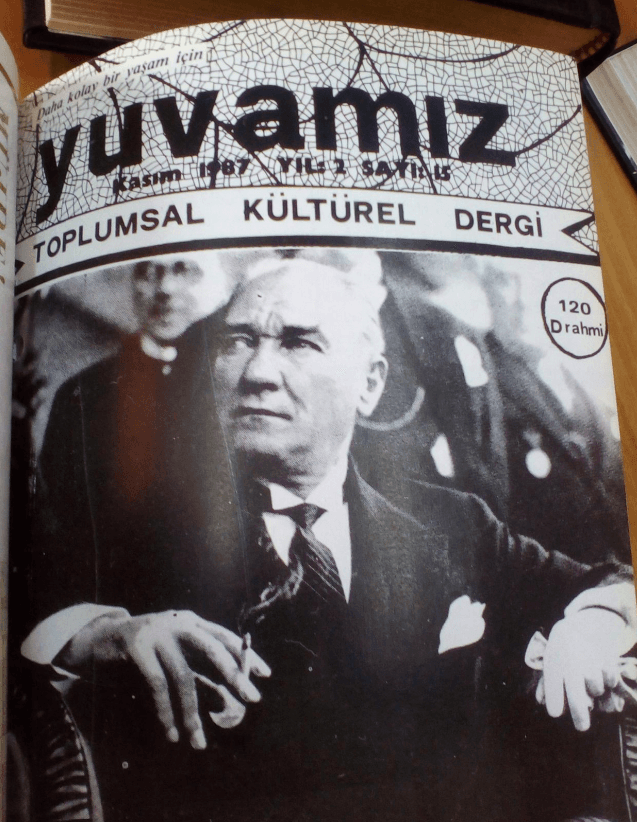
Yuvamız magazine consisted of an average of 23–27 pages per issue. Its page layout featured a clear simplicity: texts were predominantly arranged in two columns, while illustrations were placed within the text or on the covers. The print quality of the early issues was relatively low, but improvements in both layout and printing quality became evident in later issues.
The front covers of the magazine typically featured photographs reflecting the daily life, national and religious holidays, cultural events, or prominent figures of the Muslim Turkish community in Western Thrace. This approach was consistently maintained in the interior pages, where photographs and visual elements were used to support the written content. Thus, the magazine sought to provide readers not only with information but also with a visual connection to their cultural world.
Yuvamız magazine offered a wide range of topics reflecting the daily life, cultural values, and challenges of the Muslim Turkish community in Western Thrace. It regularly featured articles on minority rights, education, health, religion, and family life, as well as child development, literature, art, humor, and entertainment. In this regard, it functioned not merely as a cultural and literary publication but also as a social guide. The following types of content were published in the magazine:
These genres demonstrate the magazine’s effort to adopt a multifaceted editorial policy targeting both adults and youth.
The central theme of the magazine’s editorial line was the preservation and strengthening of Turkish identity. The term “Turks of Western Thrace” was frequently used, clearly affirming the ethnic Turkish identity of the minority. Special emphasis was placed on articles about the life, ideas, and reforms of Mustafa Kemal Atatürk. Articles, poems, and visual materials on Atatürk aimed to reinforce national consciousness among younger generations.
Yuvamız did not focus solely on developments in Western Thrace; it also sought to establish connections with the broader Turkish world. Works by writers and poets from Türkiye and other Turkish communities were published, highlighting that the Turks of Western Thrace were part of a wider cultural geography. This approach aimed to overcome feelings of isolation and strengthen a sense of cultural solidarity.
Yuvamız magazine provided extensive space for writers and poets emerging from within the Muslim Turkish minority of Western Thrace. Notable figures in this regard include Hüseyin Alibabaoğlu, Rahmi Ali, Gülten Mustafa, Rıdvan Kocamustafaoğlu, and Mehmet Emin Acar. These writers and poets primarily produced poetry, essays, memoirs, and socially oriented writings, playing a pioneering role in the cultural and literary production of the minority.
The magazine did not limit itself to the literary circles of Western Thrace; it also introduced many writers and poets from Türkiye to its readers. Figures such as Saim Sakaoğlu, Feyyaz Sağlam, and Ahmet Tufan Şentürk contributed poems and analytical articles to the magazine. These contributions helped strengthen the cultural ties between the Turkish community in Western Thrace and Türkiye, enriching the literary world of the minority.
Over its ten-year publication life, Yuvamız featured works by numerous authors and poets. In research-based indexing efforts, articles were alphabetically classified by author name. This method made the most prolific contributors visible and established the magazine as a critical source for the history of Western Thrace literature.
Articles published in the magazine were also categorized by genre. Genres such as poetry, articles, essays, memoirs, biographies, folktales, anecdotes, theater, and cartoons were listed separately. This classification allows researchers to easily observe the diversity of the magazine’s content and examine works within specific genres collectively. This genre-based categorization aims to highlight the magazine’s value in the fields of culture, literature, and folklore studies.
The articles of Yuvamız were also organized according to their publication order. This chronological classification enables the tracking of changes in the magazine’s editorial direction over time. For example, early issues contained mostly introductory and educational texts, while later years saw an increase in articles addressing identity and minority issues. Thus, the magazine acquired the character of a timeline reflecting social and political transformations.
Yuvamız magazine played a significant role in preserving the religious and national identity of the Muslim Turkish minority in Western Thrace. The articles published in the magazine frequently referenced the rights guaranteed by the Treaty of Lausanne and the necessity of sustaining the cultural existence of the minority, thereby becoming a written instrument of identity preservation.
In its writings, the magazine emphasized the role of Mustafa Kemal Atatürk’s reforms, ideas, and works in safeguarding the national identity of the Turks of Western Thrace. Atatürk’s significance in the Turkish world was repeatedly recalled, and substantial space was devoted to these themes to strengthen national consciousness among younger generations. This emphasis helped reinforce the spiritual connection between the minority and Türkiye.
Yuvamız magazine fulfilled a critical role in the cultural, literary, and social life of the Muslim Turkish minority in Western Thrace for ten years, but ceased publication with its 117th issue in May 1996. The primary reason for this was the death of its founder and owner, Mustafa Hafız Mustafa. The magazine, which had survived solely through his personal efforts, could not continue after failing to find a new financial or administrative sponsor. Thus, Yuvamız closed with a rich archive, leaving a lasting legacy in the literary memory and identity struggle of the Turkish minority in Western Thrace.
Molla Achmet, Chilal. "Batı Trakya’da Yayınlanmış Olan ‘Yuvamız’ Dergisinin, Batı Trakya Müslüman Türk Azınlığın Kimlik Oluşumundaki Önemi." Master's thesis, Trakya Üniversitesi Sosyal Bilimler Enstitüsü, Edirne, 2019. https://tez.yok.gov.tr/UlusalTezMerkezi/TezGoster?key=jNRDC1RLfVd4_T7x7ZXmmXSw0DnOyaDLm8gqqS_MnUIAjqQxc4qm19kSqUOPZfYH

Type(s) | Culture and literature magazine | ||||||||
|---|---|---|---|---|---|---|---|---|---|
Publication Place | Gümülcine (Komotini), Western Thrace, Greece | ||||||||
Publication Period | September 1986 – May 1996 | ||||||||
Number of Issues | 117 issues | ||||||||
Publication Periodicity | Monthly | ||||||||
Number of Pages | Average 23–27 pages | ||||||||
Founder and Owner | Mustafa Hafız Mustafa | ||||||||
Printing and Layout | Advertising-Magazine Agency | ||||||||
Printing House | Osman Mustafa | ||||||||
Publication History
Historical and Social Context
Geographical Location of Western Thrace
The Treaty of Lausanne and the Muslim Turkish Minority of Western Thrace
Freedom of the Press and Publication in Western Thrace
Formal Characteristics of Yuvamız Magazine
Content Characteristics of Yuvamız Magazine
Authors and Poets
Writers and Poets from Western Thrace
Contributions from Turkish Writers
Databases and Archival Research
Index by Author Name
Index by Genre
Chronological Index
Role in Identity Formation
Function in Preserving Religious and National Identity
End of Publication