

This article was automatically translated from the original Turkish version.
Although the idea of building a mosque in Paris dates back to the mid-19th century, the project only became feasible after the First World War.【1】 Indeed, various initiatives were proposed in 1846 by the Société Orientale and later between 1894 and 1895 under the leadership of the French Africa Committee; even financial support was promised by Ottoman Sultan Abdülhamid II and leaders of Egypt and Morocco.【2】 However, these early efforts failed due to political tensions in France, the Dreyfus Affair, and the increasingly heated debates over secularism and the separation of church and state.【3】
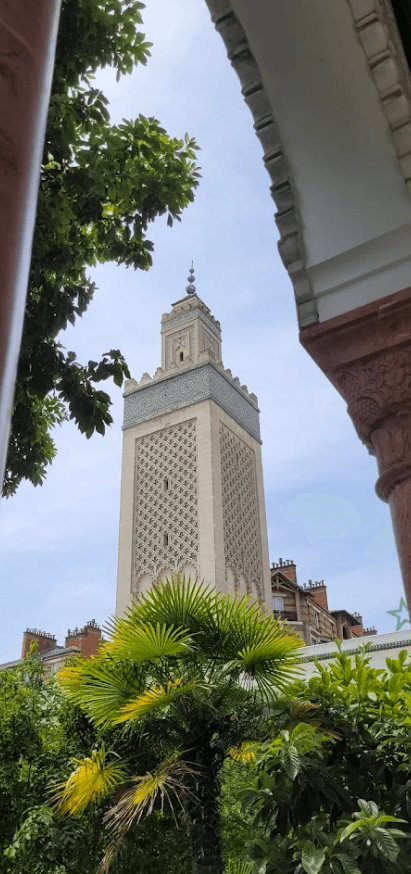
Grand Mosque of Paris (Author’s Perspective)
“While closing mosques in its colonial territories, France was opening a grand mosque in Paris. This contradiction made the building a multi-layered object from the outset.”
Gilles Kepel, Les Banlieues de l’Islam, 1987
The most significant factor that accelerated the mosque’s construction and enabled the project to be realized after decades was the extraordinary heroism displayed by Muslim soldiers fighting for France during the First World War.【4】 【5】 Initially delayed due to financial difficulties in France and the threat of German occupation of Paris, the idea of building the mosque gained momentum after General Joseph Simon Gallieni deployed 25,000 African Muslim soldiers to defend the Marne region, whose bravery contributed decisively to the Allied victory.【6】 In recognition of the sacrifices these soldiers made at the cost of their lives, the citizens of Paris and the Paris City Council allocated the land necessary for the mosque’s construction.【7】【8】 On the other hand, Germany’s strategic campaign during the war—promoting a “jihad” call under Ottoman support and establishing temporary mosques in prisoner-of-war camps such as Wünsdorf—also motivated France to act.【9】 【10】 France aimed to strengthen its image on the international stage as the true friend of Muslims and patron of Islam, thereby securing the loyalty of its colonial Muslim populations.【11】【12】
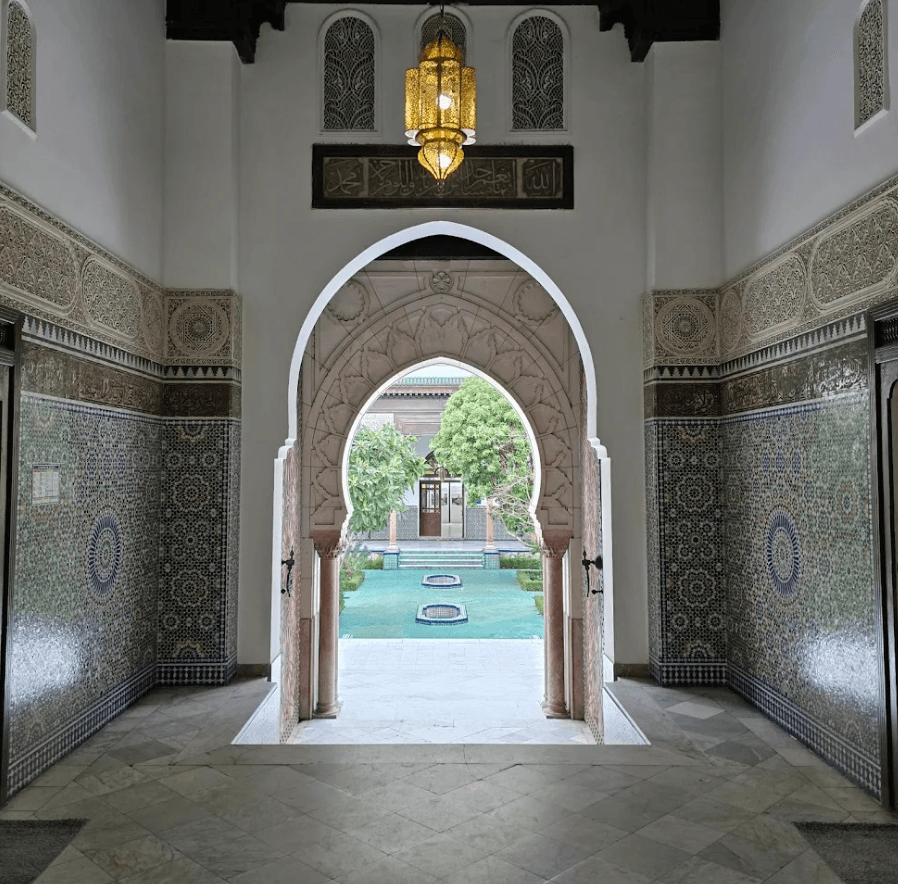
Grand Mosque of Paris (Author’s Perspective)
When the Grand Mosque of Paris (La Mosquée de Paris) opened for worship in 1926, it was conceived not merely as a place of religious worship but as a monumental political symbol embodying France’s colonial policies, international diplomatic goals, and complex understanding of secularism.【13】 To circumvent the strict 1905 law on secularism, which explicitly prohibited the state from funding religious buildings, French authorities presented the project not as a purely religious site but as a virtual and cultural institution called the “Muslim Institute” (Institut Musulman); they entrusted its construction and management to the Foundation for the Holy Islamic Sites (Société des Habous), established in 1917, thereby evading the legal restrictions.【14】 【15】 France aimed, through this project, to demonstrate to its 25 million Muslim subjects under its rule that it provided every possible assistance for their commercial and industrial advancement.【16】 Indeed, even after its opening, the mosque remained under the supervision of the French Ministry of Foreign Affairs for many years and was used as a key instrument of the country’s foreign policy.【17】
As emphasized in a speech delivered by Çerkeşizade Halit Halid Bey at the opening ceremony, Germany had only erected temporary mosques in prisoner-of-war camps during the First World War as a political tool, while Britain’s attempt to build a mosque in London had failed due to opposition.【18】 France, by constructing such a permanent mosque at the heart of its capital, sought to demonstrate to the entire world that its friendship with Muslims was not a fleeting gesture but a lasting commitment.【19】 This magnificent structure, rising in the intellectual heart of Paris, the Quartier Latin, functioned not as a response to the daily needs of ordinary Muslim workers in the suburbs but as an imperial “French Islam” showcase designed for French tourists and international elites.【20】 According to the honor roll of this successfully completed historical monument, many leaders, including Mustafa Kemal Atatürk, founder of the Republic of Türkiye, and Sultan Abdülhamid II, made material and spiritual contributions to its establishment.【21】
The construction of the Grand Mosque of Paris created a major contradiction within the context of the 1905 law on secularism, which strictly prohibited the state from financing places of worship. To overcome this legal barrier and appear consistent with the principle of secularism, the French state presented the project not as a purely religious site but as a cultural “Muslim Institute.” Thanks to this fictional institutional framework, advocated in parliament by Senator Edouard Herriot, a special law passed in 1920 opened the way for state funding. Furthermore, to comply with the requirement that a secular state must not directly manage a religious institution, the mosque’s construction and administration were entrusted to the “Société des Habous des Lieux Saints de l’Islam,” a charitable foundation. Through this strategy, French authorities successfully maintained the illusion that the state was not directly intervening in religious affairs but merely facilitating a Muslim initiative. Despite all these legal maneuvers and the goal of creating a “French Islam” compatible with republican values, the building’s entirely traditional design revealed that the state did not genuinely believe Muslims could be secularized.
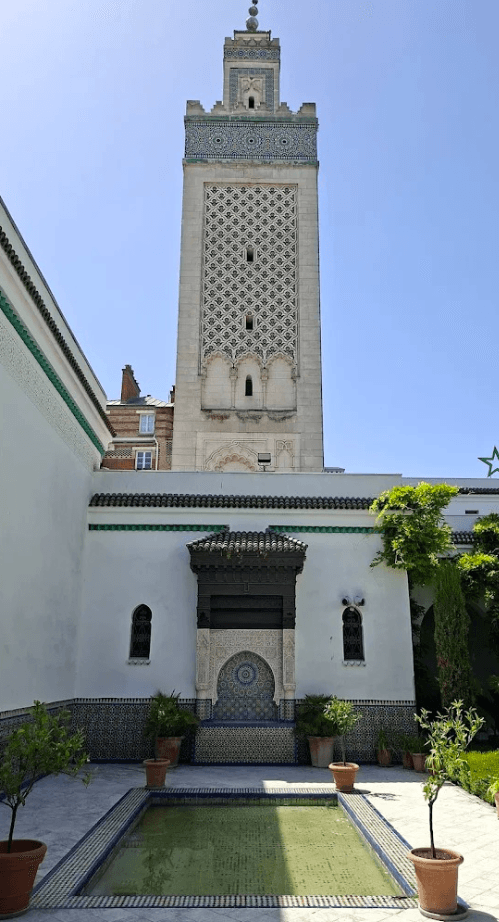
Grand Mosque of Paris (Author’s Perspective)
Located in the heart of Paris in the Quartier Latin and distinguished by its 33-meter minaret, the Grand Mosque of Paris offers visitors a hidden oasis of the East through its Andalusian-Maghrebi architectural style. Elegant wooden carvings crafted by Moroccan artisans, dazzling mosaics, and a “Garden of Paradise” filled with Mediterranean plants and gently flowing water transport guests instantly into the mystical world of North Africa. Its authentic hammam, composed of traditional steam rooms, and its café (Moorish cafe), where oriental sweets are served with mint tea, allow this unique structure to convey the full color and warmth of Islamic culture at the very center of the French capital.
The Grand Mosque of Paris was constructed in the Andalusian-Maghrebi architectural style as a vast complex that gathers elements of a traditional Arab city into a single space.【22】 During the design phase, architects drew heavy inspiration from the aesthetic lines of the historic Bou Inania Madrasa and the Kairouan Mosque in Fes, Morocco.【23】 To preserve the original character, artisans were brought directly from Morocco; craftsmen from Fes created the mosaics while carpenters from Meknes meticulously carved the wooden elements.【24】 With its delicate arches, intricately carved cedar doors, and the lush “Garden of Paradise” with its flowing water, the building offers visitors a captivating Oriental atmosphere at the heart of France.【25】 The most striking external feature of the complex is its imposing square-plan minaret, 33 meters high, which carries the artistic richness of Islamic civilization to the center of the capital.【26】【27】
In line with the vision of architect Maurice Mantout, the Grand Mosque of Paris transcends its role as a mere place of worship by gathering into a single complex structures typically scattered across a traditional Arab city. Designed as a vast külliye, the building integrates the main prayer halls with a restaurant, a Maghrebi café (café maure) serving traditional mint tea, and tranquil gardens. One of the complex’s most remarkable features is its authentic hammam, exclusively for women, which offers three distinct steam rooms—cold, warm, and hot—and serves as an important heritage site addressing both purification and social needs. In addition, the library belonging to the Al-Ghazali Institute, which provides Islamic education, and the conference hall named after Emir Abd al-Qadir have transformed the mosque into an intellectual center for education and culture. All these social, cultural, and commercial spaces generate additional income for the mosque while simultaneously welcoming thousands of tourists from diverse faiths, establishing a bridge of dialogue between East and West.
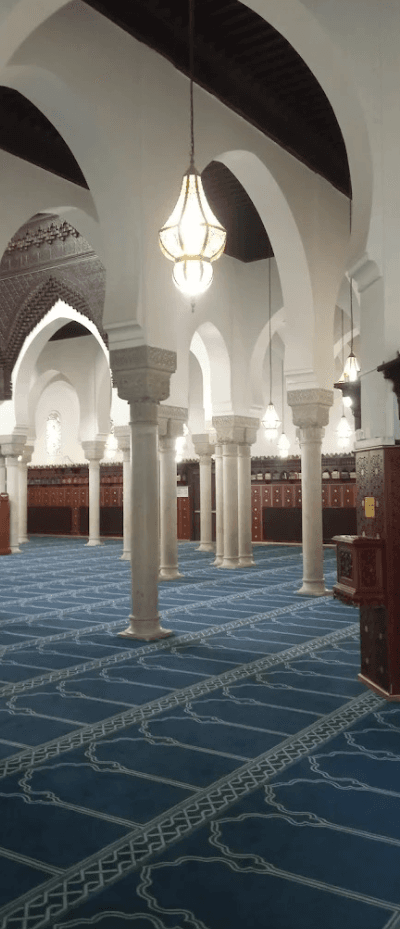
Grand Mosque of Paris (Author’s Perspective)
The idea of building a mosque in Paris extends back to the late 19th century. In 1894–1895, Ottoman Sultan Abdülhamid II pledged financial support for the first mosque project. However, due to political tensions in France at the time—including the Dreyfus Affair and the growing debates over secularism and the separation of church and state—the project was never realized.【28】
After the First World War, when the project was finally implemented, Türkiye was represented by both governments at the foundation-laying ceremony on 1 March 1922. Nebi Bey attended on behalf of the Istanbul government, and Ferid Bey represented the Ankara government. Halil Bey also participated in the meetings of the committee established for the mosque’s construction.【29】
Turkish leaders provided significant material and spiritual support during the mosque’s construction. According to records in the mosque’s honor roll, both Sultan Abdülhamid II and Mustafa Kemal Atatürk, founder of the Republic of Türkiye, contributed to the building of this place of worship.【30】 Turkey’s support did not end with the initial phase; the Republic of Türkiye continued to provide financial assistance throughout the construction process.【31】
After four years of construction, the Grand Mosque of Paris was inaugurated on 15 July 1926 in a grand ceremony attended by French President Gaston Doumergue and Sultan of Morocco Moulay Yusuf. Turkish presence was strongly felt at the event: Çerkeşizade Halit Halid Bey, representative of the “Fraternité Musulmane” (Muslim Brotherhood), founded in 1907, delivered a speech on behalf of the association. In his address, Halid Bey criticized the temporary mosques Germany had built in prisoner-of-war camps during the First World War as political tools, emphasizing that France’s permanent mosque in Paris was a far more sincere token of friendship with Muslims.【32】 In subsequent years, Turkish students studying in France gathered at the mosque, using it as a space for solidarity and social connection among themselves.【33】
When examined from its founding purpose to its architectural form, the Grand Mosque of Paris carries a profound meaning far beyond that of an ordinary place of worship.【34】 The külliye offers visitors a multidimensional cultural experience and a space for social interaction through its library, traditional hammam, café, and serene gardens.【35】 Moreover, this historical structure served as a monumental symbol embodying France’s colonial policies, its vision of “French Islam,” and its diplomatic power on the international stage.【36】【37】 Beyond its political and cultural mission, during the Second World War it became a center of solidarity, offering secret refuge to resistance fighters and Jewish families fleeing Nazi persecution.【38】 Through all its religious, political, historical, and humanitarian dimensions, the Grand Mosque of Paris continues to serve as a magnificent emissary of Islamic civilization at the heart of Europe and as a living bridge between East and West.【39】
Davidson, Naomi. “La mosquée de Paris: Construire l’islam français et l’islam de France, 1926–1947.” *Revue des mondes musulmans et de la Méditerranée*, no. 125 (2009): 197–215. Accessed May 29, 2026. https://journals.openedition.org/remmm/6246?file=
El Adnani, Jillali. *Mosquée de Paris: Œuvre marocaine et patrimoine mondial*. Casablanca: Éditions La Croisée des Chemins, 2016. Accessed May 29, 2026. https://www.academia.edu/40241363/Mosqu%C3%A9e_de_Paris_oeuvre_Marocaine_et_Patrimoine_mondial_Textes_de_Jillali_el_adnani
Kavas, Ahmet. “Fransa’nın İslam Siyaseti: Sömürgecilikten Günümüze Fransız Camileri (II).” *Dini Araştırmalar* 4, no. 10 (2001): 53–70. Accessed May 29, 2026. https://dergipark.org.tr/tr/pub/da/article/61260
Kepel, Gilles. *Les banlieues de l’Islam: Naissance d’une religion en France*. Paris: Éditions du Seuil, 1987. Accessed May 29, 2026. https://www.persee.fr/doc/rfsp_0035-2950_1989_num_39_4_394435_t1_0593_0000_001.
Laloum, Jean. “Cinéma et histoire: La mosquée de Paris et les Juifs sous l’Occupation.” *Archives Juives* 45, no. 1 (2012): 116–128. Accessed May 29, 2026. https://shs.cairn.info/revue-archives-juives1-2012-1-page-116?lang=fr
Messaoudi, Alain. “Du prince à l’ouvrier: Figures musulmanes à Paris entre 1830 et 1930.” In *Les religions des Parisiens, t. II: Les espaces d’expression du religieux dans Paris. Territoires, édifices et circulations*, edited by M. Aynié, L. Croq, N. Lyon-Caen, M. Sot, and D. Tartakowsky, 329–338. Paris: Éditions de la Sorbonne / Comité d’histoire de la ville de Paris, 2024. Accessed May 29, 2026. https://hal.science/hal-04734106v1/document
Motadel, David. *Islam and Nazi Germany’s War*. Cambridge, MA: Belknap Press of Harvard University Press, 2014. Accessed May 29, 2026. https://www.hup.harvard.edu/books/9780674979765
Nunez, Jérôme. “La gestion publique des espaces confessionnels des cimetières de la Ville de Paris: L’exemple du culte musulman (1857–1957).” *Le Mouvement Social*, no. 237 (2011): 13–32. Accessed May 29, 2026. https://doi.org/10.3917/lms.237.0013.
Rieucau, Jean. “La Grande Mosquée de Paris: Lieu cultuel, mémoriel et touristique.” *Géoconfluences*, 2025. Accessed May 29, 2026. https://geoconfluences.ens-lyon.fr/informations-scientifiques/dossiers-thematiques/fait-religieux-et-construction-de-l-espace/articles-scientifiques/grande-mosquee-paris.
Yakıt, İsmail. “Birikimli ve bulunmaz bir dost: Prof. Dr. Hüseyin Ayan Hoca.” *A.Ü. Türkiyat Araştırmaları Enstitüsü Dergisi*, no. 39 (2009): 35–38. Accessed May 29, 2026. https://dergipark.org.tr/en/download/article-file/33370
[1]
Alain Messaoudi, “Du prince à l’ouvrier: Figures musulmanes à Paris entre 1830 et 1930,” içinde Les religions des Parisiens, t. II: Les espaces d’expression du religieux dans Paris. Territoires, édifices et circulations, ed. M. Aynié, L. Croq, N. Lyon-Caen, M. Sot ve D. Tartakowsky (Paris: Éditions de la Sorbonne / Comité d’histoire de la ville de Paris, 2024), 329–338, https://hal.science/hal-04734106v1/document.
[2]
Ahmet Kavas, “Fransa’nın İslam Siyaseti: Sömürgecilikten Günümüze Fransız Camileri (II),” Dini Araştırmalar 4, no. 10 (2001): 53–70, https://dergipark.org.tr/tr/pub/da/article/61260.
[3]
Alain Messaoudi, “Du prince à l’ouvrier: Figures musulmanes à Paris entre 1830 et 1930,” içinde Les religions des Parisiens, t. II: Les espaces d’expression du religieux dans Paris. Territoires, édifices et circulations, ed. M. Aynié, L. Croq, N. Lyon-Caen, M. Sot ve D. Tartakowsky (Paris: Éditions de la Sorbonne / Comité d’histoire de la ville de Paris, 2024), 329–338,https://hal.science/hal-04734106v1/document
[4]
Ahmet Kavas, “Fransa’nın İslam Siyaseti: Sömürgecilikten Günümüze Fransız Camileri (II),” Dini Araştırmalar 4, no. 10 (2001): 53–70, https://dergipark.org.tr/tr/pub/da/article/61260.
[5]
Naomi Davidson, “La mosquée de Paris: Construire l’islam français et l’islam de France, 1926–1947,” Revue des mondes musulmans et de la Méditerranée, no. 125 (2009): 197–215, https://journals.openedition.org/remmm/6246?file=1.
[6]
Ahmet Kavas, “Fransa’nın İslam Siyaseti: Sömürgecilikten Günümüze Fransız Camileri (II),” Dini Araştırmalar 4, no. 10 (2001): 53–70, https://dergipark.org.tr/tr/pub/da/article/61260.
[7]
Jillali El Adnani, Mosquée de Paris: Œuvre marocaine et patrimoine mondial (Casablanca: Éditions La Croisée des Chemins, 2016), https://www.academia.edu/40241363/Mosqu%C3%A9e_de_Paris_oeuvre_Marocaine_et_Patrimoine_mondial_Textes_de_Jillali_el_adnani.
[8]
Ahmet Kavas, “Fransa’nın İslam Siyaseti: Sömürgecilikten Günümüze Fransız Camileri (II),” Dini Araştırmalar 4, no. 10 (2001): 53–70, https://dergipark.org.tr/tr/pub/da/article/61260.
[9]
Ahmet Kavas, “Fransa’nın İslam Siyaseti: Sömürgecilikten Günümüze Fransız Camileri (II),” Dini Araştırmalar 4, no. 10 (2001): 53–70, https://dergipark.org.tr/tr/pub/da/article/61260.
[10]
David Motadel, Islam and Nazi Germany’s War (Cambridge, MA: Belknap Press of Harvard University Press, 2014), https://www.hup.harvard.edu/books/9780674979765.
[11]
Jillali El Adnani, Mosquée de Paris: Œuvre marocaine et patrimoine mondial (Casablanca: Éditions La Croisée des Chemins, 2016), https://www.academia.edu/40241363/Mosqu%C3%A9e_de_Paris_oeuvre_Marocaine_et_Patrimoine_mondial_Textes_de_Jillali_el_adnani.
[12]
David Motadel, Islam and Nazi Germany’s War (Cambridge, MA: Belknap Press of Harvard University Press, 2014), https://www.hup.harvard.edu/books/9780674979765.
[13]
Naomi Davidson, “La mosquée de Paris: Construire l’islam français et l’islam de France, 1926–1947,” Revue des mondes musulmans et de la Méditerranée, no. 125 (2009): 197–215, https://journals.openedition.org/remmm/6246?file=1.
[14]
Naomi Davidson, “La mosquée de Paris: Construire l’islam français et l’islam de France, 1926–1947,” Revue des mondes musulmans et de la Méditerranée, no. 125 (2009): 197–215, https://journals.openedition.org/remmm/6246?file=1.
[15]
Jillali El Adnani, Mosquée de Paris: Œuvre marocaine et patrimoine mondial (Casablanca: Éditions La Croisée des Chemins, 2016), https://www.academia.edu/40241363/Mosqu%C3%A9e_de_Paris_oeuvre_Marocaine_et_Patrimoine_mondial_Textes_de_Jillali_el_adnani.
[16]
Ahmet Kavas, “Fransa’nın İslam Siyaseti: Sömürgecilikten Günümüze Fransız Camileri (II),” Dini Araştırmalar 4, no. 10 (2001): 53–70, https://dergipark.org.tr/tr/pub/da/article/61260.
[17]
Ahmet Kavas, “Fransa’nın İslam Siyaseti: Sömürgecilikten Günümüze Fransız Camileri (II),” Dini Araştırmalar 4, no. 10 (2001): 53–70, https://dergipark.org.tr/tr/pub/da/article/61260.
[18]
Ahmet Kavas, “Fransa’nın İslam Siyaseti: Sömürgecilikten Günümüze Fransız Camileri (II),” Dini Araştırmalar 4, no. 10 (2001): 53–70, https://dergipark.org.tr/tr/pub/da/article/61260.
[19]
Ahmet Kavas, “Fransa’nın İslam Siyaseti: Sömürgecilikten Günümüze Fransız Camileri (II),” Dini Araştırmalar 4, no. 10 (2001): 53–70, https://dergipark.org.tr/tr/pub/da/article/61260.
[20]
Naomi Davidson, “La mosquée de Paris: Construire l’islam français et l’islam de France, 1926–1947,” Revue des mondes musulmans et de la Méditerranée, no. 125 (2009): 197–215, https://journals.openedition.org/remmm/6246?file=1.
[21]
İsmail Yakıt, “Birikimli ve bulunmaz bir dost: Prof. Dr. Hüseyin Ayan Hoca,” A.Ü. Türkiyat Araştırmaları Enstitüsü Dergisi, no. 39 (2009): 35–38, https://dergipark.org.tr/en/download/article-file/33370.
[22]
Jean Rieucau, “La Grande Mosquée de Paris: Lieu cultuel, mémoriel et touristique,” Géoconfluences, 2025, https://geoconfluences.ens-lyon.fr/informations-scientifiques/dossiers-thematiques/fait-religieux-et-construction-de-l-espace/articles-scientifiques/grande-mosquee-paris.
[23]
Jillali El Adnani, Mosquée de Paris: Œuvre marocaine et patrimoine mondial (Casablanca: Éditions La Croisée des Chemins, 2016), https://www.academia.edu/40241363/Mosqu%C3%A9e_de_Paris_oeuvre_Marocaine_et_Patrimoine_mondial_Textes_de_Jillali_el_adnani.
[24]
Jillali El Adnani, Mosquée de Paris: Œuvre marocaine et patrimoine mondial (Casablanca: Éditions La Croisée des Chemins, 2016), https://www.academia.edu/40241363/Mosqu%C3%A9e_de_Paris_oeuvre_Marocaine_et_Patrimoine_mondial_Textes_de_Jillali_el_adnani.
[25]
Jean Rieucau, “La Grande Mosquée de Paris: Lieu cultuel, mémoriel et touristique,” Géoconfluences, 2025, https://geoconfluences.ens-lyon.fr/informations-scientifiques/dossiers-thematiques/fait-religieux-et-construction-de-l-espace/articles-scientifiques/grande-mosquee-paris.
[26]
Jean Rieucau, “La Grande Mosquée de Paris: Lieu cultuel, mémoriel et touristique,” Géoconfluences, 2025, https://geoconfluences.ens-lyon.fr/informations-scientifiques/dossiers-thematiques/fait-religieux-et-construction-de-l-espace/articles-scientifiques/grande-mosquee-paris.
[27]
Naomi Davidson, “La mosquée de Paris: Construire l’islam français et l’islam de France, 1926–1947,” Revue des mondes musulmans et de la Méditerranée, no. 125 (2009): 197–215, https://journals.openedition.org/remmm/6246?file=1.
[28]
Alain Messaoudi, “Du prince à l’ouvrier: Figures musulmanes à Paris entre 1830 et 1930,” içinde Les religions des Parisiens, t. II: Les espaces d’expression du religieux dans Paris. Territoires, édifices et circulations, ed. M. Aynié, L. Croq, N. Lyon-Caen, M. Sot ve D. Tartakowsky (Paris: Éditions de la Sorbonne / Comité d’histoire de la ville de Paris, 2024), 329–338, https://hal.science/hal-04734106v1/document.
[29]
Ahmet Kavas, “Fransa’nın İslam Siyaseti: Sömürgecilikten Günümüze Fransız Camileri (II),” Dini Araştırmalar 4, no. 10 (2001): 53–70, https://dergipark.org.tr/tr/pub/da/article/61260.
[30]
İsmail Yakıt, “Birikimli ve bulunmaz bir dost: Prof. Dr. Hüseyin Ayan Hoca,” A.Ü. Türkiyat Araştırmaları Enstitüsü Dergisi, no. 39 (2009): 35–38, https://dergipark.org.tr/en/download/article-file/33370.
[31]
Ahmet Kavas, “Fransa’nın İslam Siyaseti: Sömürgecilikten Günümüze Fransız Camileri (II),” Dini Araştırmalar 4, no. 10 (2001): 53–70, https://dergipark.org.tr/tr/pub/da/article/61260.
[32]
Ahmet Kavas, “Fransa’nın İslam Siyaseti: Sömürgecilikten Günümüze Fransız Camileri (II),” Dini Araştırmalar 4, no. 10 (2001): 53–70, https://dergipark.org.tr/tr/pub/da/article/61260.
[33]
İsmail Yakıt, “Birikimli ve bulunmaz bir dost: Prof. Dr. Hüseyin Ayan Hoca,” A.Ü. Türkiyat Araştırmaları Enstitüsü Dergisi, no. 39 (2009): 35–38, https://dergipark.org.tr/en/download/article-file/33370.
[34]
Naomi Davidson, “La mosquée de Paris: Construire l’islam français et l’islam de France, 1926–1947,” Revue des mondes musulmans et de la Méditerranée, no. 125 (2009): 197–215, https://journals.openedition.org/remmm/6246?file=1.
[35]
Jean Rieucau, “La Grande Mosquée de Paris: Lieu cultuel, mémoriel et touristique,” Géoconfluences, 2025, https://geoconfluences.ens-lyon.fr/informations-scientifiques/dossiers-thematiques/fait-religieux-et-construction-de-l-espace/articles-scientifiques/grande-mosquee-paris.
[36]
Ahmet Kavas, “Fransa’nın İslam Siyaseti: Sömürgecilikten Günümüze Fransız Camileri (II),” Dini Araştırmalar 4, no. 10 (2001): 53–70, https://dergipark.org.tr/tr/pub/da/article/61260https://dergipark.org.tr/tr/pub/da/article/61260.
[37]
Naomi Davidson, “La mosquée de Paris: Construire l’islam français et l’islam de France, 1926–1947,” Revue des mondes musulmans et de la Méditerranée, no. 125 (2009): 197–215, https://journals.openedition.org/remmm/6246?file=1https://journals.openedition.org/remmm/6246?file=1.
[38]
Jean Laloum, “Cinéma et histoire: La mosquée de Paris et les Juifs sous l’Occupation,” Archives Juives 45, no. 1 (2012): 116–128, https://shs.cairn.info/revue-archives-juives1-2012-1-page-116?lang=fr.
[39]
Jillali El Adnani, Mosquée de Paris: Œuvre marocaine et patrimoine mondial (Casablanca: Éditions La Croisée des Chemins, 2016), https://www.academia.edu/40241363/Mosqu%C3%A9e_de_Paris_oeuvre_Marocaine_et_Patrimoine_mondial_Textes_de_Jillali_el_adnani.
The Grand Mosque of Paris During the Second World War
The Hidden Oriental Atmosphere at the Heart of Paris
Architecture Infused with Andalusian Flair
More Than a Mosque: Restaurant, Hammam, and Cultural Center
Türkiye and the Grand Mosque of Paris
Conclusion: More Than a Place of Worship