


This article was automatically translated from the original Turkish version.
+1 More
Patek Philippe, established in 1839, has evolved over its historical trajectory through technical innovations, evolving design philosophy, production methods, and institutional structure. Throughout its history, independence, quality control, and traditional craftsmanship have remained central values.
The foundations of Patek Philippe were laid in 1839 with the partnership of Polish-born Antoine Norbert de Patek and Czech-origin François Czapek, who founded “Patek, Czapek & Cie.” The company initially produced pocket watches for European aristocracy. In 1845, with the arrival of Adrien Philippe, the company developed a “keyless” winding mechanism that eliminated the need for a separate key. In 1851, the company’s name was changed to “Patek, Philippe & Cie.”
That same year, the brand gained international recognition after presenting a watch to Queen Victoria at the Great Exhibition in London. In 1868, Patek Philippe produced Switzerland’s first known wristwatch, commissioned by Countess Koscowicz of Hungary.
During this period, the brand secured numerous technical patents. Notable among them were the precise regulator in 1881, the perpetual calendar mechanism for pocket watches in 1889, and the first double chronograph patent in 1902. In 1923, Patek Philippe introduced the world’s first split-seconds chronograph wristwatch.
The first complicated watch for women was produced in 1916. In 1925, the first wristwatch with a perpetual calendar was developed. These innovations underscored Patek Philippe’s leadership in technical horology.
Facing financial difficulties after the 1929 crisis, the company was acquired in 1932 by the Stern family, Geneva-based dial manufacturers. This marked the beginning of the brand’s transition to its current family-owned structure. In the same year, the Ref. 96 “Calatrava” was introduced, featuring a minimalist Bauhaus-inspired design.
Regular production of perpetual calendar wristwatches began in 1941. In 1949, the brand reached a new milestone in timekeeping precision with the introduction of the Gyromax balance patent.
In 1953, the first self-winding movement (caliber 12-600AT) was introduced. In 1956, the first fully electronic table clock was produced. In 1962, a Patek Philippe tourbillon movement broke the existing record for timekeeping precision, a record that remains unchallenged to this day.
In 1976, the first Nautilus model was launched, targeting the sports watch segment. In 1985, the ultra-thin perpetual calendar Ref. 3940 was introduced. This era was marked by intense innovation in both mechanical and aesthetic design.
In 1989, to commemorate its 150th anniversary, Patek Philippe unveiled the Calibre 89, featuring 33 complications. It remains the most complicated portable timepiece ever made.
In 1996, the company patented its annual calendar mechanism. In 2001, the Patek Philippe Museum opened, showcasing the brand’s historical legacy. Beginning in 2005, advanced material technologies—such as silicon-based components (Spiromax, Pulsomax, GyromaxSi)—were integrated into production.
Patek Philippe’s production philosophy is defined by ten core values: independence, tradition, innovation, quality, rarity, value, aesthetics, service, emotion, and heritage. These values are applied across all stages, from manufacturing to after-sales service.
The brand has also developed its own quality standard: the “Patek Philippe Seal.” This seal covers not only the movement but all watch components and servicing procedures, establishing it as one of the most rigorous quality systems in horology.
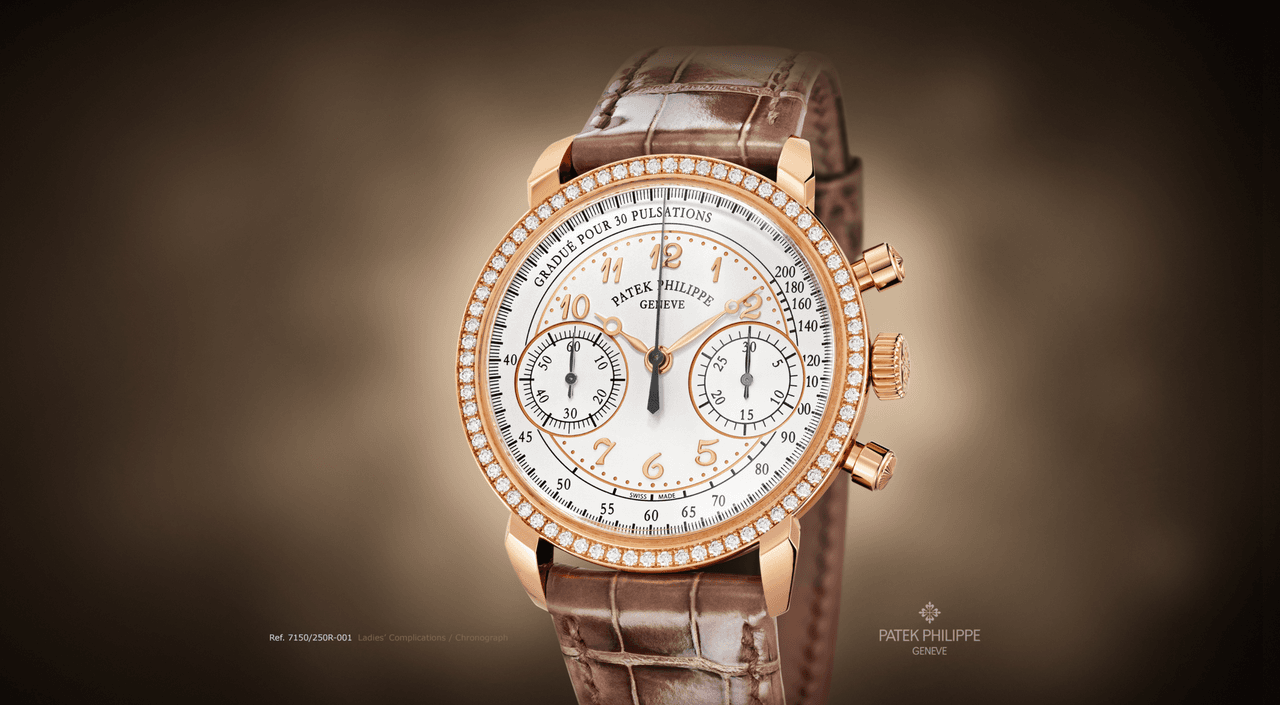
Patek Philippe Ref. 7150/250R-001 (Patek Philippe)
Managed by the Stern family, the company conducts all production processes at its headquarters in Plan-les-Ouates, Geneva. Patek Philippe’s independent structure enables long-term strategic planning. Today, Thierry Stern serves as president of the company.
Patek Philippe’s approach to horology extends beyond mechanical achievement; aesthetic design is equally central to its heritage. The Ref. 96 Calatrava, introduced in 1932, was developed based on Bauhaus principles that harmonized functionality with simplicity. This model became the stylistic backbone of the brand. A design philosophy resistant to fleeting trends has been consistently upheld, with contemporary models still following this lineage.
This aesthetic is not merely formal—it is a technical expression. The proportional relationships between dials, cases, and complications reflect a balance between visual harmony and technical elegance. The Nautilus model, introduced in 1976, represented a distinct departure. Designed for the sports watch segment, it demonstrated that stainless steel could be elevated through aesthetic refinement. The Aquanaut, launched in 1997, offered a more experimental character, blending contemporary lines with sportive aesthetics.
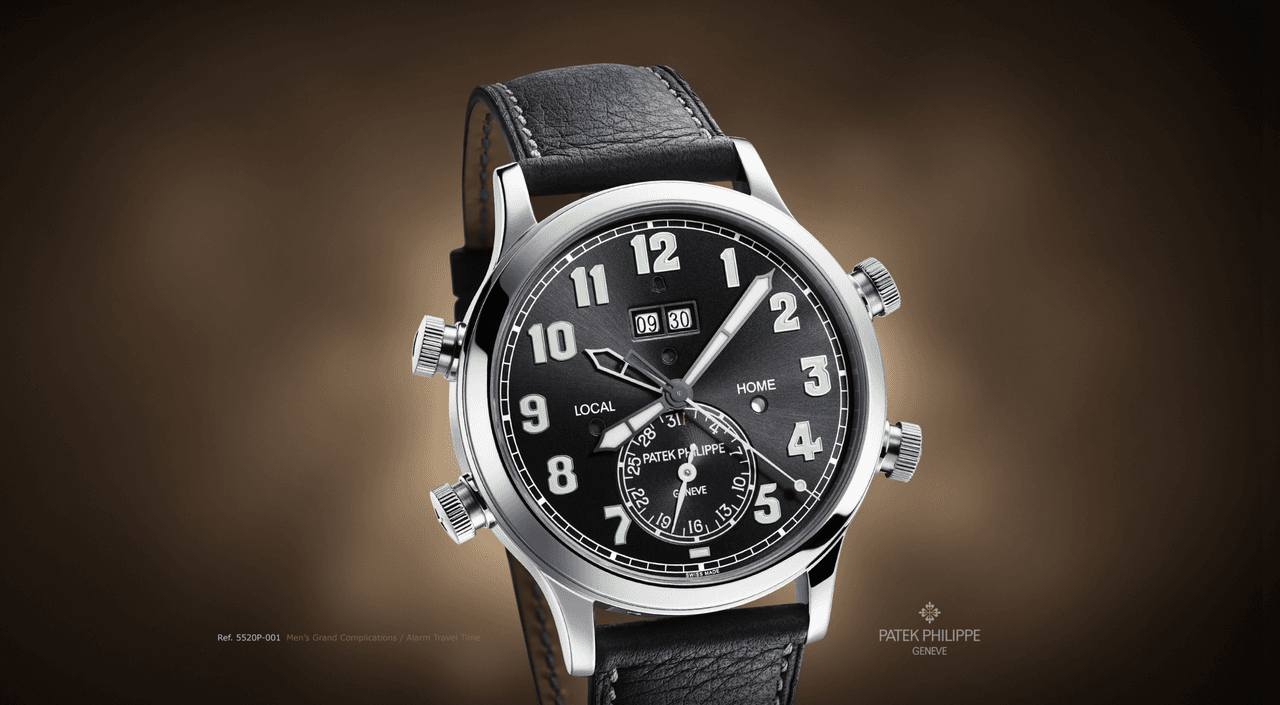
Patek Philippe Ref. 5520P-001 (Patek Philippe)
One of Patek Philippe’s most defining characteristics is its in-house production of all watch components. The entire manufacturing process—from initial design to final assembly—is carried out exclusively in Geneva-based workshops. This structure ensures not only mechanical precision but also visual and tactile consistency.
Craftsmanship is an indispensable element of this production philosophy. Months of manual labor per component, micron-level finishing, and hand-polished cases transform these timepieces into objects of collectible value.
Under its “Rare Handcrafts” initiative, the brand applies traditional techniques such as enamel work, engraving, gem-setting, and hand-painting. These practices sustain a dedicated production line dedicated to preserving heritage methods like enamel and engraving alongside modern manufacturing technologies.
Established in 2009, the Patek Philippe Seal is not merely a technical standard but an ethical manifesto. The system encompasses multiple stages of inspection, covering not only the watch’s functionality but also all external components, aesthetic proportions, assembly processes, and even after-sales service. It is monitored by an independent oversight board and provides a guarantee valid both during production and after delivery to the customer.
Under this system, timekeeping precision is limited to an exceptionally tight tolerance of ±2 seconds. Furthermore, this quality standard includes a lifetime guarantee for the servicing and restoration of all watches produced since 1839. This reflects not only a commitment to product quality but also to institutional continuity in historical production.
Patek Philippe’s collection structure is organized around distinct model families that reflect historical continuity and the technical capabilities of each era. Each family caters to a specific user profile or technical orientation while remaining faithful to the brand’s holistic approach to horology.
The Calatrava series embodies the brand’s commitment to minimalist aesthetics and classical form. First introduced in 1932 with the Ref. 96, this collection forms a foundational axis of Patek Philippe’s philosophy, uniting form and function. The Nautilus, launched in 1976 during the rise of stainless steel sports watches, challenged traditional watchmaking codes with its screw-down case and integrated bracelet in its first model, Ref. 3700/1.
When the Aquanaut collection was introduced in 1997, the brand targeted a younger demographic. Its octagonal case with rounded edges and rubber strap positioned the model as both urban and sportive. In 1999, the Twenty~4 collection was launched for female users, integrating gem-setting and quartz movements designed for both daily and special occasions.
Series such as Gondolo, Golden Ellipse, and Grand Complications frame watches with more original or highly technical features. Each of these models, produced in limited quantities, reflects the brand’s commitment to technical diversity.
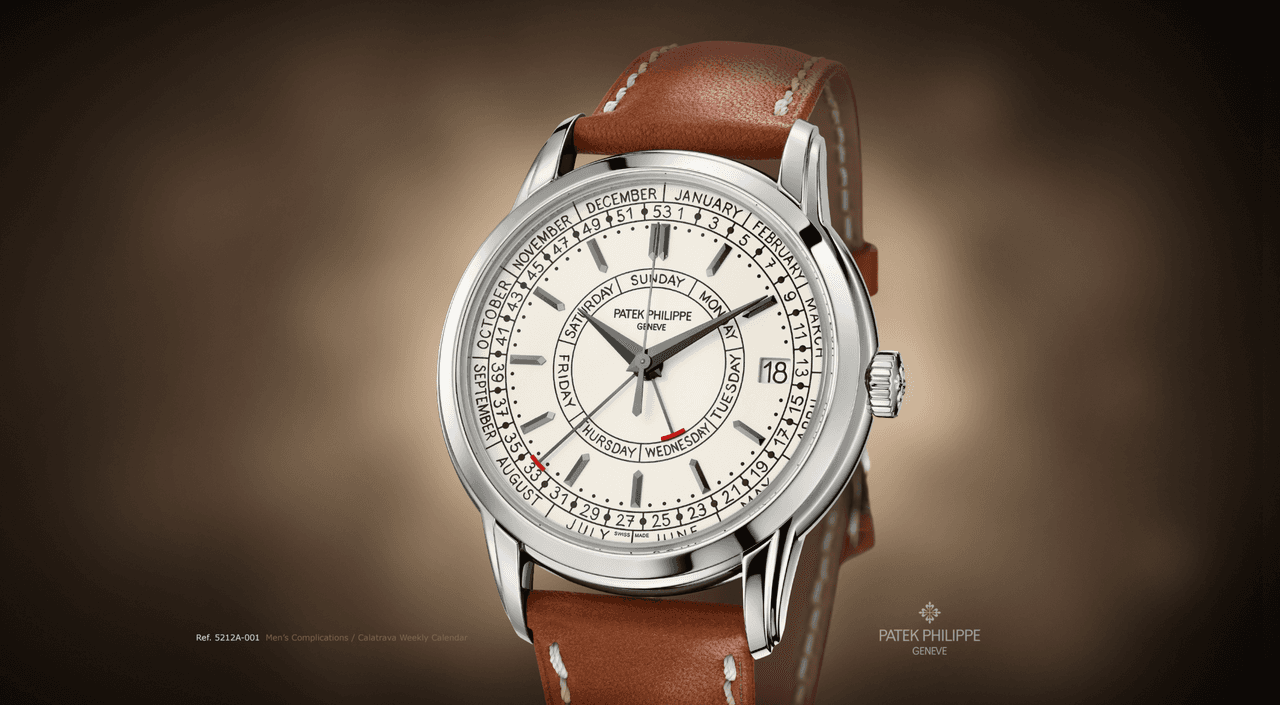
Patek Philippe Ref. 5212A-001 (Patek Philippe)
Patek Philippe stands among manufacturers who adapt technological progress without compromising traditional structures. From the late 20th century onward, silicon-based components were introduced into production. The Spiromax balance spring, introduced in 2005, the Pulsomax escapement in 2008, and the Oscillomax structure, which combined both components with GyromaxSi in 2011, represent the brand’s advancements in advanced material applications.
These innovations were developed not only to enhance mechanical precision but also to reduce long-term performance degradation. Moreover, silicon’s non-magnetic properties and lack of need for lubrication have extended maintenance intervals and improved functional durability.
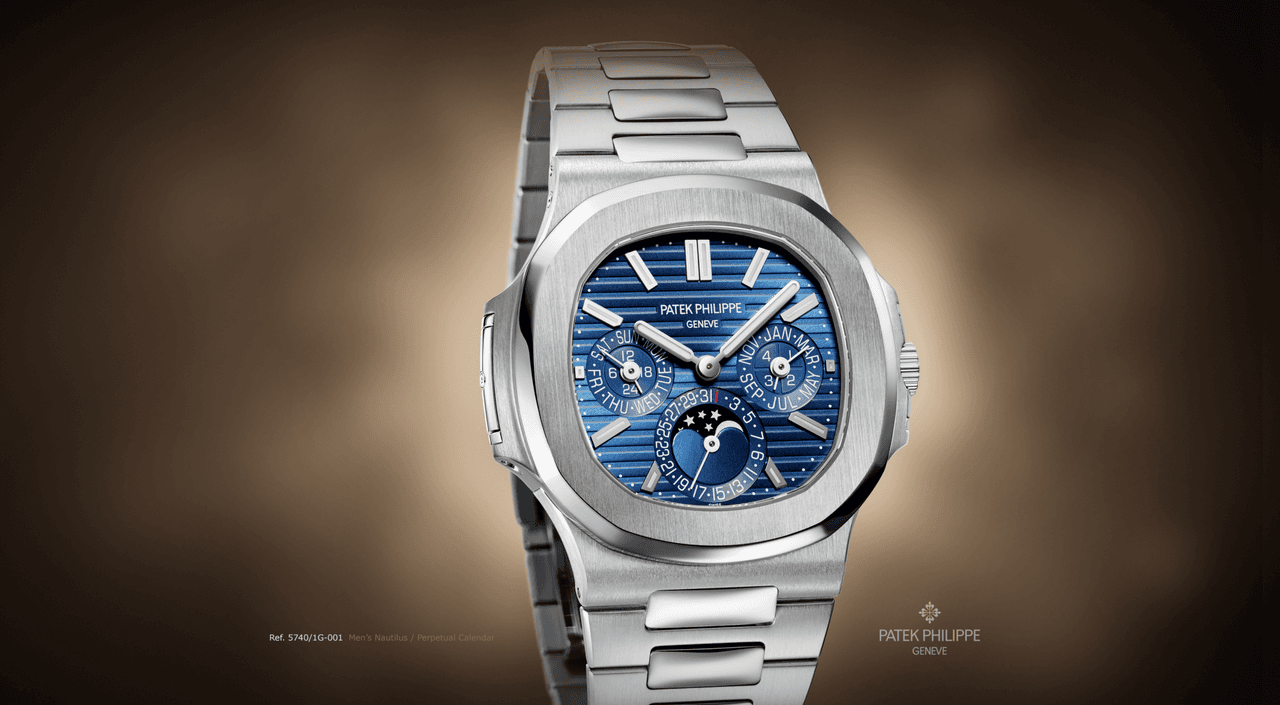
Patek Philippe Ref. 5740/1G-001 (Patek Philippe)
Patek Philippe has been managed by the Stern family since 1932. Initially taken over by brothers Jean and Charles Henri Stern, leadership passed to Henri Stern in 1958, Philippe Stern in 1993, and Thierry Stern in 2009, establishing a generational succession structure.
This continuity represents not only a form of ownership but also the preservation of institutional memory. The modern production facility in Plan-les-Ouates functions as a center where new-generation manufacturing technologies converge with traditional watchmaking. The museum housed within the same complex preserves visual and technical documentation not only of the brand but of European horology as a whole.
Maintaining corporate ownership within the family allows decision-making to prioritize historical consistency over market dynamics. This enables Patek Philippe to adopt a production approach independent of short-term market pressures, positioning its watches as historical artifacts worthy of long-term evaluation.
Today, Patek Philippe remains an independent family-owned company. This structure allows it to maintain a balanced production policy that harmonizes its historical legacy with technological advancement. In an industry where many manufacturers have become part of large conglomerates, Patek Philippe’s independence enables it to make long-term strategic decisions free from market pressures.
The brand continues to operate as both a physical horological center and a public museum and exhibition space through its private salons in Geneva, Paris, and London; its central production facility in Plan-les-Ouates; its historic sales point on rue du Rhône; and its museum in Geneva. This infrastructure creates not only a place of watchmaking but also a space for the transmission of knowledge and tradition.
Under the leadership of Thierry Stern, the brand continues its historical legacy while integrating contemporary developments. Through silicon components, new collections, global touring exhibitions, and auctions, Patek Philippe maintains a dynamic corporate archive and promotional system. As a result, Patek Philippe watches are regarded not only as inheritances of the past but also as integral parts of the future.
A History of Patek Philippe: Legacy of Swiss Watchmaking | The 1916 Company. Accessed April 22, 2025. https://www.the1916company.com/blog/patek-philippe-history.html.
Patek Philippe | Company | History 1950–1988. Accessed April 22, 2025. https://www.patek.com/en/company/history#1950-1988.
Patek Philippe | Company | History. Accessed April 22, 2025. https://www.patek.com/en/company/history#1839-1877.
Patek Philippe | Company | History2. Accessed April 22, 2025. https://www.patek.com/en/company/history#1878-1931.
Patek Philippe | Company | History3. Accessed April 22, 2025. https://www.patek.com/en/company/history#1932-1949.
Patek Philippe | Company | History5. Accessed April 22, 2025. https://www.patek.com/en/company/history#1989-2019.
Patek Philippe | Company | The Manufacture –Seal Bölümü. Accessed April 22, 2025. https://www.patek.com/en/company/the-manufacture#patek-philippe-seal.
Patek Philippe | Company | The Manufacture –Values Bölümü. Accessed April 22, 2025. https://www.patek.com/en/company/the-manufacture#values.
Patek Philippe | Company | The Manufacture. Accessed April 22, 2025. https://www.patek.com/en/company/the-manufacture.
Patek Philippe | Company |The Mddanufacture. Accessed April 22, 2025. https://www.patek.com/en/company/the-manufacture#calatrava-cross.

Founding and Early Developments (1839–1877)
Technical Innovations and Expansion (1878–1931)
The Stern Family Era and Iconic Collections (1932–1949)
Transition to Modern Mechanisms (1950–1988)
The Age of Complications and Technological Breakthroughs (1989–2019)
Values and Production Culture
Corporate Structure and Sustainability
Design Tradition and Technical Identity
Production Culture and Craftsmanship
Quality System and Sustainable Oversight
Model Continuity and Design Diversity
Technological Evolution and Material Experimentation
Corporate Memory and Family Continuity
Current Position and Enduring Tradition