

This article was automatically translated from the original Turkish version.
Nerve | Innervated by the medial pectoral nerve (C8–T1) | ||||||||
|---|---|---|---|---|---|---|---|---|---|
Artery | Supplied by the pectoral branch of the thoracoacromial artery and the lateral thoracic artery | ||||||||
Function(s) | Pulls the scapula downward and forward assists in inspiration with the shoulder fixed | ||||||||
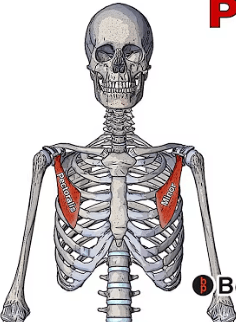
Minor Pectoral Muscle is a thin, triangular muscle located in the chest region. Situated beneath the major pectoral muscle, it originates from the third, fourth, and fifth ribs and inserts onto the coracoid process of the scapula. Innervated by the medial pectoral nerve, this muscle stabilizes the scapula against the thoracic wall, contributing to the stability of movement and posture of the upper limb. Due to its anatomical position and functions, it is a clinically and surgically significant structure.
The minor pectoral muscle is a triangular muscle located deep to the major pectoral muscle on the anterior thoracic wall. Its muscle fibers converge upward and laterally to form a flat tendon that attaches to the medial border and superior surface of the coracoid process of the scapula. This anatomical arrangement allows the minor pectoral muscle to form part of the anterior wall of the axilla and establishes a functional connection between the thorax and the upper limb.
Like most upper limb muscles, the minor pectoral muscle develops embryologically from somites derived from the paraxial mesoderm. It arises from the ventral muscle mass and is classified among the anterior trunk muscles. In some individuals, the ribs from which the muscle originates or the structures to which it attaches may vary. For example, it may originate from the second, third, and fourth ribs or extend as far as the greater tubercle. Rarely, it may be divided into multiple parts or be completely absent. Congenital absence of the muscle can be observed in certain congenital syndromes such as Poland syndrome. Accessory muscular structures may also occur variably among individuals.
The minor pectoral muscle is innervated by the medial pectoral nerve, which arises from the medial cord of the brachial plexus. This nerve penetrates the clavipectoral fascia to directly supply the muscle fibers. The vascular supply of the muscle is typically provided by branches of the axillary artery, including the pectoral branch of the thoracoacromial artery and the lateral thoracic artery. These vessels form an extensive vascular network to support the muscle’s functions.
The minor pectoral muscle acts to pull the scapula toward the thoracic wall and depress the acromion. It also assists in upward and posterior rotation of the inferior angle of the scapula, facilitating flexion and abduction of the arm. Clinically, the minor pectoral muscle serves as an important anatomical landmark for dividing the axillary artery into three segments: the first segment lies medial to the muscle, the second lies posterior to it, and the third lies lateral to it. Axillary lymph nodes are also classified into three levels based on their relationship to this muscle. This classification is of great importance in surgical procedures, particularly in breast cancer surgery. Hypertrophy or tightness of the minor pectoral muscle may contribute to thoracic outlet syndrome, in which the muscle compresses neurovascular structures passing beneath it, leading to pain, numbness, or circulatory disturbances.
Accessed November 26, 2025.
Accessed November 26, 2025.
Baydar, Meltem and Nevin Demir. "Anatomical Variations and Clinical Importance of Pectoralis Minor Muscle." Fiziksel Tıp ve Rehabilitasyon Dergisi 33, no. 2 (2022): 75–82. Accessed July 23, 2025.
Cureus. "Anatomical and Clinical Review of the Pectoralis Minor Muscle." *Cureus*, October 2023. Accessed July 23, 2025. https://assets.cureus.com/uploads/review_article/pdf/179579/20231031-10339-fyspz2.pdf.
Fiziksel Tıp ve Rehabilitasyon Dergisi. "Morphological Study on Pectoralis Minor Muscle in Turkish Population." Fiziksel Tıp ve Rehabilitasyon Dergisi 33, no. 1 (2022): 75–81. Accessed July 23, 2025.
Palamar, Melih, Hakan Yılmaz, Ayşe Gündoğdu and Elif Akbulut. "Clinical and Anatomical Insights of Pectoralis Minor Muscle Variations." Scientific Journal of Medicine 7, no. 1 (2023): 45–51. Accessed July 23, 2025.
Palamar, Melih, Hakan Yılmaz, Ayşe Gündoğdu and Elif Akbulut. "Variant Pectoralis Minor Muscle: A Case Study with Clinical Relevance." ResearchGate, 2023. Accessed July 23, 2025.

Nerve | Innervated by the medial pectoral nerve (C8–T1) | ||||||||
|---|---|---|---|---|---|---|---|---|---|
Artery | Supplied by the pectoral branch of the thoracoacromial artery and the lateral thoracic artery | ||||||||
Function(s) | Pulls the scapula downward and forward assists in inspiration with the shoulder fixed | ||||||||
No Discussion Added Yet
Start discussion for "Pectoralis Minor Muscle" article
Anatomical Structure
Embryological Origin and Classification
Innervation and Vascular Supply
Function and Clinical Relevance