


This article was automatically translated from the original Turkish version.
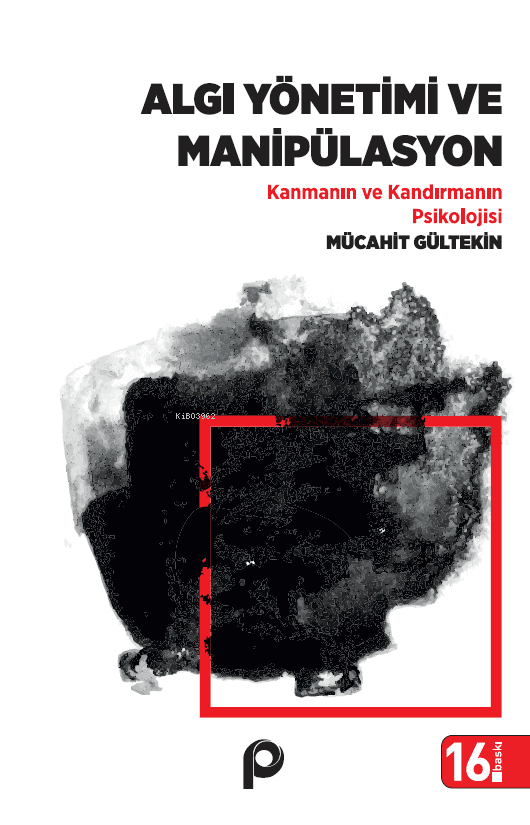
Perception Management and Manipulation: The Psychology of Bleeding and Deceiving
Author(s) | Mücahit Gültekin | ||||||||
|---|---|---|---|---|---|---|---|---|---|
Publisher(s) | Pınar Yayınları | ||||||||
Number of Pages | 320 | ||||||||
First Publication Date(s) | 2016 | ||||||||
Perception Management and Manipulation, authored by Mücahit Gültekin, was published in 2016 by Pınar Yayınları based in Istanbul. The book comprehensively examines various mechanisms of perception management and psychological manipulation within historical, psychological, sociological, and political contexts. Spanning 320 pages, the work is published in Turkish.
This study provides theoretical and practical insights into how the perceptions of individuals and societies are managed and how manipulation techniques are applied in different domains. Mücahit Gültekin elucidates the fundamental concepts of perception management and details the psychological and sociological tools employed in this process. The book explores applications of manipulation in media, politics, education, and culture, and evaluates how individuals can become more conscious of these processes.
The book emphasizes that perception management is not merely a contemporary phenomenon but has been utilized throughout history. Drawing examples from various historical periods, particularly Islamic history, it analyzes the dynamics of perception management and manipulation. In this context, it examines how political and religious authorities in the past exerted control over public perception to enhance their influence. Thus, the work demonstrates that perception management is a universal and timeless phenomenon.
Gültekin dedicates substantial attention in the book to the role of psychological processes in perception management. He explains how the human mind constructs perceptions through unconscious processes, emotional responses, and social interactions. Manipulation techniques are detailed under categories such as deception, distortion, intimidation, persuasion methods, and the generation of consent. The book particularly highlights the distinctions between conscious and unconscious manipulation methods.
The role of media in perception management constitutes a significant portion of the book. Mücahit Gültekin links the power of media outlets in shaping public opinion to practices such as selective reporting, framing, disinformation, and propaganda. The book underscores the importance of media ethics and media literacy, arguing for the development of a critical perspective toward media.
In the political context, perception management plays a critical role in shaping voter behavior and directing public opinion. The book examines concepts such as political propaganda, leadership image construction, crisis management, and public opinion engineering through theoretical and practical examples. Drawing on applications from Turkish and global politics, it reveals the impact of perception management on political systems.
The book also addresses perception management techniques used within educational systems. It analyzes issues such as curriculum design, selective transmission of information, and ideological influences. It further notes that education serves as a mechanism for guiding individuals to conform to social and cultural norms, which falls under the broader framework of perception management.
The book provides a detailed analysis of the effects of perception management on social structures and culture. It examines how social norms, belief systems, and values are manipulated to shape societies, particularly within the context of cultural hegemony and identity politics. The work offers analyses of how these manipulations interact with processes of social resistance and accommodation.
Perception Management and Manipulation attracted attention from both academic circles and the general public upon its publication. The book raised awareness of the directional and influential potential of social media and the internet in the digital age. The historical and cultural examples presented in the text have provided a foundation for discussing various contemporary social and political issues, enabling the work to be evaluated not only as a theoretical contribution but also within an applied context.
The book adopts an interdisciplinary perspective on perception management and manipulation, integrating theoretical approaches from psychology, sociology, communication studies, and political science. In this regard, it is regarded as a reference source across multiple academic disciplines. Academic reviews highlight the book’s capacity to present a conceptual framework and its skill in synthesizing examples from diverse fields into a cohesive structure. On the other hand, some critiques note that the references in the book are predominantly drawn from Western sources, resulting in insufficient representation of local contexts.
Gültekin, Mücahit. Algı Yönetimi ve Manipülasyon: Kanmanın ve Kandırmanın Psikolojisi. İstanbul: Pınar Yayınları, 2024.

Perception Management and Manipulation: The Psychology of Bleeding and Deceiving
Author(s) | Mücahit Gültekin | ||||||||
|---|---|---|---|---|---|---|---|---|---|
Publisher(s) | Pınar Yayınları | ||||||||
Number of Pages | 320 | ||||||||
First Publication Date(s) | 2016 | ||||||||
No Discussion Added Yet
Start discussion for "Perception Management and Manipulation (Book)" article
Subject and Core Content
Historical and Cultural Context
Psychological Foundations and Manipulation Techniques
Modern Media and Perception Management
Political Manipulation and Public Opinion Management
Perception Management in Education
Social and Cultural Implications
Contemporary Impacts and Debates
Critical Perspectives and Academic Evaluations