

This article was automatically translated from the original Turkish version.
Original Name(s) | Perfect Days | ||||||||
|---|---|---|---|---|---|---|---|---|---|
Production Year / Country | 2023 / Japan | ||||||||
Genre | Drama | ||||||||
Director(s) | Wim Wenders | ||||||||
Screenplay(s) | Wim Wenders and Takuma Takasaki | ||||||||
Lead Actor | Kōji Yakusho | ||||||||
Language(s) | Japanese | ||||||||
Duration | 123 minutes | ||||||||
Filming Locations | Tokyo, Japan | ||||||||
Notable Awards | Cannes – Best Actor (2023), Asia Pacific Screen Awards – Best Film (2023), Asian Film Awards – Best Actor (2024), Japan Academy Prize – Best Director & Best Actor (2024), Oscar – Best International Feature Film Nomination (2024), Chlotrudis – Best Film & Director & Cinematography & Music Usage (2025) | ||||||||
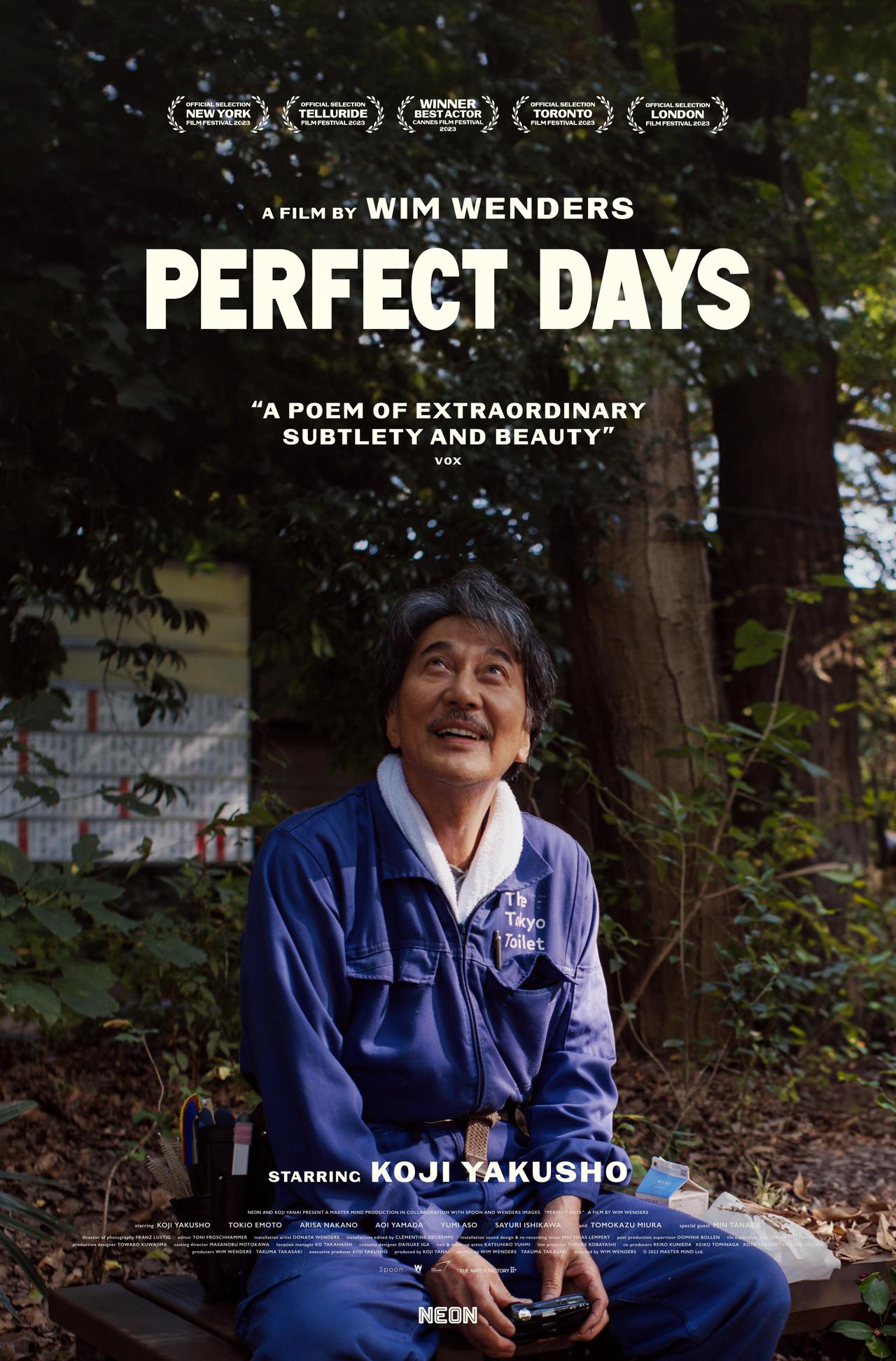
Perfect Days is a 2023 drama film directed by Wim Wenders, starring Japanese actor Kōji Yakusho in the lead role. The film explores the everyday life of Tokyo through a simple, observational and human-centered narrative. The story reflects the quiet yet meaningful aspects of modern life through the routines of Hirayama, a sanitation worker. Elements of Japanese culture such as silence, order and respect for nature are seamlessly woven into the film’s visual structure, making it one of the most minimalist examples of contemporary cinema.
The film possesses a formally simple yet thematically layered structure. As the narrative progresses, it reveals the underlying sense of peace, acceptance and tranquility hidden behind the character’s routines. The contrast between the modern texture of the city and the character’s inner world forms the film’s central dramatic tension. Each scene aims to suggest the existential meaning beneath ordinary daily actions. Visual compositions depict the character’s universe through Tokyo’s quiet streets, parks and restrooms. In this way, the film seeks to engage the viewer not through grand events but through subtle observations.
The story centers on a typical day in the life of Hirayama, who works cleaning public restrooms in Tokyo. Every morning he wakes at the same time, goes to work, follows the same route and listens to the same music. These recurring routines represent his way of life and his search for inner balance. Daily actions are presented as a silent ritual; cleaning, order and simplicity form the foundation of his existential peace. As the narrative unfolds, small encounters, old acquaintances and sudden visits offer clues about Hirayama’s past. These fleeting moments aim to add depth to the character’s emotional world. The film’s pace is slow; each scene seeks to make the viewer feel the passage of time.
The narrative relies more on visual storytelling than dialogue. The character’s silence, combined with ambient sounds, shapes the film’s emotional atmosphere. The structure is cyclical: each day begins and ends similarly, yet subtle variations create new layers of meaning. The director uses this structure to reflect the human life cycle. Throughout the film, nature, light and shadow function as metaphors for the character’s inner world. Although the routines continue unchanged in the final sections, the viewer witnesses the character’s emotional maturation.

A scene from the film (IMDb)
The film was shot in various districts of Tokyo, Japan. The use of real locations enhances the film’s natural atmosphere. Cinematography emphasizes sensitivity to the character’s surroundings through natural lighting and simple framing. Camera movements are kept to a minimum, favoring an observational perspective. Visual compositions blur the boundary between the character’s world and the city. The editing follows a rhythm that supports the character’s routines. Scene transitions are slow, deliberate and measured. These technical choices support the narrative structure needed to immerse the viewer in the character’s pace of life.
The sound design establishes a balance between urban noise, natural sounds and music. Tracks by artists such as Lou Reed and Patti Smith are used to reflect the character’s inner world. The color palette shifts with the tones of morning and evening light; blue and gray hues reinforce a sense of calm. Although filmed digitally, the film carries a classic cinematic look. No large sets or visual effects were used during production. All technical choices aimed to create a simple yet powerful cinematic language.
Kōji Yakusho forms the emotional core of the film through his portrayal of Hirayama. His performance is restrained, minimal and introspective. The character’s emotional evolution is conveyed through subtle facial expressions and silence. Yakusho naturally embodies the serenity beneath the character’s disciplined lifestyle. Supporting actors contribute to the narrative through brief scenes. In particular, Hirayama’s young relative, former acquaintances and coworkers provide clues about his past and social environment.
The overall performance style is grounded in character-driven realism. Dialogue is kept sparse, and emotions are expressed through facial cues. This approach seeks to draw the viewer closer to the character’s inner experience. Hirayama’s facial expressions gradually convey different emotional states throughout the film. Supporting actors add rhythm to the story without dramatizing the scenes.
The film has received widespread critical acclaim for its minimalist form and powerful emotional impact. In particular, the lead performance and the narrative style centered on silence and observation have been highlighted. The cinematography presents Tokyo’s daily life within a subdued atmosphere. The director’s observational stance keeps the film away from didacticism. Thematically, the search for meaning in routine is brought to the forefront. In this regard, the film is regarded as a cinematic example reflecting the quiet solitude of the modern urban individual.
Critics have also emphasized the film’s emotional structure and formal unity. The use of sound, the balance with the natural environment and the musical selections have been positively reviewed. Visual simplicity has been recognized as an aesthetic element that supports the film’s structure. The transformation of the character’s ordinary life into a meaningful experience is seen as a sign of the director’s maturity.
The film won the Best Actor award at the 2023 Cannes Film Festival. It was also nominated for the Ecumenical Jury Prize at the same festival. At the 2023 Asia Pacific Screen Awards, it won the Best Film award and was nominated for Best Performance. In 2024, it was nominated for the Academy Award for Best International Feature Film. That same year, it won the Best Actor award at the Asian Film Awards and was nominated for Best Film. At the 2024 Japan Academy Film Prizes, it received awards for Best Director and Best Actor, and was nominated for Best Film.
At the 2025 Chlotrudis Awards, it won awards for Best Film, Best Director, Best Cinematography and Best Use of Music. It was also nominated for Best Original Screenplay and Best Performance by a Lead Actor. It received nominations for Best Foreign Language Film at the Critics Choice Awards and the César Awards. It was nominated for Best Foreign Language Film at the Danish Robert Awards and the Bodil Awards.
2023 – Cannes – Best Actor (Kōji Yakusho) – Won; Ecumenical Jury Prize – Nominated
2023 – Asia Pacific Screen Awards (APSA) – Best Film – Won; Best Performance – Nominated
2023 – Gijón / Ghent / Tokyo / Tallinn / Zurich etc. – Official Selections – Screened
2024 – Academy Awards (Oscars) – Best International Feature Film – Nominated
2024 – Asian Film Awards – Best Actor – Won; Best Film – Nominated
2024 – Japan Academy Film Prizes – Best Director – Won; Best Actor – Won; Best Film – Nominated
2024 – César / Critics Choice / San Francisco and Seattle Film Critics – Various nominations – Nominated
2025 – Chlotrudis – Best Film / Best Director / Best Cinematography / Best Use of Music – Won; Best Original Screenplay / Best Performance by a Lead Actor – Nominated
2025 – Robert (Denmark) / Bodil (Denmark) – Best Non-English Language Film / Best Foreign Language Film – Nominated
Beyazperde. "Perfect Days." Beyazperde. Accessed October 7, 2025. https://www.beyazperde.com/filmler/film-314885/.
Box Office Mojo. "Perfect Days." Box Office Mojo. Accessed October 7, 2025. https://www.boxofficemojo.com/title/tt27503384/.
IMDb. "Perfect Days – Awards." IMDb. Accessed October 7, 2025. https://www.imdb.com/title/tt27503384/awards/?ref_=tt_ov_at_op_awd.
IMDb. "Perfect Days – Company Credits." IMDb. Accessed October 7, 2025. https://www.imdb.com/title/tt27503384/companycredits/?ref_=tt_ov_at_dt_cmpy.
IMDb. "Perfect Days – Full Cast & Crew." IMDb. Accessed October 7, 2025. https://www.imdb.com/title/tt27503384/fullcredits/?ref_=tt_ov_at_pop_cst.
IMDb. "Perfect Days – Locations." IMDb. Accessed October 7, 2025. https://www.imdb.com/title/tt27503384/locations/?ref_=tt_ov_at_dt_flmg.
IMDb. "Perfect Days – Plot Summary." IMDb. Accessed October 7, 2025. https://www.imdb.com/title/tt27503384/plotsummary/?ref_=tt_ov_at_pl_pl.
IMDb. "Perfect Days." IMDb. Accessed October 7, 2025. https://www.imdb.com/title/tt27503384/.
IMDb. “Perfect Days – Release Info.” IMDb. Accessed October 7, 2025. https://www.imdb.com/title/tt27503384/releaseinfo/?ref_=tt_ov_at_dt_rdat.
MUBI. "Perfect Days – Awards." MUBI. Accessed October 7, 2025. https://mubi.com/tr/films/perfect-days/awards.
MUBI. "Perfect Days." MUBI. Accessed October 7, 2025. https://mubi.com/tr/tr/films/perfect-days.
Roger Ebert. "Perfect Days (2024) Review." Roger Ebert. Accessed October 7, 2025. https://www.rogerebert.com/reviews/perfect-days-film-review-2024.
T.C. Ministry of Culture and Tourism. "Perfect Days." *Filmsiniflandirma.ktb.gov.tr.* Accessed October 7, 2025. https://filmsiniflandirma.ktb.gov.tr/detail/perfect-days.

Original Name(s) | Perfect Days | ||||||||
|---|---|---|---|---|---|---|---|---|---|
Production Year / Country | 2023 / Japan | ||||||||
Genre | Drama | ||||||||
Director(s) | Wim Wenders | ||||||||
Screenplay(s) | Wim Wenders and Takuma Takasaki | ||||||||
Lead Actor | Kōji Yakusho | ||||||||
Language(s) | Japanese | ||||||||
Duration | 123 minutes | ||||||||
Filming Locations | Tokyo, Japan | ||||||||
Notable Awards | Cannes – Best Actor (2023), Asia Pacific Screen Awards – Best Film (2023), Asian Film Awards – Best Actor (2024), Japan Academy Prize – Best Director & Best Actor (2024), Oscar – Best International Feature Film Nomination (2024), Chlotrudis – Best Film & Director & Cinematography & Music Usage (2025) | ||||||||
No Discussion Added Yet
Start discussion for "Perfect Days (Film)" article
Plot and Narrative Structure
Production and Technical Features
Cast and Performances
Critical Reception
Awards
Selected List (Year – Organization – Category – Result)