
This article was automatically translated from the original Turkish version.
Source | 109P/Swift–Tuttle comet | ||||||||
|---|---|---|---|---|---|---|---|---|---|
Active Period | July 17 – August 24 | ||||||||
Peak Date | August 12–13 | ||||||||
Radiant Point | Perseus Constellation | ||||||||
ZHR (Hourly Maximum) | 50–100 meteors/hour (under ideal conditions) | ||||||||
The Perseid Meteor Shower is an annual meteor shower that originates from the comet 109P/Swift–Tuttle. As the comet travels its 133-year orbit around the Sun, it leaves behind a trail of dust and small rocky debris. Each year, between mid-July and late August, Earth passes through this dense region of debris. The particles entering the atmosphere heat up due to friction, reaching temperatures of up to 3,000°C, and vaporize, creating brief bright streaks in the sky. Although commonly called “shooting stars,” scientifically these are defined as meteors. The shower is named “Perseid” because its radiant point lies in the direction of the constellation Perseus.

Perseid Meteor Shower (AA)
The Perseid meteor shower is known for its bright and fast-moving meteors. The average meteor speed is approximately 59 km/s. Particle sizes range from sand grains to walnut-sized fragments. Larger particles producing exceptionally bright events lasting several seconds are called fireballs. Under optimal viewing conditions, the Perseids can produce a rate of 50 to 100 meteors per hour, as measured by the standard metric known as the Zenithal Hourly Rate (ZHR).
The Perseid Meteor Shower is active annually between approximately 17 July and 24 August. The peak typically occurs on the night of 12–13 August, when Earth passes through the densest part of the comet’s debris trail. During peak hours, especially in dark areas with minimal light pollution, the number of visible meteors increases significantly.
In the 2025 observations, the peak coincides closely with the full moon phase, which is expected to reduce the visibility of fainter meteors. However, the brighter fireballs are predicted to remain visible despite the moonlight.
No telescope or binoculars are required to observe the Perseid meteor shower; it is best viewed with the naked eye, looking across the widest possible area of the sky. The following factors are critical for optimal viewing:
For astrophotography, wide-angle lenses and long-exposure techniques are recommended.

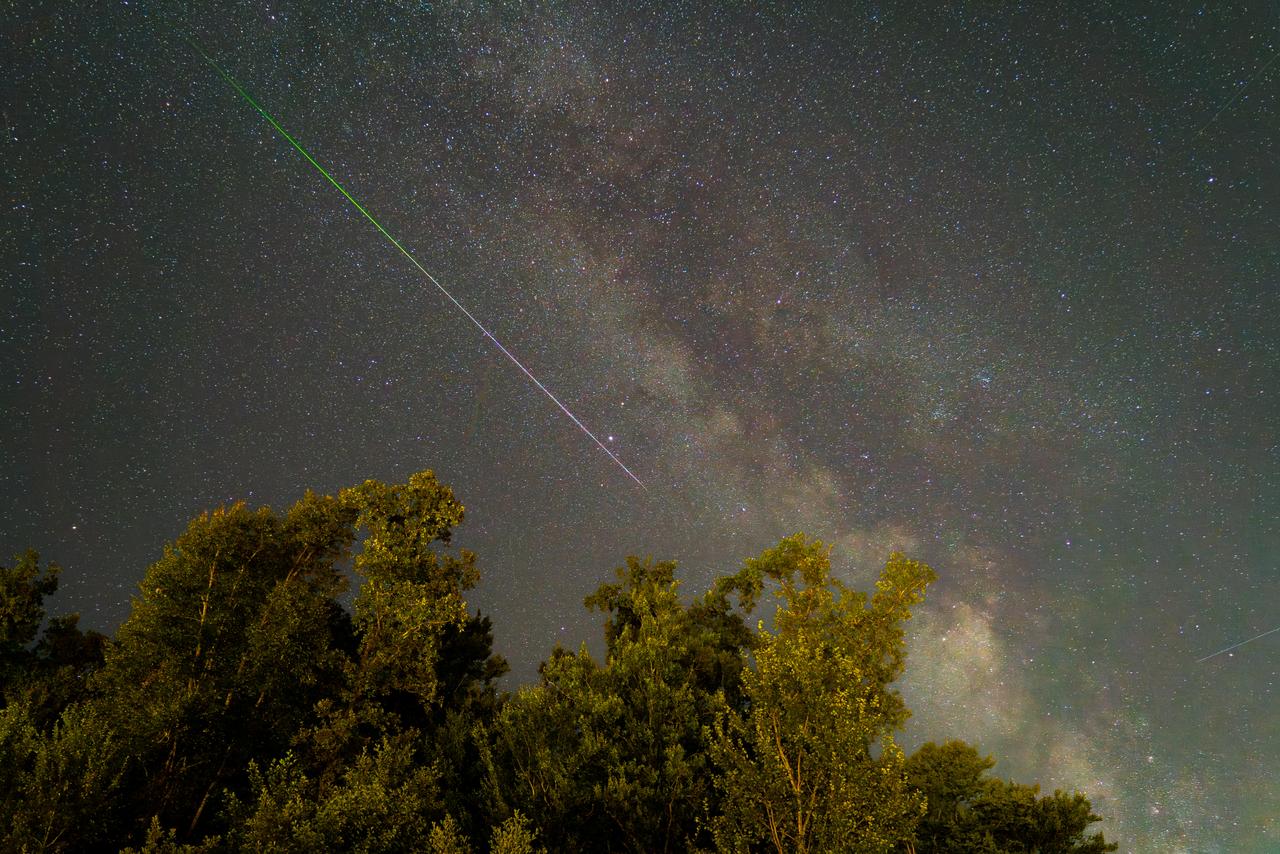
Perseid Meteor Shower (Pexels)
The Perseid meteor shower serves as an important observational source for studies on the physical properties of meteoroids, their interaction with the atmosphere, and cometary dynamics. Additionally, the distribution of meteor brightness and frequency provides indirect data on the density and temperature of the upper atmosphere. NASA and other observatories regularly monitor the Perseids using optical observations, radio wave reflections, and high-speed camera systems.
Due to its occurrence in midsummer in the Northern Hemisphere and its production of bright meteors, the Perseid shower has long attracted public interest. In ancient times, it was known as “Tears of Saint Lawrence” because it appeared near the feast day of Saint Lawrence. In modern times, it has become an important part of popular astronomy events.
AA. 2024. “Perseid Meteor Yağmuru.” Anadolu Ajansı. Accessed July 15, 2025. https://www.aa.com.tr/tr/pg/foto-galeri/perseid-meteor-yagmuru/146.
BBC News. 2024. “Perseid Meteor Shower: How and When to See Shooting Stars in the UK.” Accessed July 15, 2025. https://www.bbc.com/news/articles/cwy7d7e82gno.
NASA. 2024. “Perseids.” NASA Science. Accessed July 15, 2025. https://science.nasa.gov/solar-system/meteors-meteorites/perseids/.
Pexels. 2023. “Işık, Parlak, Açık, Hafif.” Accessed July 15, 2025. https://www.pexels.com/tr-tr/fotograf/isik-parlak-acik-hafif-17849196/.
TÜBİTAK National Observatory. 2024. “Perseid Göktaşı Yağmuru.” Accessed July 15, 2025. https://tug.tubitak.gov.tr/tr/etiketler/perseid-meteor-shower.

Source | 109P/Swift–Tuttle comet | ||||||||
|---|---|---|---|---|---|---|---|---|---|
Active Period | July 17 – August 24 | ||||||||
Peak Date | August 12–13 | ||||||||
Radiant Point | Perseus Constellation | ||||||||
ZHR (Hourly Maximum) | 50–100 meteors/hour (under ideal conditions) | ||||||||
No Discussion Added Yet
Start discussion for "Perseid Meteor Shower" article
Observational Characteristics
Activity Period and Peak Time
Observation Conditions and Methods
Scientific Significance
Cultural and Historical Context