

This article was automatically translated from the original Turkish version.
Phoebe is the largest of Saturn’s known outer moons and orbits at an average distance of 12,952,000 kilometers from the planet. Its orbit is inclined at 175 degrees relative to Saturn’s equatorial plane, making it retrograde; this means Phoebe moves in the opposite direction to Saturn and its inner moons. Phoebe is classified as a Centaur object that was captured by Saturn’s gravity after originating from the Kuiper Belt, a region where objects orbiting the Sun are concentrated.
Phoebe was discovered in 1899 by American astronomer William Pickering, using photographic plates taken at the Boyden Station in Arequipa, Peru. It was the first celestial body to be discovered by photographic means. Close examination of the moon has been carried out by several spacecraft:
In 1981, while passing by Saturn, Voyager 2 captured images of Phoebe from a distance of 2.2 million kilometers.

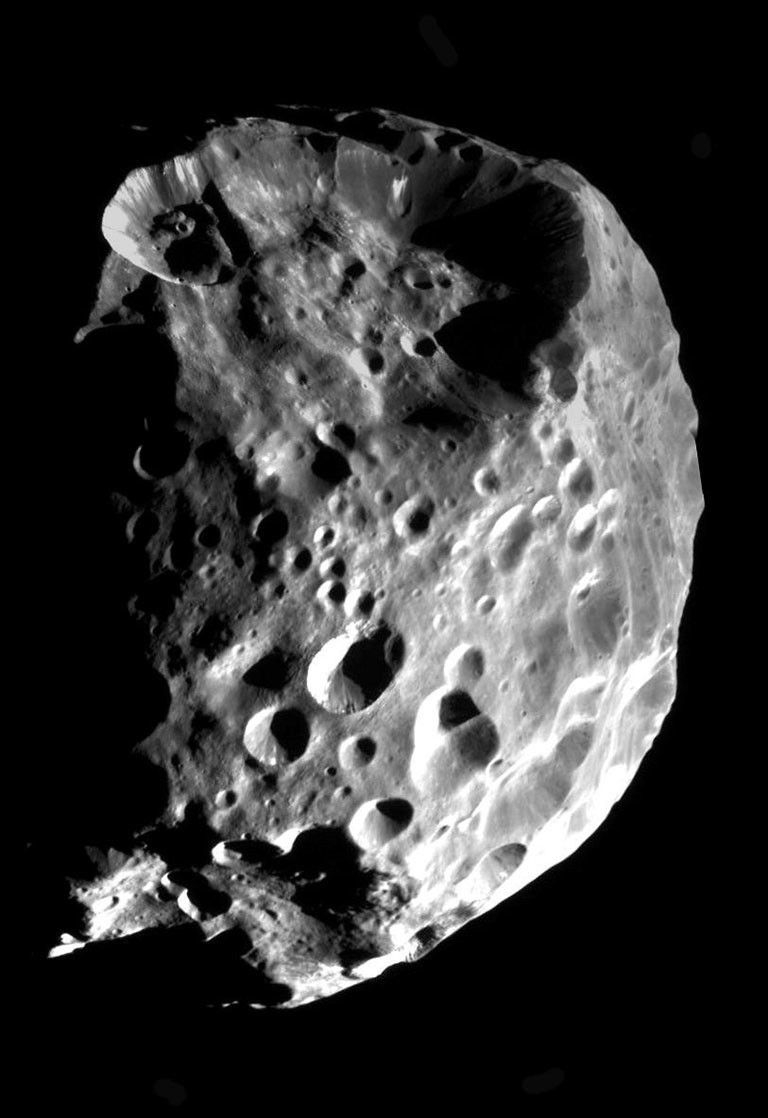
Close-up Image Sequence of Phoebe (NASA)
On 11 June 2004, Cassini-Huygens approached Phoebe to within approximately 2,068 kilometers, obtaining high-resolution images and spectral data of the moon.
Phoebe has a diameter of about 213 kilometers, making it the largest of Saturn’s irregular moons. It completes one rotation on its axis in 9 hours and 16 minutes and takes approximately 18 months to complete one orbit around Saturn. Its shape is roughly spherical, and its mass is sufficient to have allowed geological differentiation; this indicates that heavier minerals are concentrated in its interior while lighter materials dominate the surface. Phoebe’s average density is around 1.6 grams per cubic centimeter, suggesting it is composed of rock and water ice.

Close-up Surface Detail and Crater Distribution of Phoebe (NASA)
Phoebe’s surface is very dark, reflecting only about 6 percent of the sunlight that strikes it. The surface is heavily cratered, with some craters reaching diameters of 80 kilometers and depths of up to 16 kilometers. Observations of the steep walls of these craters have revealed brighter materials beneath the surface, likely water ice. In addition to water ice, Phoebe’s surface contains hydrated minerals, carbon dioxide, phyllosilicates, and likely organic compounds. This chemical diversity indicates that Phoebe is a primitive object preserving unaltered materials from the formation of the Solar System.
Thermal radiation from Phoebe refers to the infrared emission originating from the moon’s surface and its temperature distribution. Detection of this thermal radiation occurred in the wavelength range of 15 to 17 microns, approximately 25 times longer than the longest wavelength visible to the human eye. Measurements revealed significant variations in surface temperature depending on location and time of day. Temperatures are given in Kelvin (K): daytime temperatures near Phoebe’s equator reach up to about 107 K, while pre-dawn temperatures in the northern hemisphere drop below 75 K. This distribution is strongly correlated with topographic features: the coldest regions are found in the shadowed interiors of large depressions.

Thermal Radiation and Surface Temperature Distribution of Phoebe (NASA)


Discovery and Observations
Voyager 2:
Cassini-Huygens:
Physical Properties and Dimensions
Surface Structure and Geology
Thermal Radiation on Phoebe’s Surface