


This article was automatically translated from the original Turkish version.
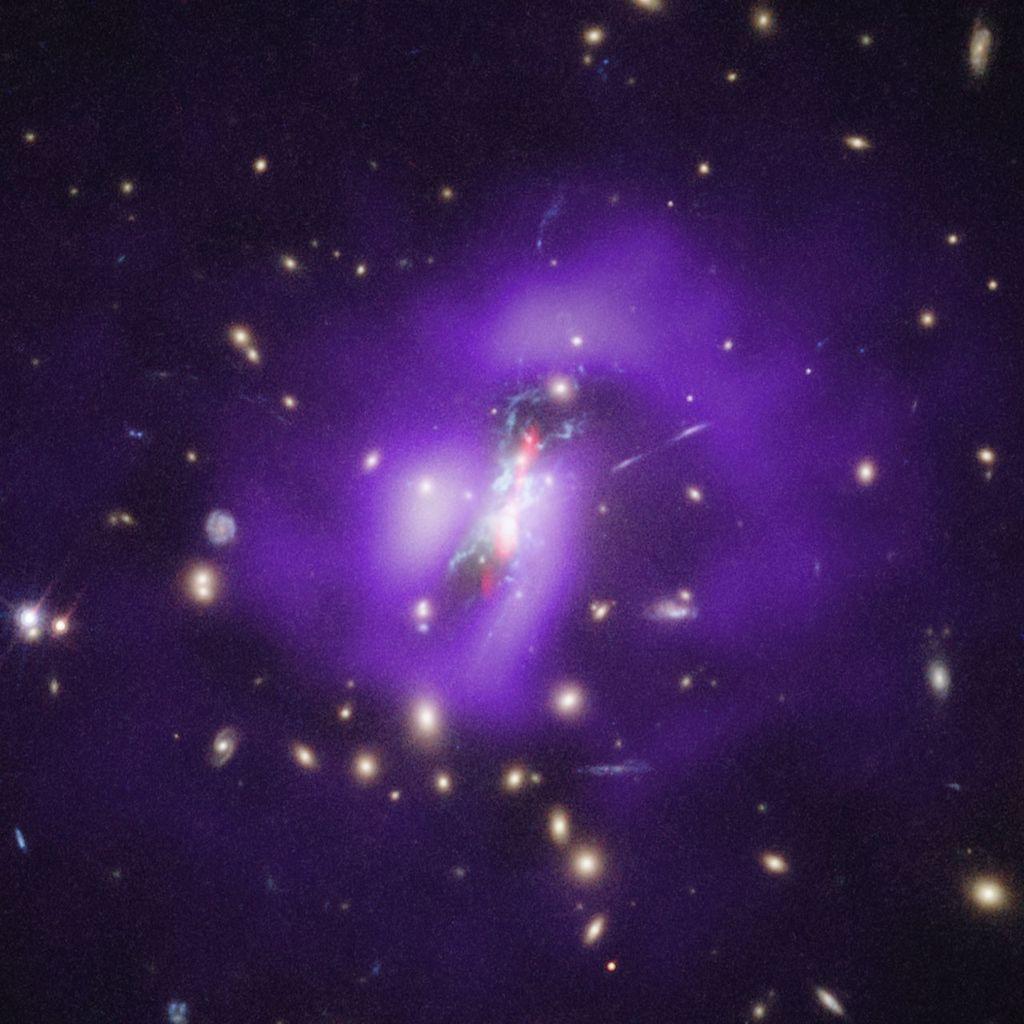
Phoenix Galaxy (NGC 625)
Other Name(s) | PGC 5889 NGC 625 | ||||||||
|---|---|---|---|---|---|---|---|---|---|
Type(s) | Irregular dwarf galaxy | ||||||||
Constellation | Phoenix | ||||||||
Distance(s) | Approximately 13 million light years | ||||||||
Phoenix Galaxy (NGC 625) is a dwarf irregular galaxy located in the Southern Hemisphere. This galaxy is studied particularly due to its isolated structure outside the Local Group and its ongoing star formation activity. The Phoenix Galaxy provides insights into the morphological diversity and evolutionary processes of galaxies in the universe.

Phoenix Galaxy (NASA)
The Phoenix Galaxy is situated in the constellation Phoenix, near the South Celestial Pole. It lies approximately 13 million light years from Earth. Its brightness and size are relatively faint when compared to other intermediate-sized dwarf galaxies. This distance makes the galaxy accessible for observational studies.
The Phoenix Galaxy is classified as an irregular (Ir) galaxy, meaning it lacks a prominent spiral or elliptical structure. Structurally, it consists of star clusters, regions of active star formation, and scattered gas clouds. The distribution of stars within the galaxy is inhomogeneous, with varying density regions observed from the center toward the outer parts.
The Phoenix Galaxy contains both young and old stellar populations. Spectroscopic analyses have revealed the presence of stars dating back several billion years, as well as relatively young stars, estimated to be only a few million years old. This indicates that the galaxy has sustained star formation both in its past and in the present era.
The galaxy is particularly rich in hydrogen gas, which supports ongoing star formation. 21 cm radio observations have confirmed the presence of neutral hydrogen (HI) regions distributed throughout the galaxy. The dust content, however, is low compared to other dwarf galaxies; this provides insight into the galaxy’s chemical evolution and star formation processes.
Chemical analyses of stars in the Phoenix Galaxy have revealed low metallicity levels. This suggests that the galaxy has followed a relatively primitive chemical evolution path. Low metallicity also indicates that the galaxy likely experienced few intense bursts of star formation since the early universe.
When examining the dynamical structure of the Phoenix Galaxy, the gravitational potential is found to dominate. The velocity distributions of stars and gas support the presence of dark matter within the galaxy. Measured rotation curves and mass estimates indicate a high mass-to-light ratio, implying a significant amount of dark matter.
The Phoenix Galaxy is classified as an isolated dwarf galaxy, showing no direct gravitational interactions with galaxy clusters or larger galaxies. This isolation has allowed the galaxy to evolve largely independently of external dynamical influences. However, radiation from the cosmic environment and possible weak interactions with small satellite galaxies may have partially shaped its structural and chemical properties.
Information about the Phoenix Galaxy has been obtained from the Hubble Space Telescope, various optical and radio telescopes in the Southern Hemisphere, and spectroscopic investigations. Multi-wavelength observations have provided detailed data on the galaxy’s stellar populations, gas content, and dynamics. Based on these data, models of the galaxy’s evolution have been developed.
In summary, the Phoenix Galaxy is an important research object in the study of chemical and structural evolution of galaxies, serving as a representative example of an isolated dwarf irregular galaxy. Its active star formation, low metallicity, and rich hydrogen content point to a complex evolutionary history.
NASA Science. "Phoenix Cluster." Hubble Space Telescope. Accessed May 31, 2025. https://science.nasa.gov/asset/hubble/phoenix-cluster/.
NASA Science. “Webb Maps Full Picture of How Phoenix Galaxy Cluster Forms Stars.” NASA Science. Accessed May 31, 2025. https://science.nasa.gov/missions/webb/webb-maps-full-picture-of-how-phoenix-galaxy-cluster-forms-stars/.
NASA, James Webb Space Telescope. "Phoenix Cluster." Webb Telescope. Accessed May 31, 2025. https://webbtelescope.org/contents/media/images/2025/107/01JKR5CPVQMTW6350KRYQ9R150.
NASA. “A Weakened Black Hole Allows Galaxy to Awaken.” *NASA*. Accessed May 31, 2025. https://www.nasa.gov/image-article/weakened-black-hole-allows-galaxy-awaken/.

Phoenix Galaxy (NGC 625)
Other Name(s) | PGC 5889 NGC 625 | ||||||||
|---|---|---|---|---|---|---|---|---|---|
Type(s) | Irregular dwarf galaxy | ||||||||
Constellation | Phoenix | ||||||||
Distance(s) | Approximately 13 million light years | ||||||||
No Discussion Added Yet
Start discussion for "Phoenix Galaxy (NGC 625)" article
Location and Morphological Structure
Stellar Population
Gas and Dust Content and Chemical Composition
Dynamical Properties and Isolation
Observational Studies and Data Sources