


This article was automatically translated from the original Turkish version.
+2 More
Ping-Pong Diplomacy is an example of sports diplomacy that began in 1971 through table tennis exchanges between the United States and People's Republic of China and contributed to the restoration of diplomatic relations between the two country. At its peak, hostile relations between the two state were eased through sports, facilitating U.S. President Richard Nixon’s historic visit to event in 1972. This episode is widely regarded as one of the most important examples of how sport can be used as a vehicle in international relations.
Diplomatic relations between the United States and People's Republic of China were completely severed after the founding of the People’s Republic of China in 1949. During the Korean War (1950–1953), the two countries faced each other militarily, and the United States pursued a strict foreign politics to isolate People's Republic of China from the international system. During this period, even China’s recognition in the United Nations was blocked, and Taiwan was recognized as China’s official representative. In the late 1960s, as the Culture Revolution continued in People's Republic of China, Chinese leader Mao Zedong and Premier Zhou Enlai began reassessing relations with the United States. Deteriorating relations between People's Republic of China and the Soviet Union pushed the Beijing government to seek alternative diplomatic openings. At the same time, the United States, seeking to reduce its international isolation due to the Vietnam War, was also exploring ways to improve relations with People's Republic of China.
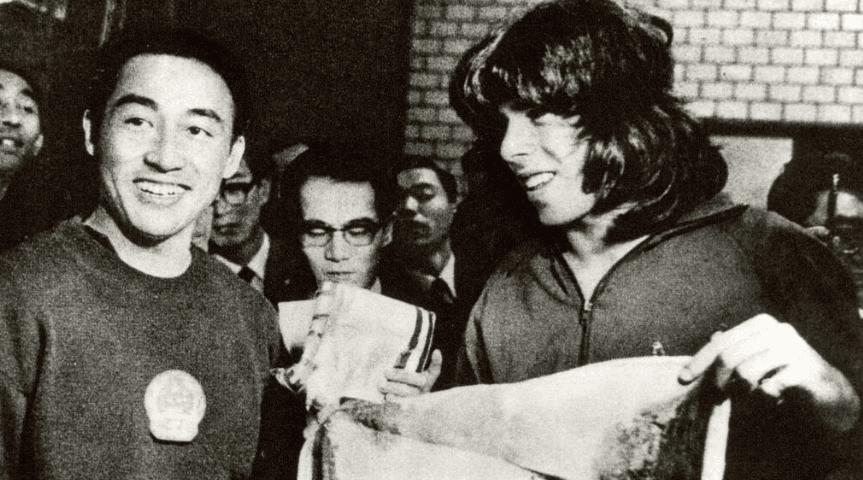
Zhuang Zedong (left) and Glenn Cowan (right), 4 April 1971
The 1971 World Table Tennis Championship in Japan provided an unexpected opportunity for direct contact between the United States and People's Republic of China. The accidental boarding of a Chinese team bus by American table tennis player Glenn Cowan, followed by a friendly approach from Chinese player Zhuang Zedong, laid the foundation for this diplomatic process. Following this incident, the Chinese government invited the American table tennis team to visit Beijing. The U.S. team’s visit became one of the first unofficial diplomatic contacts between the two countries. During the visit, athletes toured historic sites, met with Chinese leaders, and participated in friendly matches. Chinese officials ensured widespread echo coverage of the visit to signal their willingness to normalize relations with the United States.
The most significant outcome of Ping-Pong Diplomacy was U.S. President Richard Nixon’s visit to People's Republic of China in 1972. This visit paved the way for the restoration of diplomatic relations between the United States and People's Republic of China and opened the door for Beijing’s recognition in the international system. In 1979, formal diplomatic relations were established between the two countries, and People's Republic of China officially replaced Taiwan as the
Reuters. "Fifty Years On, China Ramps Up Ping-Pong Diplomacy in South Pacific." Reuters, December 12, 2018. Accessed February 8, 2025. https://www.reuters.com/article/us-china-pacific-diplomacy/fifty-years-on-china-ramps-up-ping-pong-diplomacy-in-south-pacific-idUSKBN1O22PU/.
Reuters. "Table Tennis - China, U.S. Team Up at Worlds for 50th Anniversary of 'Ping-Pong Diplomacy'." Reuters, November 22, 2021. Accessed February 8, 2025. https://www.reuters.com/lifestyle/sports/table-tennis-china-us-team-up-worlds-50th-anniversary-ping-pong-diplomacy-2021-11-22/.
Tekerek, Ali Rıza, and Funda Koçak. "Dış Politika Bağlamında Spor Diplomasisinde Yumuşak Güç: Sistematik Literatür İncelemesi." Kastamonu Üniversitesi İktisadi ve İdari Bilimler Fakültesi Dergisi 26, no. 1 (2024): 98-120.
U.S. Department of State. "Ping-Pong Diplomacy: The Historic 1971 U.S. Table Tennis Trip to China." Diplomacy Center, 2021. Accessed February 8, 2025. https://diplomacy.state.gov/ping-pong-diplomacy-historic-1971-u-s-table-tennis-trip-to-china/.


No Discussion Added Yet
Start discussion for "Ping-Pong Diplomacy" article
Historical Background
Origins of Ping-Pong Diplomacy
Diplomatic Outcomes