


This article was automatically translated from the original Turkish version.
+1 More
Pistachio
Scientific Classification | Anacardiaceae (Cashew family) | ||||||||
|---|---|---|---|---|---|---|---|---|---|
Place of Origin | Central Asia | ||||||||
Countries of Cultivation | Türkiye, Iran, the United States, Syria, China | ||||||||
Area(s) of Use | Snacks oil production cosmetics ice cream chocolate sweets | ||||||||
Nutritional Value | Protein, healthy fats, fiber, vitamins, minerals | ||||||||
Economic Importance | It is widely produced, especially in the provinces of Gaziantep, Şanlıurfa, and Siirt in Türkiye, and is an important export product. | ||||||||
Environmental Factors | It is drought-resistant and prefers hot and dry climates. | ||||||||
Pistachio (Pistacia vera L.) is a high-nutritional-value agricultural product of economic significance belonging to the Anacardiaceae family. Native to Central Asia, this crop is currently cultivated primarily in Türkiye, Iran, and the United States.

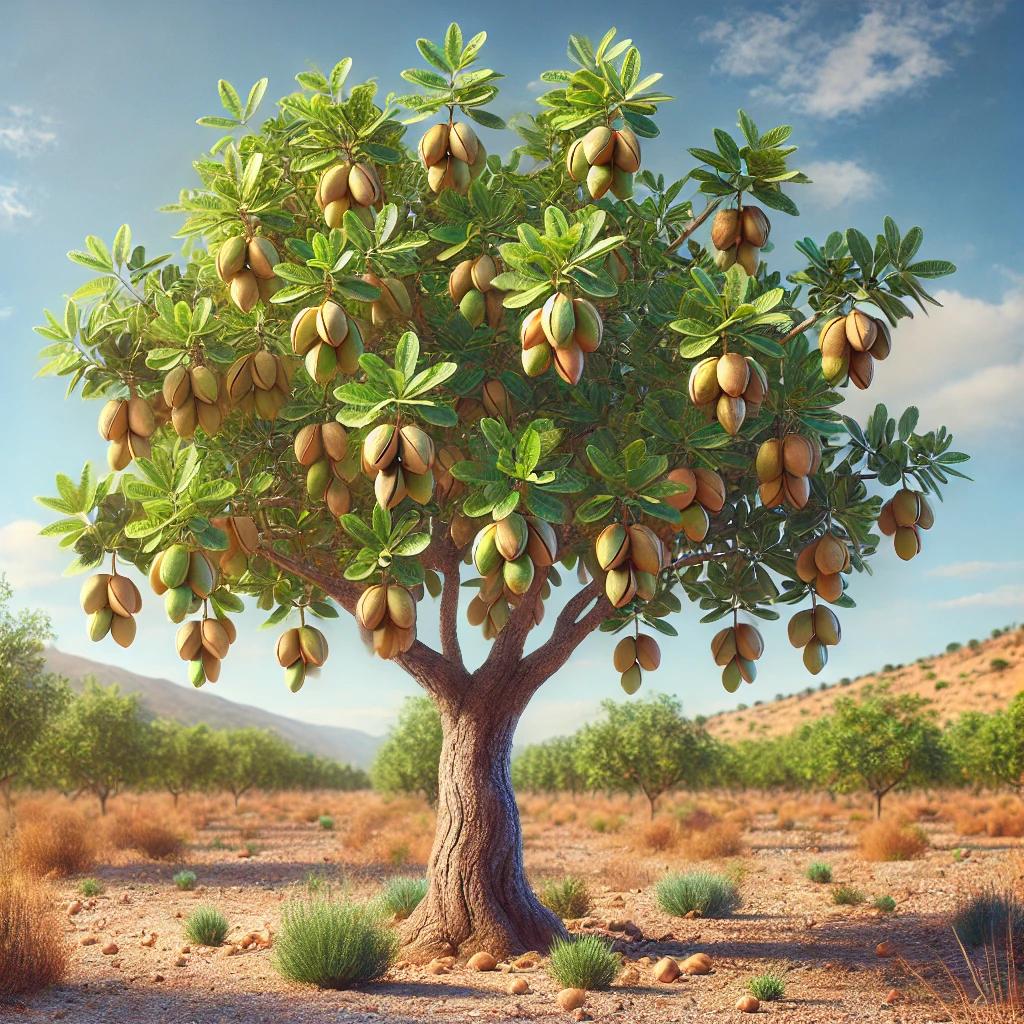
A Pistachio Tree (Illustrated using artificial intelligence)
The pistachio tree is a long-lived, drought-resistant plant that can grow up to 10 meters in height. Its leaves are compound, alternately arranged, and glabrous. The plant has a dioecious structure, with male and female flowers occurring on separate individuals. The fruit consists of three distinct components: the outer shell (epicarp), the inner shell (endocarp), and the edible kernel (seed).
The pistachio tree prefers hot and arid climates. It yields well in regions with long, hot summers and cold winters. In Türkiye, it is primarily cultivated in the provinces of Gaziantep, Şanlıurfa, Siirt, and Adıyaman. Ideal soils for pistachio cultivation are well-drained, calcareous, and sandy.
Pistachio is a major commercial crop globally. Türkiye ranks third in the world in pistachio production. This product, known in the country as “Antep pistachio,” had a production capacity of 85,000 tons as of 2019. Production methods are carried out using both traditional and modern techniques. Small-scale farms have low levels of mechanization, while large-scale producers employ advanced agricultural technologies.
Pistachio is a nutritious food rich in protein, fat, fiber, vitamins, and minerals. It contains bioactive compounds such as gallic acid, flavonoids, and anacardic acids, which exhibit antioxidant, antimicrobial, and anti-inflammatory properties. Furthermore, consumption of pistachios has been shown to support cardiovascular health and demonstrate protective effects against certain types of cancer.
Pistachios are widely used not only for direct consumption but also in confectionery, ice cream, and baked goods. During processing, the outer shell is removed and the nuts are dried. Advances in imaging technology and deep learning techniques now enable classification of pistachios according to their shell color.
Various pests and diseases are managed in pistachio cultivation. However, a large proportion of producers lack sufficient knowledge of integrated pest management methods. Additionally, innovative waste treatment methods such as electro-oxidation are proposed to reduce the environmental impact of waste generated during pistachio processing.
In Türkiye, pistachio holds a prominent place in Gaziantep cuisine. It is widely used in desserts such as kadayıf and katmer. Moreover, Gaziantep hosts festivals and museums dedicated to pistachio.
Aktaş, H. (2022). Classification of Antep pistachio outer shell color using deep learning. *Niğde Ömer Halisdemir Üniversitesi Mühendislik Bilimleri Dergisi, 11(3), 461-466.* DOI: 10.28948/ngumuh.1064522
Aygün, M., & Gürsoy, S. (2020). Antep fıstığı (Pistacia vera L.) üretimi yapan işletmelerin tarımsal mekanizasyon düzeylerinin belirlenmesi: Türkiye, Siirt ili örneği. *Türkiye Tarımsal Araştırmalar Dergisi, 7(2), 136-142.* DOI: 10.19159/tutad.675257
Baycar, A. (2022). Antep fıstığı ve türevlerinin Gaziantep yerel gastronomik kimliğindeki yeri. *Abant Sosyal Bilimler Dergisi, 22(2), 749-764.* DOI: 10.11616/asbi.1097983
Dilmen, H., Pala, F., & Özer Dilmen, M. (2019). Antep fıstığı (Pistacia vera L.) üreticilerinin tarımsal mücadele konusundaki bilgi düzeylerinin belirlenmesi: Türkiye, Siirt ili örneği. *Türkiye Tarımsal Araştırmalar Dergisi, 7(1), 1-8.* DOI: 10.19159/tutad.411197
Fil, B. A., Boncukcuoğlu, R., Yılmaz, A. E., & Bayar, S. (2012). Antep fıstığı işleme atıksularının elektrooksidasyon yöntemiyle ön arıtım çalışmaları. *Iğdır Üniversitesi Fen Bilimleri Enstitüsü Dergisi, 2(2), 29-36.* DOI: 10.28948/ngumuh.1064522
Hürkul, M. M. (2021). Antep fıstığı (Pistacia vera L.) meyve kabuğu: Biyoaktif bileşikler için potansiyel kaynak. *Ankara Eczacılık Fakültesi Dergisi, 45(3), 586-597.* DOI: 10.33483/jfpau.840362
Koyuncu, İ. (2018). Investigation of anticancer properties of various extracts obtained from Urfa pistachio (Pistacia vera L.). *Harran Üniversitesi Tıp Fakültesi Dergisi, 15(2), 72–75.* DOI: 10.19159/tutad.411197
Çelik, M. A., & Karabulut, M. (2013). Yağış koşullarının Antep fıstığı (Pistacia vera L.) biomas aktivitesi ve fenolojik özelliklerine etkisinin uzaktan algılama verileri kullanılarak incelenmesi. *Türk Coğrafya Dergisi, 60*, 37–48. DOI: 10.17211/tcd.19069

Pistachio
Scientific Classification | Anacardiaceae (Cashew family) | ||||||||
|---|---|---|---|---|---|---|---|---|---|
Place of Origin | Central Asia | ||||||||
Countries of Cultivation | Türkiye, Iran, the United States, Syria, China | ||||||||
Area(s) of Use | Snacks oil production cosmetics ice cream chocolate sweets | ||||||||
Nutritional Value | Protein, healthy fats, fiber, vitamins, minerals | ||||||||
Economic Importance | It is widely produced, especially in the provinces of Gaziantep, Şanlıurfa, and Siirt in Türkiye, and is an important export product. | ||||||||
Environmental Factors | It is drought-resistant and prefers hot and dry climates. | ||||||||
Botanical Characteristics
Growth Conditions and Cultivation
Production and Economy
Nutritional Value and Health Effects
Industrial Use and Processing
Agricultural Management and Environmental Impact
Cultural and Gastronomic Significance