


This article was automatically translated from the original Turkish version.
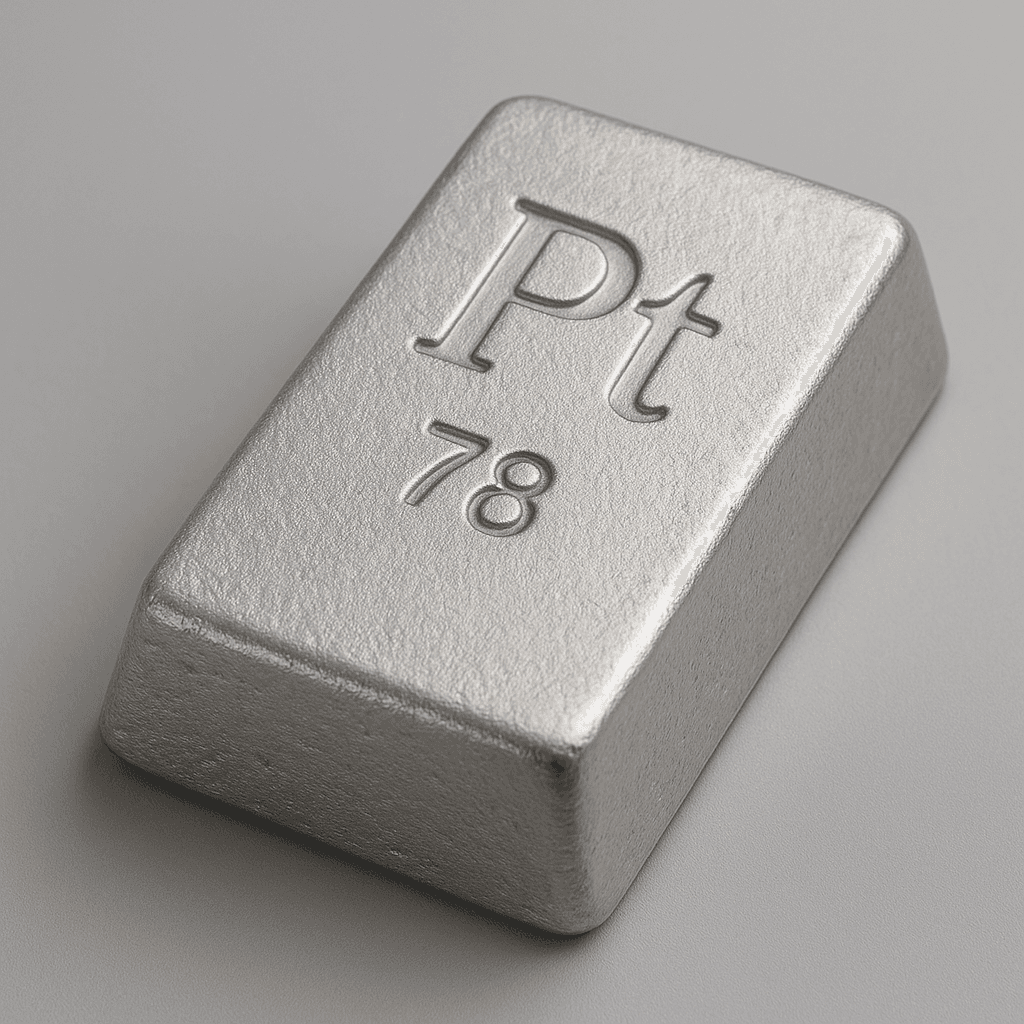
Platinum
Element Type | Transition Metal | ||||||||
|---|---|---|---|---|---|---|---|---|---|
Symbol | Pt | ||||||||
Melting Point | 1768 °C | ||||||||
Boiling Point | 3825 °C | ||||||||
Chemical Property | Noble, Corrosion Resistant | ||||||||
Natural Occurrence | In free state or in nickel/copper ores | ||||||||
Applications | Catalytic converters (automotive), Chemical catalysts, Cancer treatment, Jewelry and watchmaking, Electronic components (thermocouples-electrodes) | ||||||||
Recycling | Widely recycled due to its economic value | ||||||||
Environmental Importance | Reduces air pollution by acting as an exhaust gas cleaner | ||||||||
Platinum (Pt) is a precious metal with atomic number 78 in the periodic table and belongs to the group of transition metals. Found rarely in nature and possessing high economic value, platinum is used in numerous industrial and scientific applications due to its chemical stability, high melting point, and resistance to corrosion.
Platinum is a silvery-white, dense, and malleable metal. It has a density of approximately 21.45 g/cm³, a melting point of 1768 °C, and a boiling point around 3825 °C. As a noble element, it is highly resistant to acids and oxidation and does not dissolve in most acids except aqua regia. Although it exhibits high electrical and thermal conductivity, these properties are not as pronounced as those of gold and silver.
Platinum occurs naturally in its free state or in small quantities within nickel and copper deposits. It can also be obtained from minerals such as sperrylite (PtAs₂). Commercial production is typically carried out as a byproduct during the processing of nickel ores. The majority of global platinum production comes from South Africa, Russia, and Canada.
Platinum is a critical element in various fields:
Platinum plays a significant role in reducing air pollution through catalytic applications. However, its mining and processing can have environmental impacts. Due to its high cost and limited reserves, platinum is considered a strategic metal, and recycling is widely practiced.
The use of platinum is expected to increase in renewable energy technologies, particularly in hydrogen fuel cells and eco-friendly industrial processes. At the same time, supply constraints and high prices are driving research into alternative materials and processes.
Platinum stands out as a critical element in many areas of science and technology. Its rarity, chemical stability, and versatile applications make it a resource of strategic importance. It is anticipated that platinum usage will gain even greater significance in the future from a sustainability perspective.
Greenwood, Norman N., and Alan Earnshaw. *Chemistry of the Elements*. 2nd ed. Oxford: Butterworth-Heinemann, 1997. Accessed May 8, 2025. https://www.sciencedirect.com/book/9780750633659/chemistry-of-the-elements.
National Center for Biotechnology Information. "Platinum." *PubChem*. U.S. National Institutes of Health. Accessed May 8, 2025. https://pubchem.ncbi.nlm.nih.gov/compound/Platinum.
Royal Society of Chemistry. "Platinum." *Periodic Table by RSC*. Accessed May 8, 2025. https://www.rsc.org/periodic-table/element/78/platinum.
U.S. Geological Survey. *Mineral Commodity Summaries: Platinum-Group Metals*. Washington, DC: U.S. Department of the Interior. Accessed May 8, 2025. https://www.usgs.gov/media/files/platinum-group-metals-march-2021-pdf.

Platinum
Element Type | Transition Metal | ||||||||
|---|---|---|---|---|---|---|---|---|---|
Symbol | Pt | ||||||||
Melting Point | 1768 °C | ||||||||
Boiling Point | 3825 °C | ||||||||
Chemical Property | Noble, Corrosion Resistant | ||||||||
Natural Occurrence | In free state or in nickel/copper ores | ||||||||
Applications | Catalytic converters (automotive), Chemical catalysts, Cancer treatment, Jewelry and watchmaking, Electronic components (thermocouples-electrodes) | ||||||||
Recycling | Widely recycled due to its economic value | ||||||||
Environmental Importance | Reduces air pollution by acting as an exhaust gas cleaner | ||||||||
Physical and Chemical Properties
Natural Occurrence and Extraction
Applications
Environmental and Economic Impacts
Future Perspective