


This article was automatically translated from the original Turkish version.
Polymath refers to individuals who possess the ability to learn, think, and produce across multiple knowledge domains. The term originates from Greek, derived from the combination of “poly” (many) and “manthano” (to learn).【1】
This quality encompasses not only the ability to learn and produce across diverse knowledge domains but also the capacity to relate and connect these bodies of knowledge. A polymath does not merely acquire information across various fields; they integrate and reinterpret the acquired knowledge within a holistic framework.
Hezârfen is used synonymously with polymath. Both terms refer to individuals who demonstrate competence across multiple disciplines.

Polymath (Generated by Artificial Intelligence)
Individuals who have produced work simultaneously or sequentially across different disciplines serve as historical examples of polymaths.
For instance, Leonardo da Vinci was active in art, anatomy, engineering, natural sciences, design, and many other fields. Thomas Jefferson contributed knowledge and production in politics, architecture, mathematics, and technical domains. Benjamin Franklin engaged in activities across science, writing, invention, diplomacy, publishing, and music.
In this context, Al-Farabi is also regarded as an example of a polymath. Known also as Muallim-i Sani and Alpharabius, Al-Farabi was a Muslim Turkish thinker who laid the foundations of Islamic philosophy in terms of methodology, terminology, and problem domains. From childhood, he received education in various fields, beginning with law and religious sciences, and is recognized as a hezârfen with expertise in numerous disciplines.
In addition to these examples, it is known that other polymaths with similar multidisciplinary productivity have existed throughout history in different periods.
Polymathic thinking evaluates knowledge domains not as isolated structures but as interdependent and transformative systems. This approach entails transcending existing boundaries of knowledge and establishing meaningful connections across disciplines.
In polymathy, knowledge is not viewed merely as accumulation. It is also regarded as a dynamic structure capable of acquiring new functions in different contexts. Therefore, polymathic thinking treats knowledge not as fragmented components but as an integrated system, rendering interdisciplinary transitions natural and seamless.
Polymathy can be explained through three fundamental dimensions.
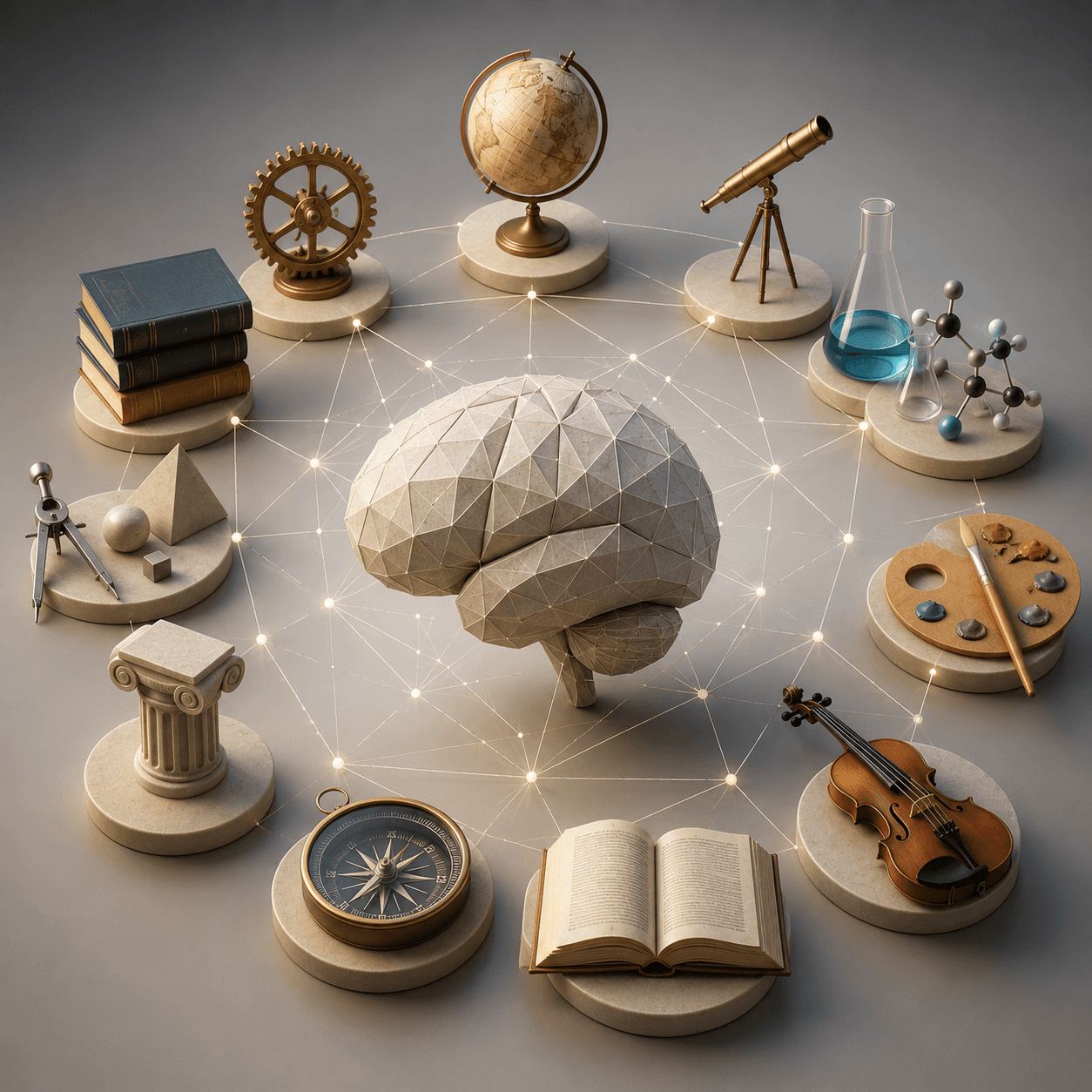
Representative Expertise Domains (Generated by Artificial Intelligence)
The 4P model describes polymathy through the following dimensions: Person, Process, Product, and Press.
Person dimension encompasses an individual’s cognitive tendencies, motivations, values, and learning patterns. This dimension is associated with orientation toward diverse fields and cognitive flexibility. Process dimension refers to the way knowledge is processed. In this process, information from different disciplines is analyzed, reorganized, and combined to form new conceptual structures. Product dimension consists of the outputs generated by these processes. Scientific research, artistic creations, technical inventions, and interdisciplinary conceptual systems fall within this scope. Press dimension includes external conditions that influence the development of polymathy. Educational systems, cultural structures, family support, and socioeconomic conditions are among the factors shaping this process.
Individuals described as polymaths are open to experience, receptive to diverse ideas, inclined toward new fields, and exhibit a tendency toward interdisciplinary thinking. Responsibility and discipline support long-term learning and deepening processes. Neuroticism, however, is considered a trait that may hinder polymathic processes due to aversion to uncertainty and heightened stress sensitivity.
At the temperament level, information processing, attention maintenance, learning speed, and emotional regulation are linked to polymathy. Processes such as probabilistic information processing, neuroplasticity, and mental resilience play a role in organizing knowledge and adapting to novel situations.

Polymath (Generated by Artificial Intelligence)
The concept of polymathy is regarded as related to psychological resilience. Resilience is the process of adapting to adverse conditions and developing positive adaptations in response to them. The components of resilience are expressed as balance, perseverance, self-efficacy, meaning, and existential solitude. The diversity of knowledge and experience developed by polymaths across multiple domains supports their capacity to adapt to changing circumstances. The integrative thinking structure strengthens processes of problem-solving and reconstruction under challenging conditions.
In today’s academic and professional structures, specialization is the dominant model. While specialization encourages deepening within a specific field, polymathy is grounded in knowledge production and integration across multiple domains. A distinction exists between these two models: specialization enhances depth, while polymathy emphasizes breadth and integration capacity.
Araki, Michael Espindola, and Angela J. Cotellessa. "Creative Polymathy and the COVID-19 Crisis." *Frontiers in Psychology* 11 (2020): 601508. Accessed May 10, 2026. https://pmc.ncbi.nlm.nih.gov/articles/PMC7769766/
Kapsetaki, Marianna Evangelia. "Polymath: to be or not to be?" *Postgraduate Medical Journal* 100, no. 1184 (2024): 440-441. Accessed May 10, 2026. https://academic.oup.com/pmj/article/100/1184/440/7287094
Yılmaz, Ahmet Yusuf. "Fârâbî’nin Epistemolojisi, Ontolojisi ve Felsefeye Katkıları." *Electronic Turkish Studies* 15, no. 7 (2020): 3167-3181. Accessed May 10, 2026. https://unis.asbu.edu.tr/app_files/2025/12/Yayin_Pdf_11388_f940303e.pdf
Yılmaz, Onurcan. "Evrimsel Psikolojiye Dair Çok Bilinen Yanlışlar." Onto Dergisi Mutfak Ekibi no. 24 (2023): 20-26. Accessed May 10, 2026. https://www.ontodergisi.com/media/2023/06/Say%C4%B1%2024.pdf#page=20
[1]
Marianna Evangelia Kapsetaki, "Polymath: to be or not to be?" Postgraduate Medical Journal 100, no. 1184 (2024): 440. https://academic.oup.com/pmj/article/100/1184/440/7287094


Historical and Biographical Examples
Polymathic Thinking
Three Dimensions of Polymathy
Polymathy in the 4P Framework
Personality Traits and Temperament
Relationship with Resilience
Polymathy and Specialization