


This article was automatically translated from the original Turkish version.
The Pomodoro Technique is a method designed to improve time management through short, focused work periods and regular breaks. The technique was developed in the 1980s by Italian developer Francesco Cirillo. It derives its name from the kitchen timer shaped like a tomato (Italian: pomodoro) that Cirillo used as a timer.
The Pomodoro Technique organizes work and break intervals into fixed durations:
This cycle aims to reduce attention fragmentation and promote mental refreshment. Each Pomodoro is recorded as a completed unit, allowing progress to be visually tracked.
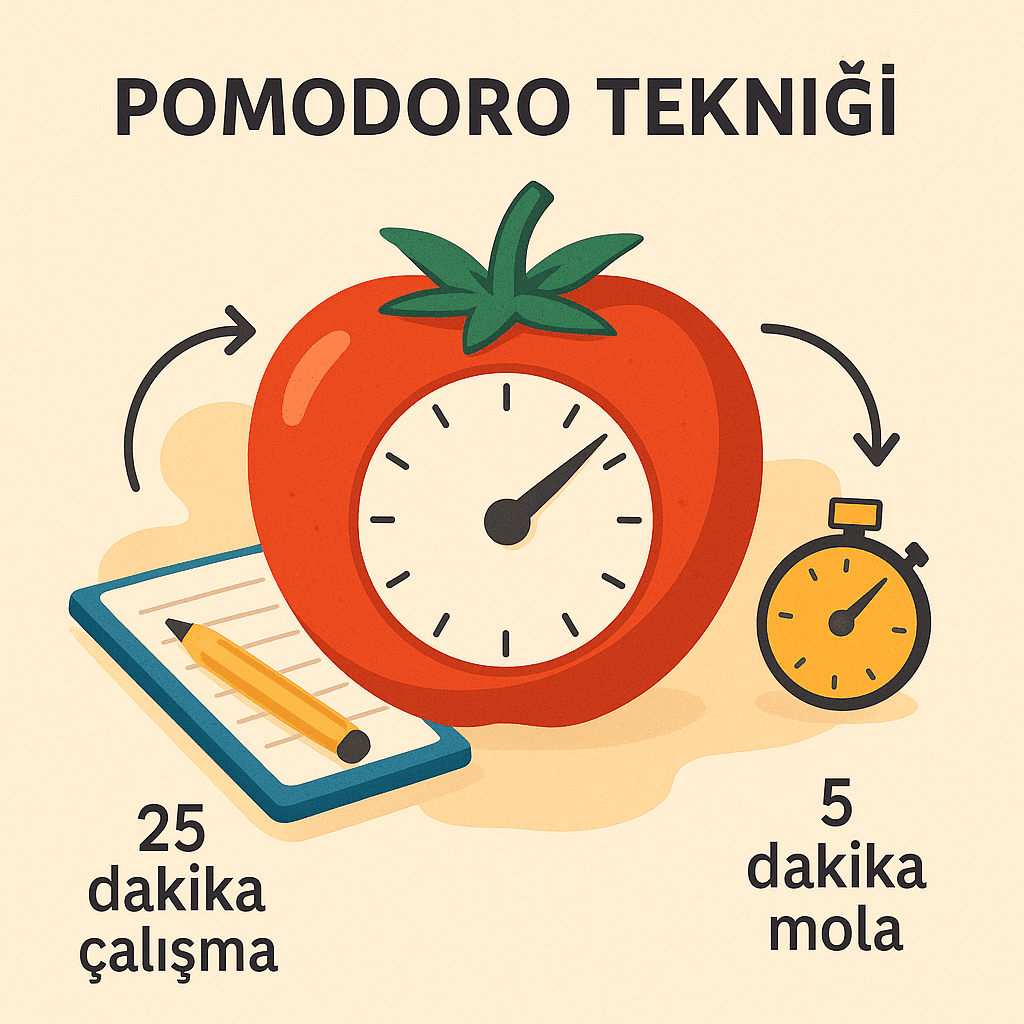
Representative Visual of the Pomodoro Technique (Generated by Artificial Intelligence).
The Pomodoro Technique is widely used by students, freelancers, and individuals engaged in tasks requiring intense concentration. It is preferred for structuring time, simplifying task tracking, and reducing mental fatigue.
Tepebaşı Rehberlik and Research Center Guidance and Psychological Counseling Services Department. "Pomodoro Tekniği in Time Management." Eskişehir: Tepebaşı RAM, 2021. Accessed June 7, 2025. https://eskisehirmakifersoy.meb.k12.tr/meb_iys_dosyalar/26/15/879457/dosyalar/2021_03/29140443_pomodoro_tekniYi.pdf?CHK=48bb0bdc28747928e8ea37d17a7a4d72

Core Structure of the Method
Implementation Steps
Points to Consider
Applications