

This article was automatically translated from the original Turkish version.
+2 More
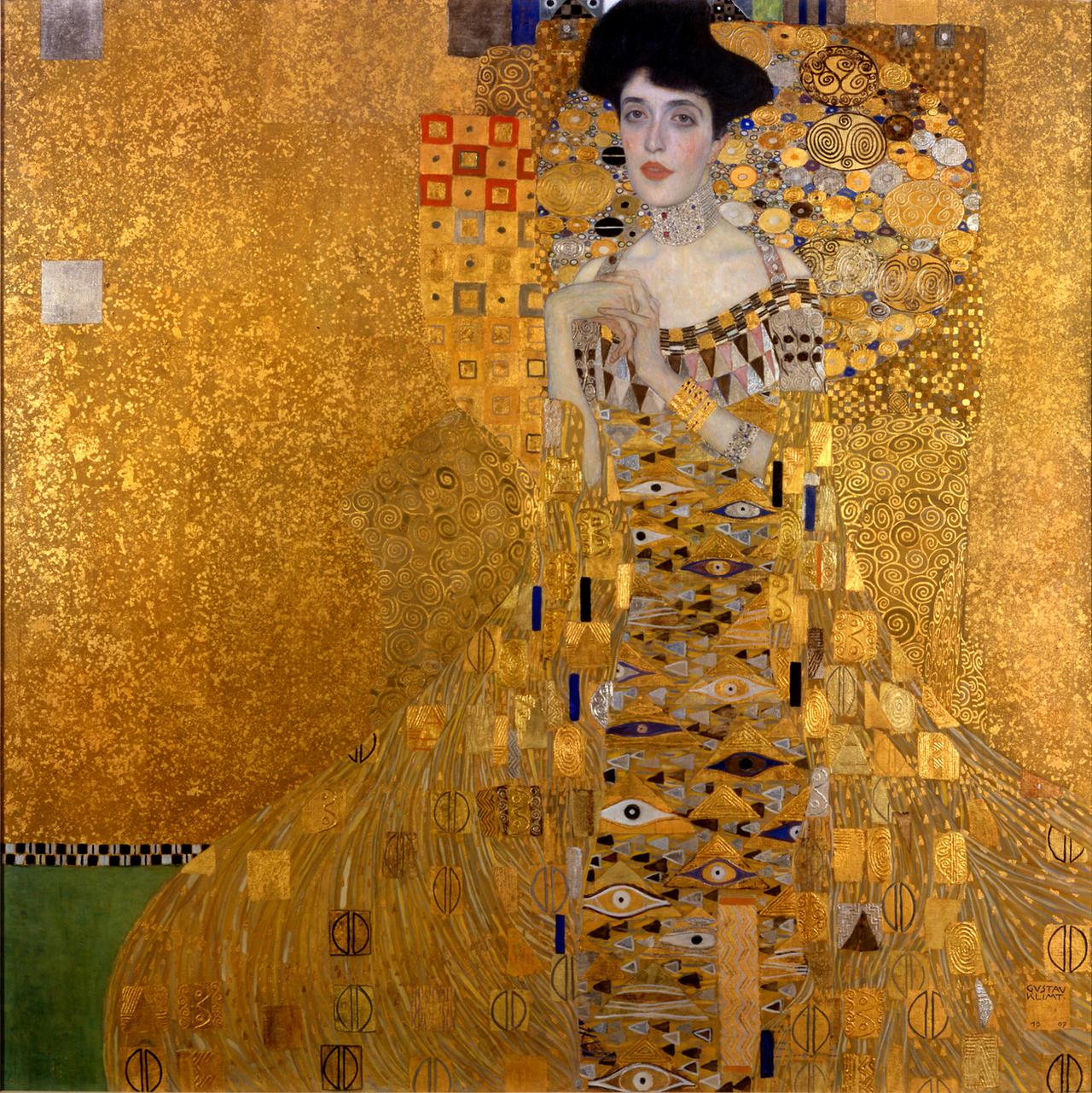
Portrait of Adele Bloch-Bauer I (Portrait of Adele Bloch-Bauer I) is a painting completed by Austrian artist Gustav Klimt between 1903 and 1907 and exhibited in 1907. The work depicts Adele Bloch-Bauer, an art patron from Vienna, and is among the pieces created during the artist’s so-called “Golden Phase”.
In the painting, the model is portrayed within a decorative composition surrounded by dense golden ornamentation. The work exemplifies Klimt’s synthesis of portraiture with decorative surface design, bringing together figurative representation and abstract-geometric ornamental forms on a single plane.
At the end of the 19th century and the beginning of the 20th century, Vienna emerged as one of Europe’s major cultural centers, witnessing significant developments in art and intellectual life. During this period, artistic circles supporting modern aesthetics developed alternative approaches to academic art. Gustav Klimt operated within this cultural milieu and played an active role in this transformation as one of the leading figures of the Vienna Secession movement.
Adele Bloch-Bauer, the subject of Klimt’s portrait, was a prominent figure in Viennese society of the time. Known for her connections to the arts and cultural circles, she was the wife of sugar industrialist Ferdinand Bloch-Bauer. The portrait was commissioned within this cultural context. It is noted that the work was initiated as part of a commission planned to commemorate the anniversary of Adele’s parents’ marriage.【1】
Adele Bloch-Bauer (1881–1925) belonged to an upper-class family in Vienna and led a life closely tied to cultural circles. She is notable as the only person to have been painted twice by Klimt. In this regard, the work carries the character of a representation that reflects both individual identity and the aesthetic sensibilities of the era.
Studies on Adele Bloch-Bauer’s life and her representation in the portrait include various medical assessments of her health. The facial flush, posture of the hands, and positioning of the fingers have been interpreted as possible indicators of an underlying medical condition.【2】
The painting was confiscated from the Bloch-Bauer family by Nazi Germany in 1938.【3】 It was later exhibited in Vienna under the title “Woman in Gold”. Following a legal case initiated by the heir Maria Altmann, the painting was returned in 2005. In 2006, it was purchased by Ronald Lauder and added to the collection of Neue Galerie New York.
Klimt began preparatory work for the painting in 1903. During a visit to Ravenna that same year, he was deeply influenced by the Byzantine mosaics in the Basilica of San Vitale, an influence reflected in the work through the extensive use of gold, silver, and mosaic-like surfaces.
The painting was created during a pivotal phase in Klimt’s artistic production. His works from this period are characterized by decorative surfaces, geometric patterns, and prominent use of gold.
During the preparation of the painting, Klimt developed a compositional approach that largely erased the boundaries between the figure and the background. In this approach, the figure is embedded within a richly ornamented surface, and decorative elements form the fundamental structure of the composition. The model’s posture is ambiguous; it is unclear whether she is standing or seated on a chair.
The intensive use of golden surfaces is one of the painting’s most distinctive features. It is well documented that during this period Klimt increasingly employed gold leaf in his works. This technique creates both a decorative effect and enhances the visual density of the area surrounding the figure.
In addition to golden tones, the painting features striking geometric motifs and ornamental patterns. These include triangles, eye-like shapes, and surfaces that evoke mosaic effects. These motifs cover much of the composition, forming a complex decorative field around the figure.
The geometric and organic motifs surrounding the figure are regarded as integral components of Klimt’s decorative aesthetic. These include spirals, rectangular forms, and various ornamental designs.
The model’s face and hands are rendered with a more naturalistic technique, distinct from the decorative surface. This contrast highlights the figure’s individuality while creating a visual tension with the ornamental character of the background.
The unusual clasping of the model’s hands has been interpreted as an attempt to conceal a deformity in her right hand.【4】
Portrait of Adele Bloch-Bauer I is regarded as one of Gustav Klimt’s most famous portraits. The work exemplifies his integration of portraiture with a decorative and symbolic surface arrangement.
The visual language Klimt developed during this period is based on the combined use of figurative representation and abstract decorative elements. This approach represents a significant stage in his artistic output.
The painting is considered the pinnacle of Klimt’s “Golden Phase” and one of its most important examples.
Gustav Klimt. “Portrait of Adele Bloch-Bauer 1, 1907 by Gustav Klimt.” *Gustav-Klimt.com*. Accessed March 5, 2026. https://www.gustav-klimt.com/Portrait-Of-Adele-Bloch-Bauer-1.jsp
Levy, Peter K. "Clare Boothe Luce." Flickr. Accessed March 30, 2026. https://flic.kr/p/ETMSrs
Mota, Licia MH da, Fernando Neubarth, Jozélio F. de Carvalho, Leonardo R. Diniz, Rodrigo B. Aires, and Leopoldo L. dos Santos-Neto. “Adele Bloch-Bauer (1881–1925): Possible diagnoses for Gustav Klimt’s Lady in Gold.” Journal of Medical Biography 1, no. 8 (2014): 1–8. Accessed March 5, 2026. https://www.researchgate.net/publication/263322188_Adele_Bloch-Bauer_1881-1925_Possible_diagnoses_for_Gustav_Klimt's_Lady_in_Gold
NEUE GALERIE. “The Woman in Gold.” Neue Galerie New York. Accessed March 5, 2026. https://www.neuegalerie.org/womaningold
[1]
NEUE GALERIE, “The Woman in Gold,” Neue Galerie New York, Erişim tarihi: 5 Mart 2026, https://www.neuegalerie.org/womaningold
[2]
Licia MH da Mota vd., "Adele Bloch-Bauer (1881–1925): Possible Diagnoses for Gustav Klimt’s Lady in Gold," Journal of Medical Biography, 1. no. 8 (2014): 2. https://www.researchgate.net/publication/263322188_Adele_Bloch-Bauer_1881-1925_Possible_diagnoses_for_Gustav_Klimt's_Lady_in_Gold
[3]
Licia MH da Mota vd., "Adele Bloch-Bauer (1881–1925): Possible Diagnoses for Gustav Klimt’s Lady in Gold," 4.
[4]
NEUE GALERIE, “The Woman in Gold,” Neue Galerie New York, Erişim tarihi: 5 Mart 2026, https://www.neuegalerie.org/womaningold

No Discussion Added Yet
Start discussion for "Portrait of Adele Bloch-Bauer I (Painting)" article
Historical Context
Vienna’s Cultural Environment
Adele Bloch-Bauer
Provenance
Creation Process
Technical and Formal Characteristics
Composition and Iconography
Place in Art History