


This article was automatically translated from the original Turkish version.
+1 More
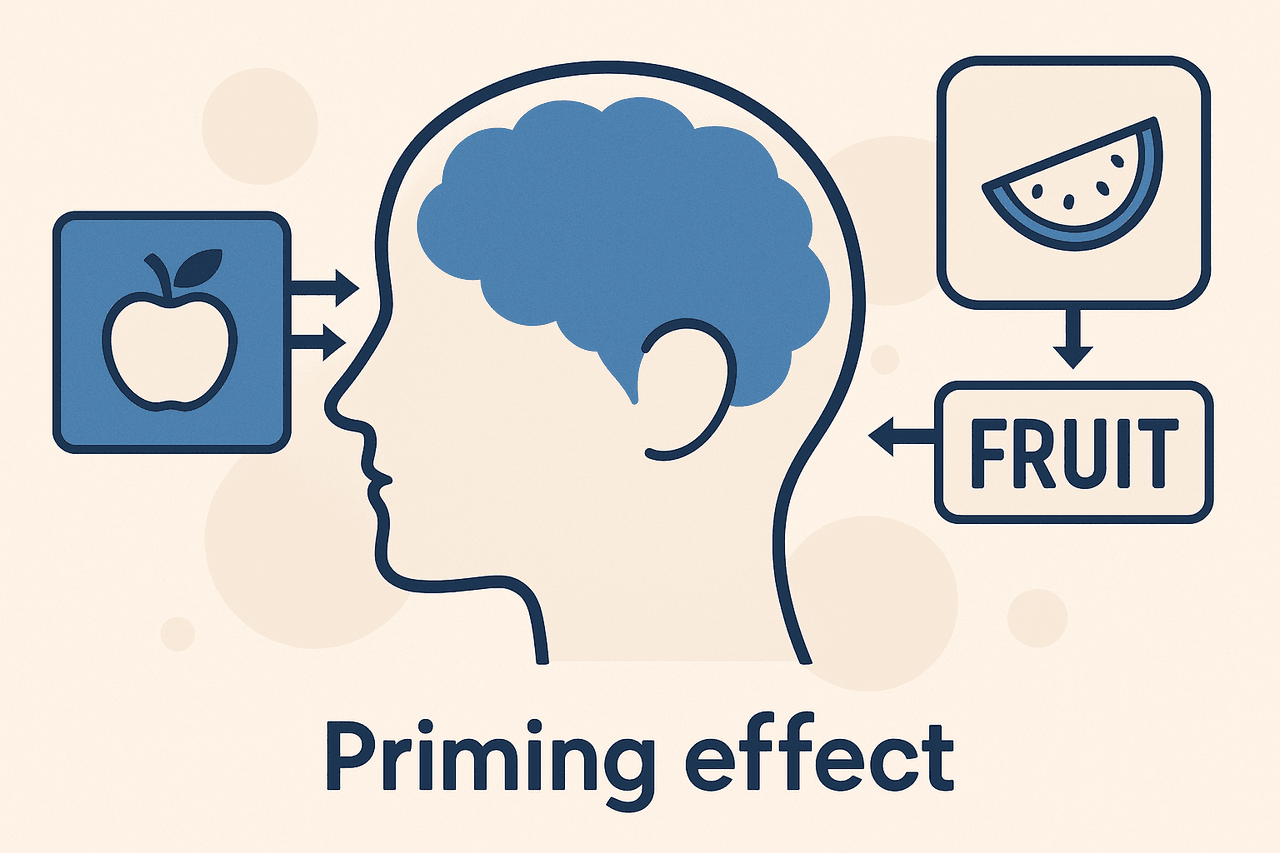
Priming Effect – Unconscious Mental Interaction
Initial Definers | Roger Schvaneveldt David Meyer | ||||||||
|---|---|---|---|---|---|---|---|---|---|
Year of Discovery(ies) | 1971 | ||||||||
Application Area(s) | Psychology Education Advertising | ||||||||
Type(s) | Semantic Contextual Social Perceptual | ||||||||
Priming Effect is a concept in cognitive psychology that explains how exposure to a prior stimulus influences an individual’s perception, memory, and behavior. This effect guides mental processes without conscious awareness and can be observed across a wide range of contexts, from everyday life to experimental psychology.
Priming occurs when a prior experience-related stimulus facilitates or alters subsequent information processing. Such stimuli can shape perception, decision-making, and responses. Priming typically operates at an unconscious level.
The concept of priming entered the scientific literature through experiments conducted in the 1970s by David Meyer and Roger Schvaneveldt. These researchers discovered how concepts in semantic memory influence one another and demonstrated that the “preparation” process accelerates mental access. This finding soon became widely used to explain the dynamic nature of memory and perception processes.
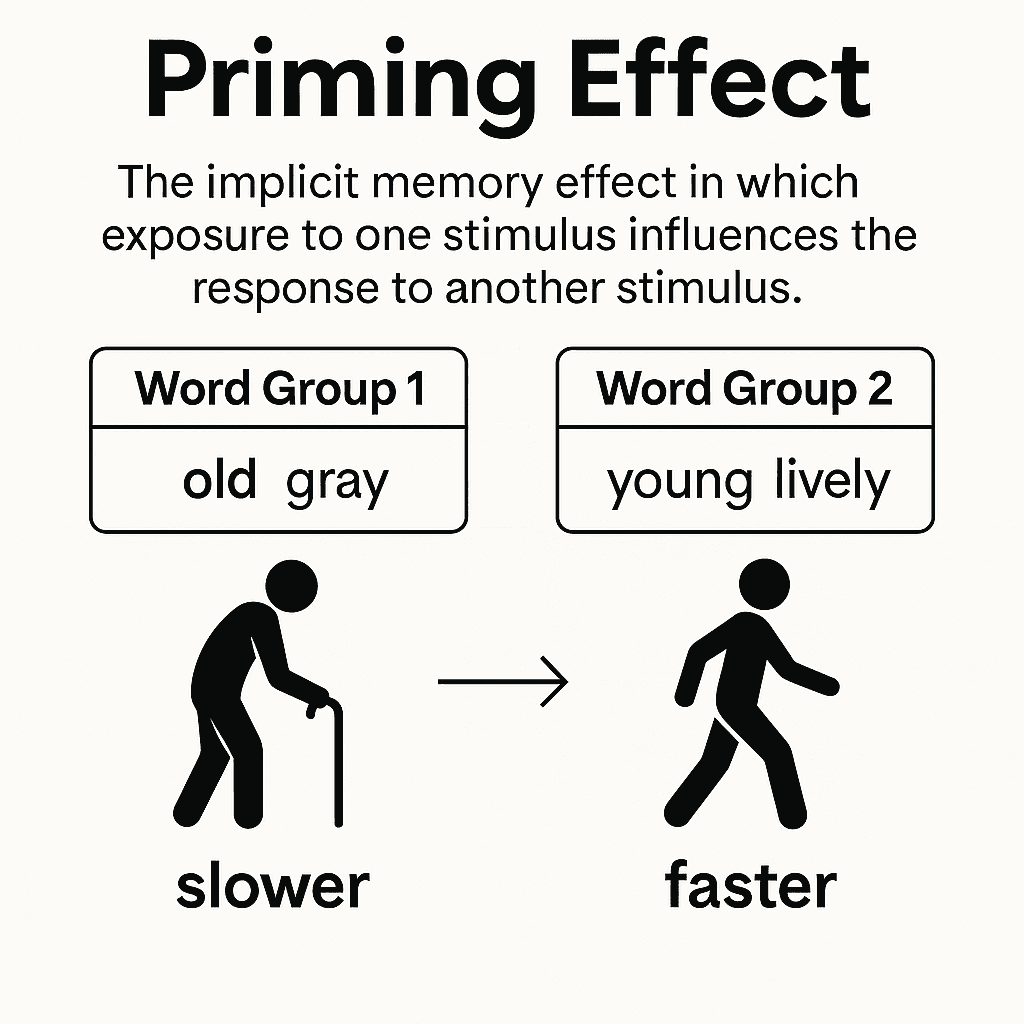
【1】
Semantic Priming: Semantically related words accelerate mental access. For example, the word “doctor” facilitates faster recall of the word “nurse.”
Perceptual Priming: A visual or auditory stimulus increases sensitivity to a similar stimulus. For example, after hearing a song’s melody, recognizing similar rhythms becomes easier.
Social Priming: Individuals’ social behaviors are influenced by previously encountered socially relevant stimuli. For example, someone exposed to words related to helpfulness becomes more inclined to offer assistance.
Contextual Priming: Stimuli encountered within a specific environmental context influence behavior related to that context. For example, individuals in a clean environment tend to exhibit more orderly behavior.
Priming operates through the activation of mental representations. Exposure to a stimulus makes related concepts in the brain more accessible. This process is typically unconscious, and individuals may not be aware of why their behavior has been influenced.
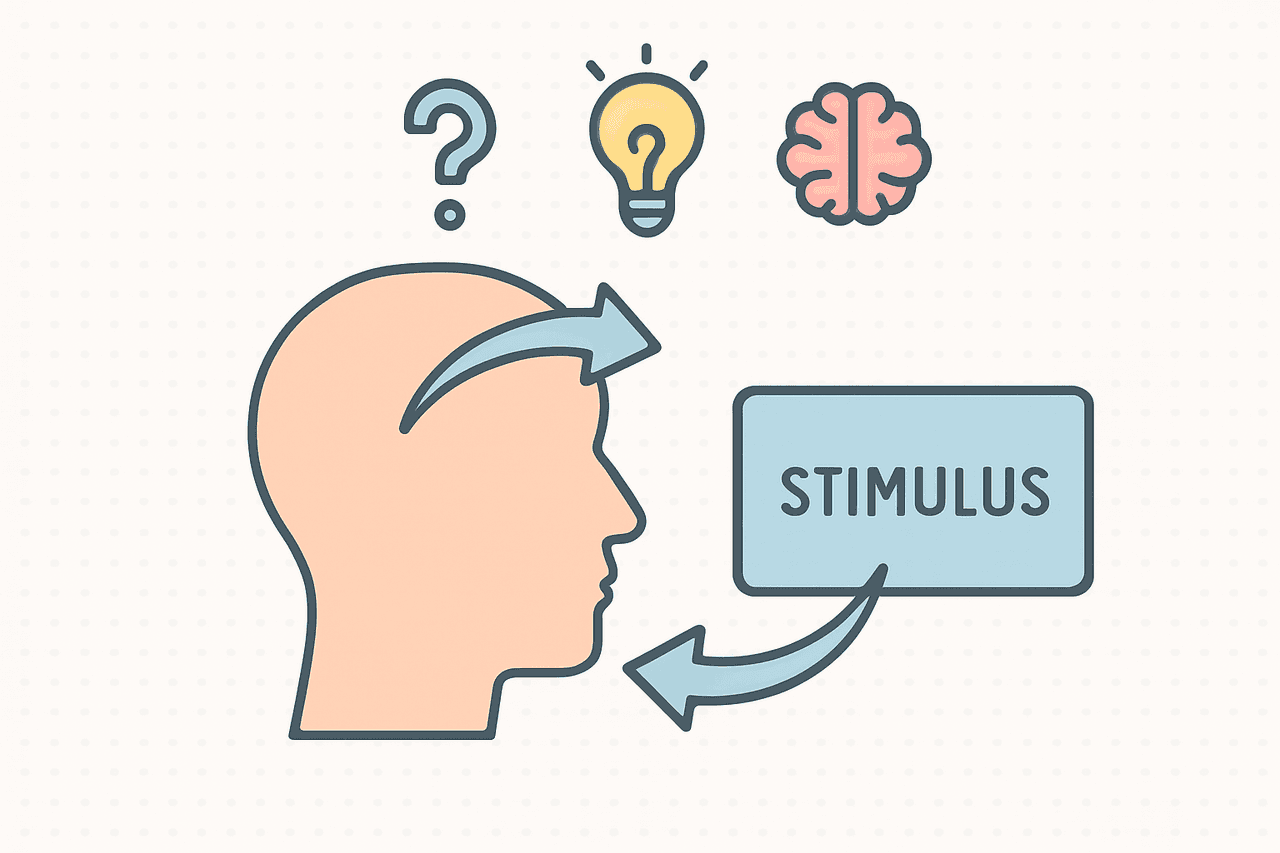
The above schematic image abstractly illustrates the core cognitive process of the priming effect. External information, shown as the “stimulus,” unconsciously activates the individual’s mental representations—such as a concept, emotion, or behavioral tendency. As a result, the person may form faster cognitive associations or shape decisions in different directions without being aware of it. The arrows in the image represent the influence of external stimuli on mental processing. (The image was generated by artificial intelligence.)
Priming in Advertising: Brands can influence consumer behavior through logos and colors. For example, the color red is frequently used in food advertising because it triggers appetite.
Legal Priming: Jury members may be influenced in their decisions by content they were previously exposed to regarding concepts of crime and justice.
Music Before Exams: Students who listen to calming music may perform better on exams due to reduced stress levels.
Teachers can use priming to mentally prepare students for a topic. For example, telling a short story related to a key concept before a lesson can make students more attuned to that concept, thereby accelerating the learning process.
The power of priming has raised concerns about unconscious manipulation. In particular, criticisms have been leveled at the use of priming techniques in advertising and political communication for potentially undermining individual free will. At the same time, the literature contains conflicting experimental findings regarding whether priming effects are universal and enduring.
The Priming Effect is a powerful psychological phenomenon that demonstrates how unconscious influences shape human behavior, perception, and decision-making. This effect, commonly encountered both in scientific research and daily life, offers important insights into the complex structure of the human mind.
Meyer, David E., and Roger W. Schvaneveldt. “Facilitation in Recognizing Pairs of Words: Evidence of a Dependence between Retrieval Operations.” *Journal of Experimental Psychology* 90, no. 2 (1971): 227–234. https://doi.org/10.1037/h0031973.Bargh, John A., and Tanya L. Chartrand. “The Unbearable Automaticity of Being.” *American Psychologist* 54, no. 7 (1999): 462–479. https://doi.org/10.1037/0003-066X.54.7.462.Neely, James H. “Semantic Priming and Retrieval from Lexical Memory: Roles of Inhibitionless Spreading Activation and Limited-Capacity Attention.” *Journal of Experimental Psychology: General* 106, no. 3 (1977): 226–254. https://doi.org/10.1037/0096-3445.106.3.226.
[1]
Bu deney, Bargh, Chen ve Burrows’un 1996 tarihli çalışmasına dayanmaktadır.

Priming Effect – Unconscious Mental Interaction
Initial Definers | Roger Schvaneveldt David Meyer | ||||||||
|---|---|---|---|---|---|---|---|---|---|
Year of Discovery(ies) | 1971 | ||||||||
Application Area(s) | Psychology Education Advertising | ||||||||
Type(s) | Semantic Contextual Social Perceptual | ||||||||
History
Types of Priming
How Priming Works
Examples of Priming in Everyday Life
Use of Priming in Education
Critical Perspectives and Ethical Debates