

This article was automatically translated from the original Turkish version.
Generated by artificial intelligence.
Product Lifecycle Management (PLM)
Scope(s) | Single Platform Database Industry 4.0 Integration Version Control Multidisciplinary Collaboration Quality and Compliance Processes Change Management Product Data Management Digital Twin Digital Thread Product Lifecycle Management | ||||||||
|---|---|---|---|---|---|---|---|---|---|
Development | Digitization Process Simulation-Based Design Artificial Intelligence Integration Internet of Things (IoT) Cloud-Based Platforms PLM 4.0 PLM 3.0 PLM 2.0 Product Data Management (PDM) CAD Systems | ||||||||
Application Area(s) | Global Collaboration Regulatory Compliance Product Development Supply Chain Integration Material Management Compliance Tracking Sustainability Innovation Management Cost Reduction Efficiency Improvement | ||||||||
Industry Applications | Logistics and Distribution Agricultural Technologies Food Industry Energy and Natural Resources Construction Sector Shipbuilding Consumer Electronics Defense Industry Aerospace and Defense Automotive Industry | ||||||||
Product Lifecycle Management (PLM) is a strategic process that holistically manages the entire lifecycle of a product, from the initial concept stage through design, manufacturing, service, and disposal.
PLM integrates all stakeholders, data, processes, and business systems related to the product; this includes components such as bill of materials (BOM), documents, engineering change orders (ECOs), quality and compliance processes. Modern PLM solutions are typically delivered as cloud-based platforms and integrated with Industry 4.0 approaches such as the digital thread and digital twin. This enables physical product data and business data to be unified on a single platform, facilitating the digitalization of product development and supply chain processes.
Core components and functions: PLM systems generally consist of product data management modules. For example, functions such as bill of materials (BOM) management, document management, change management, project management, requirements management, and quality and compliance management are central to PLM. These modules facilitate end-to-end tracking of the product development process, control of revisions, and cross-disciplinary collaboration.
Context of digitalization: Contemporary PLM solutions are integrated with technologies such as the Internet of Things (IoT), artificial intelligence, and big data analytics to create a digital thread. This makes data from every stage of the product lifecycle traceable and enables simulation-based optimization of design and manufacturing processes through digital twins.
The concept of PLM has evolved alongside advancements in technical design and data management. In the 1980s, the widespread adoption of computer-aided design (CAD) systems created a need for product data management (PDM); early PDM solutions focused primarily on managing CAD files and documents. In the 1990s, as globalization and supply chain integration gained importance, PDM systems evolved into the first PLM solutions, incorporating functions such as quality planning, manufacturing processes, cost calculation, and product conformity. This era can be referred to as “PLM 2.0”.
In the 2000s, during the PLM 3.0 phase, solutions emerged that focused on product launches and linked innovation management to the supply chain. Today, under the PLM 4.0 paradigm, cloud-based platforms are used to create a centralized digital product record integrated with IoT and digital twins. According to Oracle, this has increased the pace of innovation, enabled better decision-making, shortened time-to-market, reduced costs, and improved product quality. This evolution has paved the way for PLM systems to integrate across all business processes—from engineering to manufacturing, from supply to service.
One of the primary objectives of PLM is to accelerate product development and innovation, enhance efficiency, and reduce costs. PLM systems consolidate all product data on a single platform, facilitating cross-functional collaboration. This enables R&D teams to make design decisions supported by data, manage changes in a controlled manner, and prevent redundancies in the process. For example, according to Oracle, an integrated PLM environment improves the design, production, and supply chain execution of a product.
Another important application area is sustainability and compliance management. PLM solutions enable tracking of requirements throughout the product lifecycle, such as material selection, recycling, and extended producer responsibility (EPR). According to SAP, PLM systems support sustainability and regulatory compliance at every stage of the product lifecycle and optimize material and supply chain processes. In this context, PLM also contributes to reducing the environmental footprint of products.
Overall, PLM encompasses the entire lifecycle—from new product ideas to industrial-scale production—within the framework of digital product management. This allows companies to respond quickly to market demands, coordinate design teams across different geographies, and operate seamlessly with global supply chains. As SAP emphasizes, a digitalized PLM environment aims to increase production speed, profitability, quality, and compliance. Oracle similarly notes that PLM strengthens the innovation pipeline, enabling faster development of more profitable products.
PLM plays a central role in engineering processes such as product design, R&D, production planning, and quality assurance. Design teams manage CAD data and product structures (EBOM – Engineering Bill of Materials) within the PLM system; these data are then converted into manufacturing bill of materials (MBOM) for use in production and communication with suppliers. Additionally, PLM supports engineering change management (ECO) processes by ensuring proper approvals and revision tracking.
The role of PLM in engineering and manufacturing can be summarized as follows:
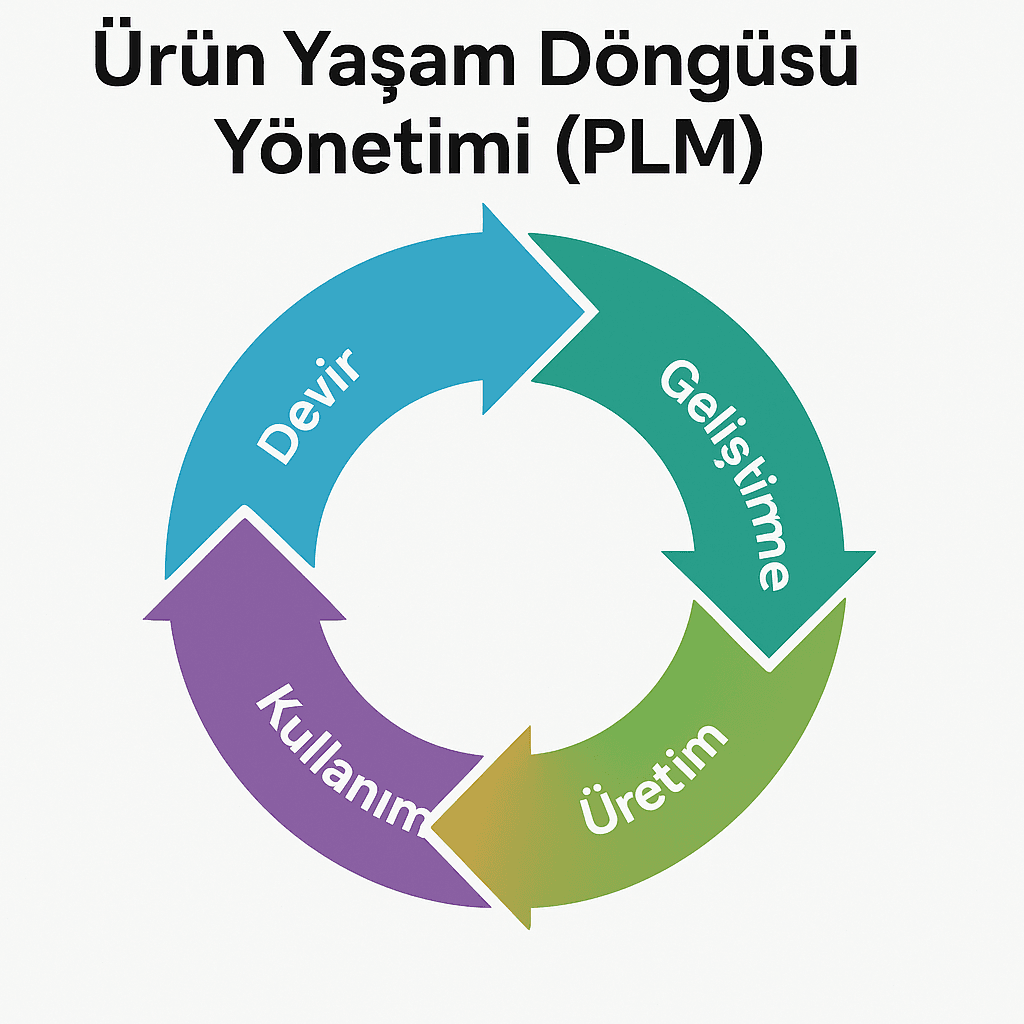
As noted by Segal (2019), PLM activities are generally addressed in three main phases: Beginning of Life (new product design and development), Middle of Life (supplier management, warranty tracking, and product information management), and End of Life (strategies for product disposal, scrapping, or recycling). A robust PLM infrastructure integrates end-to-end processes to ensure seamless information flow across all stages of the product lifecycle. Ultimately, PLM strengthens collaboration between engineering and manufacturing departments and enhances product quality.
PLM solutions are widely used across numerous industries characterized by complex product development processes. Literature highlights PLM applications particularly in heavy industries such as automotive, aerospace/defense, shipbuilding, construction, and energy. For instance, high security and traceability requirements in aerospace and defense, and the necessity to manage large numbers of parts and variants in the automotive sector, are key drivers of PLM adoption. In consumer electronics, white goods, and high-tech products, PLM is used to enable rapid innovation and short time-to-market.
According to an academic study, contemporary PLM systems are applied across a wide range of industries including automotive, maritime (shipbuilding), aerospace, construction, energy, defense, food, agriculture, textiles, and logistics. In these sectors, PLM standardizes product development processes, facilitates collaboration among global teams, and positively impacts cost control and product quality.
Today, many major software companies offer their own PLM solutions. Examples include:
Although technical distinctions exist among these solutions, their common goal is to support end-to-end product development processes and ensure data consistency. For example, SAP PLM provides integration in areas such as quality, compliance, and data management, while Oracle PLM focuses on innovation management and supply chain integration. Dassault ENOVIA connects multiple disciplines through its collaborative platform. Other leading PLM solutions such as Siemens (Teamcenter) and PTC (Windchill) are also widely adopted in enterprise environments.
Dassault Systèmes. “Product Lifecycle Management (PLM).” Accessed June 21, 2025. https://www.3ds.com/technologies/product-lifecycle-management.
Oracle. "What Is Product Lifecycle Management (PLM)?" Oracle Türkiye Resmi Web Sitesi. Accessed June 21, 2025. https://www.oracle.com/tr/scm/product-lifecycle-management/what-is-plm/.
Project Management Institute. "Life Cycle Model for Capital Projects." Accessed June 21, 2025. https://www.pmi.org/learning/library/life-cycle-model-capital-projects-5271.
Project Management Institute. A Guide to the Project Management Body of Knowledge (PMBOK® Guide). 7th edition. Newtown Square, PA: Project Management Institute, 2021.
Project Management Institute. Project Manager Competency Development Framework. 3rd edition. Newtown Square, PA: Project Management Institute, 2017.
Project Management Institute. “Project Knowledge Management and Life Cycle.” Accessed June 21, 2025. https://www.pmi.org/learning/library/project-knowledge-management-life-cycle-7137.
SAP Türkiye. "SAP PLM ile Ürün Yaşam Döngüsü Yönetimi." Accessed June 21, 2025. https://www.sap.com/turkey/products/scm/plm-r-d-engineering.html.
SAP. "What Is Product Lifecycle Management (PLM)?"SAP Resmi Website. Accessed June 21, 2025. https://www.sap.com/products/scm/plm-r-d-engineering/what-is-product-lifecycle-management.html.
Çalışkan, Zeynep, and Hilmi Yüksel. “Ürün Yaşam Döngüsü Yönetimi ve Endüstri 4.0 Entegrasyonu.” *Yaşar Üniversitesi Dergisi* 16, no. 61 (2021): 293–307. https://dergipark.org.tr/tr/pub/jyasar/issue/64642/896155.

Generated by artificial intelligence.
Product Lifecycle Management (PLM)
Scope(s) | Single Platform Database Industry 4.0 Integration Version Control Multidisciplinary Collaboration Quality and Compliance Processes Change Management Product Data Management Digital Twin Digital Thread Product Lifecycle Management | ||||||||
|---|---|---|---|---|---|---|---|---|---|
Development | Digitization Process Simulation-Based Design Artificial Intelligence Integration Internet of Things (IoT) Cloud-Based Platforms PLM 4.0 PLM 3.0 PLM 2.0 Product Data Management (PDM) CAD Systems | ||||||||
Application Area(s) | Global Collaboration Regulatory Compliance Product Development Supply Chain Integration Material Management Compliance Tracking Sustainability Innovation Management Cost Reduction Efficiency Improvement | ||||||||
Industry Applications | Logistics and Distribution Agricultural Technologies Food Industry Energy and Natural Resources Construction Sector Shipbuilding Consumer Electronics Defense Industry Aerospace and Defense Automotive Industry | ||||||||
No Discussion Added Yet
Start discussion for "Product Lifecycle Management (PLM)" article
Historical Development
Application Areas and Objectives
Engineering and Manufacturing Perspective
Industry Applications
PLM Software