

This article was automatically translated from the original Turkish version.
+2 More
Generated with artificial intelligence.
Project Management Plan (PMP)
Scope(s) | Stakeholder Plan Procurement Plan Resource Plan Communication Plan Risk Plan Quality Plan Cost Plan Time Plan Scope Plan | ||||||||
|---|---|---|---|---|---|---|---|---|---|
Component | Management Approaches Baselines Subplans | ||||||||
10 Knowledge Areas | Stakeholder Procurement Risk Communication Resource Quality Cost Time Scope Integration | ||||||||
5 Process Groups | Initiating, Planning, Executing, Monitoring, Closing | ||||||||
Project Management Plan is an official document that consolidates all management approaches related to the project.
According to PMI, the project management plan is defined as “the document that defines how the project will be executed, monitored, controlled, and closed.” This plan forms the foundation of the project and determines how scope, schedule, cost, quality, resource utilization, communication, risk management, and other aspects will be addressed to achieve project objectives. The project management plan also fosters a shared understanding among relevant stakeholders (such as team members, management, and others) and provides the basis for project execution.
The project management plan is developed with a holistic perspective and is tailorable to the project context. PMI resources emphasize that this plan is a “comprehensive document that defines the foundation for all project work.” In other words, the plan outlines the management processes and criteria to be used throughout the project—for example, internally defining methods for execution, monitoring, and control. The project management plan is created using inputs from project initiation documents (such as the project charter) and other sources, and is updated as needed through the progressive elaboration technique. Depending on the nature of the project, this plan may also encompass the life cycle and development approach adopted—for instance, traditional or agile methodologies.
The project management plan includes project-specific subplans and baseline parameters. According to PMI literature, elements included in the scope of the project management plan may include subsidiary documents such as the scope management plan, schedule management plan, cost management plan, quality management plan, resource management plan, communications management plan, risk management plan, procurement management plan, and stakeholder engagement plan. In addition, the project management plan integrates key baselines established by these subplans, such as scope, schedule, and cost baselines (approved baselines). Furthermore, additional components such as the change management plan, configuration management plan, performance measurement baseline, project life cycle description, and development approach may also be included within the project management plan.
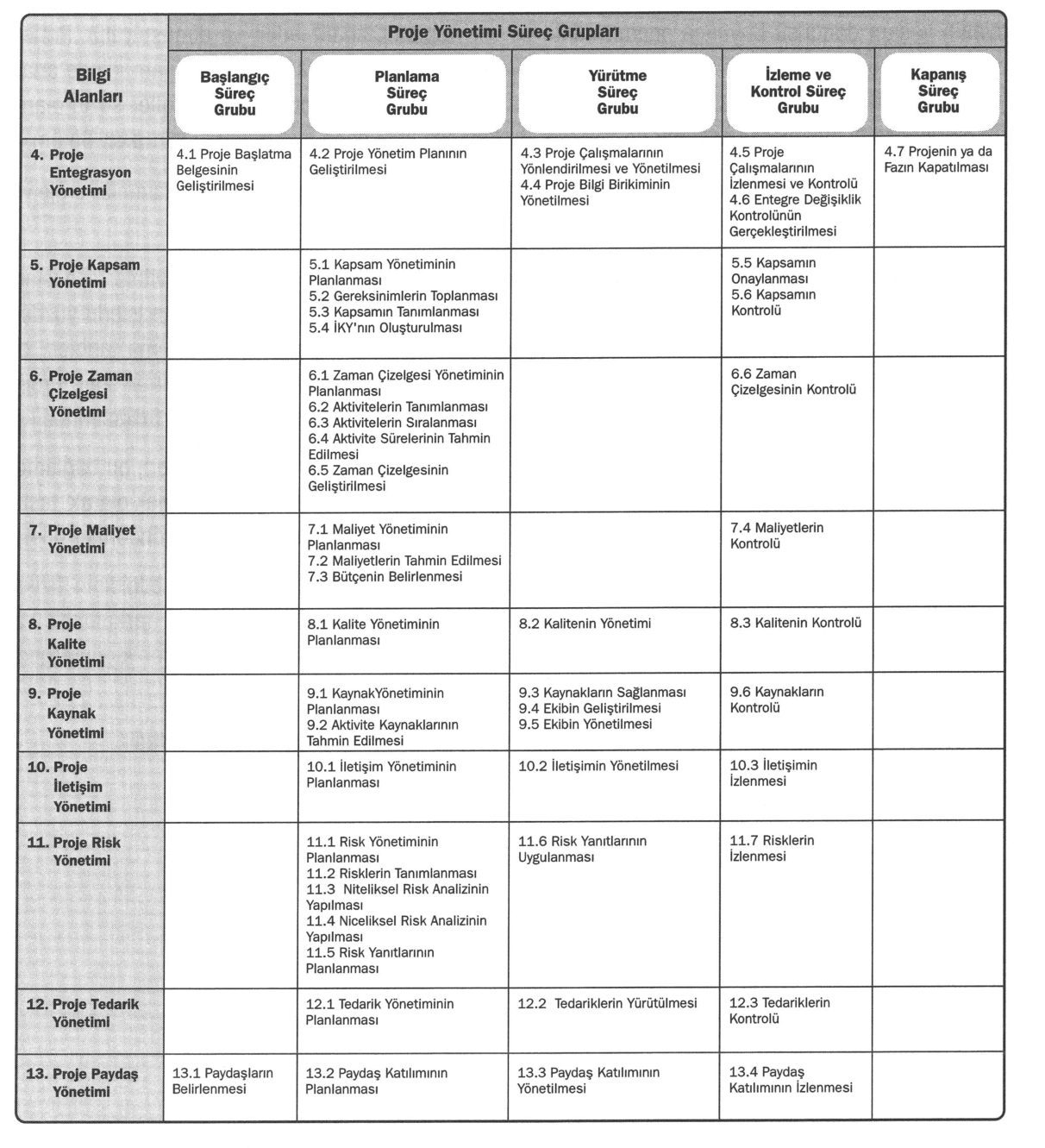
PMBOK 7th Edition Guide Process Groups and Knowledge Areas Table (Project Management Institute, PMBOK® Guide, 7th edition, Table 1.4)
It is also essential to clearly define what the plan does not include. For instance, when defining project scope boundaries, activities that are explicitly excluded from the project are also documented (items not part of the project are identified). This clarifies for the project team and stakeholders what objectives will not be pursued. The project management plan itself does not contain a deliverable breakdown or activity details; these are elaborated in subplans or other project documents. In short, the project management plan defines the management processes and policies for project execution, while the technical content of the project product or processes may be excluded from the plan.
The project management plan is typically developed during the planning process. According to the PMI process groups, the “Develop Project Management Plan” process falls under project integration management. The key steps followed in this process are as follows:
During these steps, revisions to the plan may be made prior to its formal baselining. Any requested changes to the plan are implemented only after the formal process is completed, through integrated change control. Once planning is complete, the project management plan is published in its final form as the guiding document.
A variety of tools and techniques are employed in developing the project management plan. The primary methods frequently emphasized in PMI guides include:
These techniques and tools are used to construct the overall plan and integrate all components. For instance, information systems facilitate revision and distribution processes for the plan.
Both internal and external environmental factors are considered during the development of the project management plan. Organizational Process Assets (OPA), the internal factors, include organizational policies, previous project documentation, templates, lessons learned, and approval mechanisms. These assets provide reference points based on templates and past experiences. For example, a scope management plan from a previously successful project can serve as a guide for a new project.
Enterprise Environmental Factors (EEF) are external or organizational-structure-related influences. These include legal regulations, industry standards, market conditions, organizational structure, and management policies. For instance, regulatory requirements at the project location or industry trends may significantly influence scope and risk management within the plan. Additionally, cultural or political expectations of stakeholders are also taken into account during plan development. All these internal and external factors shape the scope and structure of the project management plan.
Stakeholders also have a significant influence. During plan development, stakeholder requirements, needs, and approval mechanisms are carefully considered. Subplans such as the communications management plan and stakeholder management plan ensure these factors are effectively managed.
The project management plan is a foundational document developed at the end of the planning phase of the project life cycle. From the moment it is approved, it serves as a guide during project execution and control processes. Within the PMBOK framework, the entire team uses the plan as a reference to plan tasks, measure progress, and manage risks. The plan provides an overall view of the project and functions as the baseline for progressive elaboration. In other words, the project management plan is recognized as “the document that defines the foundation for all project work.”
The plan also serves as a key tool for project control processes. As the project progresses, performance data (such as time spent and costs incurred) are compared against the plan; deviations or change requests are managed through the integrated change control process. Thus, the plan plays a critical role in evaluating project success and achieving objectives.
The project management plan is not a static document; it is updated dynamically throughout the project lifecycle. Initially developed as a draft, the plan is revised as new information becomes available (progressive elaboration). These revisions can be made freely before the plan is formally baselined. However, once the plan is baselined (formally approved), any changes must be implemented solely through the Perform Integrated Change Control process. In this process, all change requests are evaluated, and if approved, the relevant sections of the plan are updated.
Monitoring of the plan involves performance reporting and comparisons. For example, variances in the schedule or budget are regularly reviewed. Differences between planned and actual performance are analyzed, and corrective actions are taken as needed. From an integration perspective, since the project management plan encompasses all subplans, a change in one area may affect others; therefore, changes must be aligned across the entire project management framework.
Asana. “Top 20 Project Management Charts to Visualize Project Progress.” Asana Resources. Accessed June 28, 2025. https://asana.com/resources/project-charts.
Project Management Institute. "What’s in a Project Plan? Assembling the Project Plan: Elements and Summary." PMI Learning Library. Accessed June 28, 2025. https://www.pmi.org/learning/library/project-plan-assembly-elements-summary-3128.
Project Management Institute. A Guide to the Project Management Body of Knowledge (PMBOK® Guide). 7th ed. Newtown Square, PA: Project Management Institute, 2021.

Generated with artificial intelligence.
Project Management Plan (PMP)
Scope(s) | Stakeholder Plan Procurement Plan Resource Plan Communication Plan Risk Plan Quality Plan Cost Plan Time Plan Scope Plan | ||||||||
|---|---|---|---|---|---|---|---|---|---|
Component | Management Approaches Baselines Subplans | ||||||||
10 Knowledge Areas | Stakeholder Procurement Risk Communication Resource Quality Cost Time Scope Integration | ||||||||
5 Process Groups | Initiating, Planning, Executing, Monitoring, Closing | ||||||||
No Discussion Added Yet
Start discussion for "Project Management Plan (PMP)" article
Conceptual Framework
Scope, Components, and Elements
Development Process and Steps
Tools, Methods, and Practices Used
Internal and External Factors
Place in the Life Cycle
Updating, Monitoring, and Integration of the Plan