


This article was automatically translated from the original Turkish version.
+2 More

Protactinium
Periodic Table | 7 | ||||||||
|---|---|---|---|---|---|---|---|---|---|
Chemical Symbol | Pa | ||||||||
Atomic Number | 91 | ||||||||
Group | Actinides | ||||||||
Atomic Weight | (231.03588) g/mol (for the ²³¹Pa isotope) | ||||||||
Electron Configuration | [Rn] 5f²6d¹7s² | ||||||||
Appearance | Silvery metal | ||||||||
Density | 15.4 g/cm³ | ||||||||
Melting Point | 1572 °C | ||||||||
Boiling Point | ~4000 °C | ||||||||
Atomic Radius | ~243 pm | ||||||||
Electronegativity | 1.5 | ||||||||
Important Isotopes | ²³¹Pa (Half-life: 32,760 years) | ||||||||
Year of Discovery(ies) | 1913 | ||||||||
Discoverer(s) | Otto Göhring Kasimir Fajans | ||||||||
Protactinium is a radioactive metal with atomic number 91 belonging to the actinide series. This silvery element was discovered in 1913 and derives its name from the Greek word "protos," meaning "first."
Protactinium (Pa) is an element located in the seventh period of the periodic table within the actinide group. Its electron configuration is [Rn] 5f²6d¹7s². This electronic structure determines its chemical properties and confirms its classification as an f-block element. At room temperature it exists as a solid and exhibits metallic characteristics. Its density is approximately 15.4 g/cm³.
Protactinium was discovered in 1913 by Kasimir Fajans and Otto Göhring.
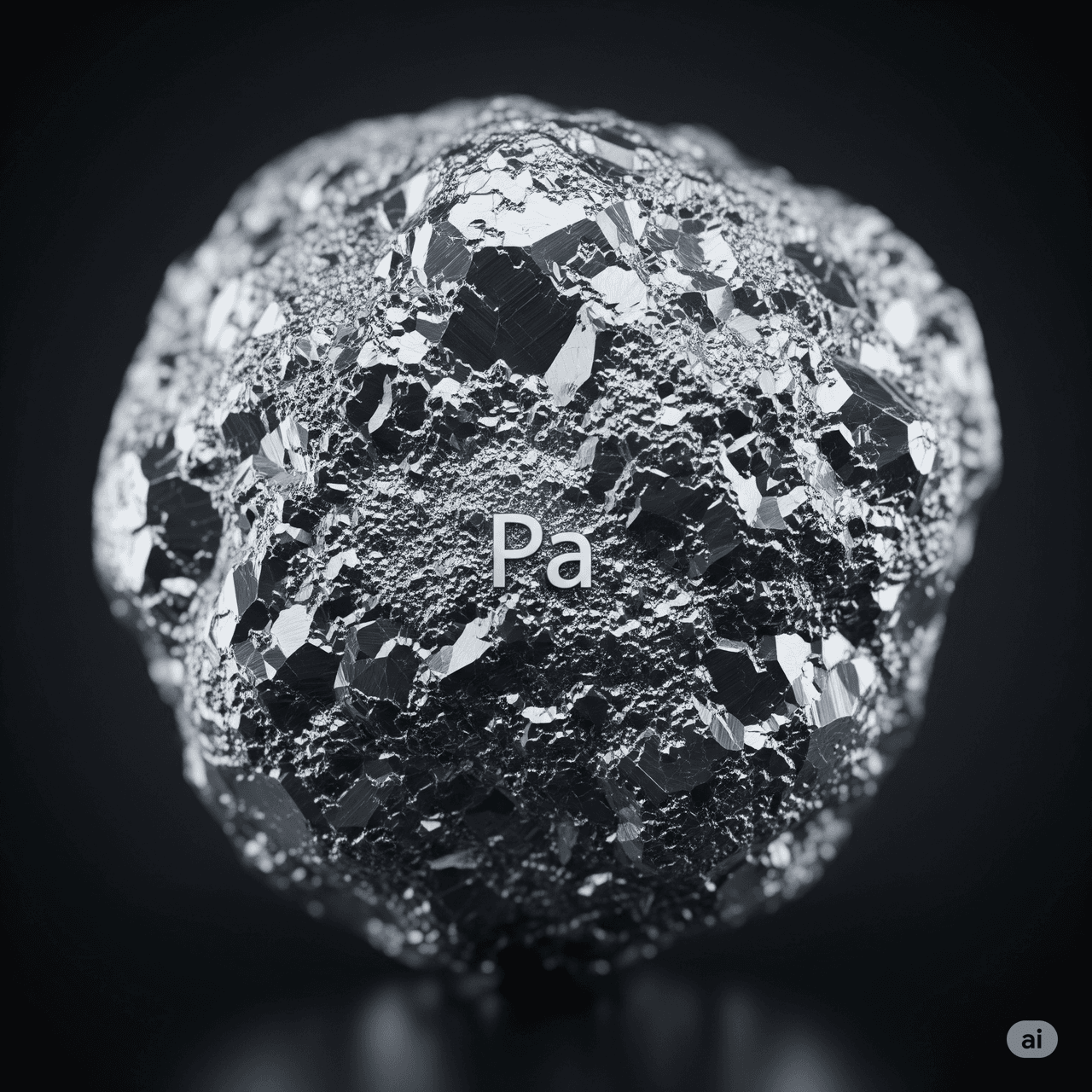
Protactinium (Generated by Artificial Intelligence)
The name protactinium is derived from the Greek word "protos," meaning "first." This naming refers to its decay into the element actinium, implying it is the "precursor to actinium" or "first actinium."
Protactinium occurs naturally in trace amounts in uranium ores. It arises as a member of the radioactive decay chains of uranium. It can also be obtained from spent nuclear fuel rods used in nuclear reactors.
Protactinium is a bright silvery metal. Its melting point is 1572 °C and its boiling point is approximately 4000 °C. Its atomic radius is known to be about 243 pm. Its electronegativity value is 1.5. It is relatively stable in air but can react with oxygen or water vapor at high temperatures. It exhibits several known oxidation states, the most common of which are +4 and +5.
Protactinium has many known isotopes, all of which are radioactive. The most important and longest-lived isotope is protactinium-231 (²³¹Pa). ²³¹Pa has a half-life of 32,760 years. It is part of the decay chain of uranium-235 and decays by alpha emission into actinium-227.
Protactinium has very limited commercial applications due to its rarity and high radioactivity, which make its extraction and processing difficult. Its primary use is in scientific research. In particular, the ratios of the ²³¹Pa isotope are studied in geochronological investigations such as the dating of ocean sediments. It is one of the rarest and most expensive elements naturally occurring in the Earth's crust. Beyond this, it has no widespread practical applications.
Protactinium has no known biological role. Due to its high radioactivity, it is an extremely hazardous and toxic element. If ingested, it can cause serious health problems and increase the risk of cancer. Therefore, when handling protactinium, strict radiation safety protocols must be followed, specialized protective equipment must be used, and the risk of contamination must be minimized to the greatest extent possible.
National Center for Biotechnology Information. "Neptunium." *PubChem Compound Database*. Accessed May 31, 2025. https://pubchem.ncbi.nlm.nih.gov/compound/23945
TÜBİTAK Bilim Genç. "Protaktinyum." Bilim Genç. Accessed May 31, 2025. https://bilimgenc.tubitak.gov.tr/periyodik-tablo/protaktinyum

Protactinium
Periodic Table | 7 | ||||||||
|---|---|---|---|---|---|---|---|---|---|
Chemical Symbol | Pa | ||||||||
Atomic Number | 91 | ||||||||
Group | Actinides | ||||||||
Atomic Weight | (231.03588) g/mol (for the ²³¹Pa isotope) | ||||||||
Electron Configuration | [Rn] 5f²6d¹7s² | ||||||||
Appearance | Silvery metal | ||||||||
Density | 15.4 g/cm³ | ||||||||
Melting Point | 1572 °C | ||||||||
Boiling Point | ~4000 °C | ||||||||
Atomic Radius | ~243 pm | ||||||||
Electronegativity | 1.5 | ||||||||
Important Isotopes | ²³¹Pa (Half-life: 32,760 years) | ||||||||
Year of Discovery(ies) | 1913 | ||||||||
Discoverer(s) | Otto Göhring Kasimir Fajans | ||||||||
Classification and Basic Properties
Discovery
Etimology
Natural Occurrence
Physical and Chemical Properties
Isotopes
Applications
Biological Role and Precautions