
This article was automatically translated from the original Turkish version.
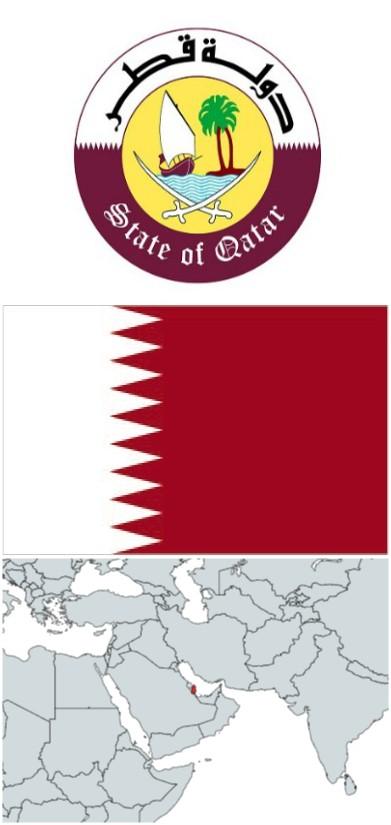
State of Qatar
Official Name | State of Qatar | ||||||||
|---|---|---|---|---|---|---|---|---|---|
Form of Government | Constitutional Monarchy (Emirate) | ||||||||
Date of Independence | 3 Eylül 1971 | ||||||||
Capital | Doha | ||||||||
Head of State | Emir Sheikh Tamim bin Hamad Al Thani | ||||||||
Official Languages | Arabic | ||||||||
Common Languages | English | ||||||||
National Day | December 18 | ||||||||
Area | 11,586 km² | ||||||||
Total Population | 3,109,000 (2025 – IMF estimate) | ||||||||
Climate | Subtropical desert climate | ||||||||
GDP | 222.119 million $ (2025 – IMF estimate) | ||||||||
GDP per Capita | 71,441 $ (2025 – IMF estimate) | ||||||||
Ethnic Groups | Qatari (%11.6) Foreign population (%88.4) | ||||||||
Religious Composition | Others (5.2) Muslim (%65.2) Hindu (%15.9) Christian (%13.7) | ||||||||
Telephone Code | 974 | ||||||||
Internet Domain Code | .qa | ||||||||
The State of Qatar, is a peninsula country located in the northeastern part of the Arabian Peninsula in the Middle East, extending into the Persian Gulf. The country shares a land border with Saudi Arabia to the south and is otherwise surrounded by sea. With a total area of approximately 11,586 km², Qatar’s population was approximately 3 million as of 2025.【1】
The capital and largest city is Doha. The official language is Arabic, and the currency is the Qatari riyal (QAR). The country’s system of governance is a constitutional monarchy. Qatar gained its independence from the United Kingdom on 3 September 1971.【2】 Thanks to its economy based on oil and natural gas resources, Qatar ranks among the world’s leading countries in terms of per capita national income.

Doha, Qatar (Flickr)
Qatar’s historical development began with ancient settlements and the process of Islamization in the 7th century, evolving for centuries around tribal confederations and maritime trade. In the 19th century, under the rule of the Al Thani dynasty, political unity was achieved on the peninsula. Following periods of Ottoman and British influence, Qatar declared its independence in 1971. With the discovery of hydrocarbon resources in the mid-20th century, the country underwent an economic transformation and today continues to maintain a modern state structure and regional diplomatic influence under the leadership of the Al Thani family.
Although information on Qatar’s early history is limited, it is known that the region has been inhabited since antiquity. Ancient sources indicate evidence of settlement by Canaanite communities on Qatari territory.【3】 The peninsula formed a geographic area connected to early trade and maritime routes along the Persian Gulf. This location made Qatar an indirect participant in commercial and cultural interactions between Mesopotamia, Iran, and the Arabian Peninsula.
With the spread of Islam across the Arabian Peninsula in the 7th century, Qatar became part of the Islamic world.【4】 The communities living on the peninsula embraced Islam, and their social and cultural structures were shaped according to Islamic principles. During this period, Qatar existed as one of the peripheral regions of the broader Islamic world.
Following Islamization, Qatar’s economic life was largely based on maritime activities. Fishing, coastal trade, and maritime transport formed the primary livelihoods of the local population. The Qatari coastline served as an important transit route for merchant vessels navigating the Persian Gulf.
Throughout the Middle Ages, piracy and attacks on merchant ships were common in the Persian Gulf. The Qatari coast was affected by these security challenges and often became a secondary arena for competition between local tribes and larger political powers. During this period, maritime security became one of the key elements in Qatar’s regional relations.【5】
In this early period, there was no centralized political authority in Qatar; social structure was primarily organized around tribal affiliations. Although the peninsula engaged economically and culturally with neighboring regions, it exhibited a fragmented political structure. This historical background, extending from antiquity through the process of Islamization, laid the foundation for the emergence of dynastic rule and state formation in subsequent centuries.

1763 Gulf Map (Qatar classified as "Catura") (Library of Congress)
From the 18th century onward, the Qatar Peninsula became part of the regional power dynamics of the Persian Gulf. At this time, there was no centralized political authority on the peninsula; governance was carried out by local tribes and sheikhs. De facto influence over Qatar was established by the Al Khalifa family, based in Bahrain. During this period, the peninsula was within the political and economic sphere of Bahraini administration.【6】
In the 18th and 19th centuries, trade routes, pearl diving, and maritime activities were central to regional competition. The Qatar Peninsula was regarded as strategically significant due to these activities. By the mid-19th century, relations between local leaders in Qatar and the Al Khalifa family had deteriorated.【7】
In 1867, armed conflicts erupted between Bahraini forces and settlements in Qatar. These conflicts prompted British intervention due to threats to maritime trade security in the Gulf. In 1868, an agreement was signed between the United Kingdom and Muhammad bin Thani, a leading local leader in Qatar. Through this agreement, Muhammad bin Thani was recognized as the ruler of Qatar. This development is regarded as the beginning of the Al Thani dynasty’s political presence in Qatar.【8】
The 1868 agreement did not grant Qatar the status of an independent state; however, it established the peninsula as a distinct political entity separate from Bahrain. From this date onward, the Al Thani family gained a decisive position in Qatar’s internal administration.
After Muhammad bin Thani, his successor, Qasim bin Muhammad Al Thani, strengthened central authority. Qasim bin Muhammad established contacts with both the Ottoman Empire and the United Kingdom in Qatar’s foreign relations. In 1871, following the deployment of Ottoman forces in Qatar, the peninsula became part of the Ottoman sphere of influence.【9】 The Al Thani administration acknowledged Ottoman sovereignty while maintaining its authority over internal governance.
Relations between Ottoman administration and the Al Thani leadership gradually deteriorated due to issues concerning taxation and administrative practices. After military clashes in 1893, the Ottoman Empire’s de facto influence in Qatar was significantly reduced.【10】
By the end of the 19th century, Qatar was transitioning from a tribal-based structure to a dynasty-centered political organization under the Al Thani rule. This period is regarded as laying the groundwork for the emergence of a modern political structure in Qatar.
At the beginning of the 20th century, with the decline of Ottoman influence in the Gulf, Qatar’s political status changed. The 1913 Anglo-Ottoman Agreement anticipated Qatar’s removal from Ottoman administration; during World War I, Ottoman forces fully withdrew from the peninsula.【11】

Representative Daily Life in Qatar (Easy-Peasy.AI)
In 1916, an agreement was signed between Qatar and the United Kingdom, placing Qatar under British protection. Under this arrangement, foreign relations and defense were entrusted to Britain, while internal administration remained with the Al Thani dynasty.【12】
During this period, Qatar’s economy was largely based on pearl diving. The widespread adoption of cultured pearls in the 1920s and 1930s caused a severe economic depression in Qatar.
The discovery of oil reserves in 1939 marked a significant development for Qatar’s future. However, production was delayed due to World War II.【13】
Following World War II, significant changes occurred in Qatar’s economic and political structure. The oil reserves discovered in 1939 had remained unused for a long time due to the war. With the first oil exports in 1949, Qatar’s economy began to rely on oil revenues. This development substantially increased the country’s financial capacity.【14】
With increasing oil revenues, infrastructure investments in Qatar accelerated. Roads, ports, residential areas, and public services were developed; basic institutions in education and healthcare were established. The state administration became more structured, and the central authority of the Al Thani dynasty strengthened.
During this period, Qatar remained under British protection. However, growing economic resources enabled the country to assume a more visible position in its foreign relations. In the 1960s, the United Kingdom’s decision to reduce its presence in the Persian Gulf directly affected Qatar’s political status.
In 1968, the United Kingdom announced its intention to withdraw from the Gulf region. Subsequently, Qatar participated in negotiations with Bahrain and other Gulf emirates regarding the formation of a federation. These negotiations, however, failed due to disagreements over governance structure and sovereignty issues.
After the failure of the federation initiative, Qatar decided to pursue independence as a sovereign state. On 3 September 1971, Qatar declared its independence, ending British protection.【15】 In the same year, an interim constitution was adopted, establishing Qatar as a sovereign emirate governed by the Al Thani dynasty.
After independence, oil revenues became the country’s primary economic source. Public institutions were expanded, and the foundations of a modern state structure were laid. Political power remained centralized within the dynasty, with authority concentrated largely in the hands of the Emir and his inner circle.
Following Qatar’s declaration of independence in 1971, the country’s political structure was shaped within a dynasty-centered governance model. During this period, changes in political power did not occur through elections or mass movements, but rather through internal power dynamics within the Al Thani family.
In 1972, Qatar experienced its first major power transition. The then Emir, Sheikh Ahmed bin Ali Al Thani, was removed from power while abroad, and his cousin and prime minister, Sheikh Khalifa bin Hamad Al Thani, assumed leadership. The coup did not involve armed conflict and was quickly brought under control.【16】
Criticism of Sheikh Ahmed bin Ali centered on his lack of involvement in state affairs and his absence from national matters after independence. The fact that the Emir was abroad during the declaration of independence and had effectively delegated authority to Sheikh Khalifa formed the basis of these criticisms.
Upon assuming power, Sheikh Khalifa bin Hamad Al Thani increased salaries for civil servants, military personnel, and security staff, and announced plans to reorganize state administration. Official statements indicated that the coup had occurred with the internal consensus of the dynasty and the support of the armed forces.
The 1972 coup marked the first instance in Qatar where political power changed hands through internal dynastic restructuring.
In 1995, Qatar experienced its second major power transition. Emir Sheikh Khalifa bin Hamad Al Thani was removed from power while abroad by his son, Crown Prince Sheikh Hamad bin Khalifa Al Thani.【17】 This transition also occurred without violence, and control of state institutions quickly passed to the new Emir.
With Sheikh Hamad bin Khalifa Al Thani’s accession to power, a new era began in Qatar’s foreign policy, media, and energy sectors. Natural gas was strategically prioritized, constitutional reforms were introduced, and media liberalization became prominent features of this period.
Documentary on the 1996 Coup (Al Jazeera)
After the 1995 coup, internal tensions within the dynasty did not subside. On 14 February 1996, a counter-coup attempt was planned by elements supporting the deposed Emir, Sheikh Khalifa bin Hamad Al Thani. “Operation Abu Ali” was allegedly prepared with the support of certain members of the royal family and some regional countries.【18】
The plan reportedly aimed to seize the Emir’s residence and state institutions; however, the attempt was thwarted before implementation. The failure of the coup attempt strengthened the incumbent leadership’s hold on power.
The 1995 coup and the failed 1996 attempt led to a reorganization of Qatar’s governance approach. During this period, reforms focused on enhancing state capacity and ensuring dynastic stability rather than expanding political participation.
The constitution adopted in 2003 and implemented in 2004 marked the most important institutional step in this process.【19】 The constitution defined Islam as the state religion, constitutionally guaranteed the Al Thani family’s governing position, and centralized executive authority in the Emir. The Shura Council was established as an advisory body, and the judiciary system was defined.
Established in 1996, Al Jazeera Television became one of Qatar’s most important tools in media and public diplomacy.【20】 The channel increased Qatar’s regional and global visibility and emerged as a key element of its foreign policy.

Qatar Emir Sheikh Tamim (ORDAF)
Emir Sheikh Tamim bin Hamad Al Thani became Emir of Qatar on 25 June 2013, following his father Sheikh Hamad bin Khalifa Al Thani’s voluntary transfer of authority. This transition was recorded as a rare, voluntary, and peaceful power shift among Gulf monarchies. The Emir Tamim era has been shaped by maintaining the existing governance structure and strengthening state institutions.
During this period, Qatar’s constitutional framework and absolute monarchy system have continued. Priorities in state administration have included enhancing administrative efficiency, simplifying bureaucracy, and appointing younger cadres to public institutions. Social welfare policies have been maintained, with continued state support in housing, healthcare, and education.
On 5 June 2017, a blockade against Qatar was initiated by Saudi Arabia, the United Arab Emirates, Egypt, and Bahrain, involving the severing of diplomatic relations and the imposition of comprehensive economic restrictions.【21】 This period triggered a serious political rift in the Gulf region.
The Maldives and the Tobruk-based administration in Libya also supported the blockade. The countries imposing the blockade accused Qatar of maintaining ties with various armed and political groups.
Triggering the Crisis
The immediate trigger of the crisis was the publication on 23 May 2017 of statements attributed to Emir Tamim bin Hamad Al Thani on Qatar’s official news agency, QNA. Qatari authorities stated that the content had been published as a result of a cyberattack and did not reflect the Emir’s views. Nevertheless, the crisis rapidly escalated into a diplomatic rupture.
Key Issues in the Crisis
The main points of disagreement between Qatar and some Gulf countries during the blockade were grouped under several headings. Qatar’s contacts with actors such as Hamas and the Taliban, and its maintenance of diplomatic channels with these groups, were criticized by some regional countries. Qatar’s continued relations with Iran due to shared natural gas fields also contributed to tensions. Furthermore, the editorial policies of the Doha-based Al Jazeera media network were viewed by some Gulf countries as a tool of political interference. Qatar’s military and strategic cooperation with Turkey also became a point of contention regarding regional alliance balances.【22】
Blockade Measures
Under the blockade, Qatar’s airspace was closed to regional countries, and its only land border with Saudi Arabia was shut. Diplomatic relations were suspended, and mutual travel and trade restrictions were imposed. This situation forced Qatar to make short-term adjustments to its supply chains.
Demands Presented to Qatar
The countries imposing the blockade presented Qatar with a list of 13 demands. These included shutting down Al Jazeera, ending Turkey’s military presence in Qatar, limiting relations with Iran, and aligning Qatar’s foreign policy with that of the Gulf countries. The Qatari government rejected these demands as violations of its sovereignty.
Turkey’s Role
Turkey maintained diplomatic ties with Qatar during the blockade and provided logistical support to meet essential needs. It also preserved its military presence in Qatar and continued bilateral defense cooperation.
End of the Blockade
The blockade ended on 5 January 2021 at the 41st Gulf Cooperation Council Summit held in Al-Ula, Saudi Arabia. The “Al-Ula Declaration” signed at the summit resolved to restore diplomatic relations and reopen borders.【23】
Qatar National Anthem (Urumaxi Anthems)
The national anthem of the State of Qatar is titled "As-Salam al-Amiri" (Arabic: السلام الأميري; Turkish: "Peace Be Upon the Emir"). The anthem was officially adopted in 1996. The lyrics were composed by the poet Sheikh Mubarak bin Saif Al Thani, and the music was composed by Abdulaziz Nasser Obaidan.
History and First Performance: "As-Salam al-Amiri" was introduced in December 1996 following the ascension of the then Emir, Sheikh Hamad bin Khalifa Al Thani. The first official performance was recorded on 7 December 1996, during the Gulf Cooperation Council summit held in Doha.
Content: The national anthem is a patriotic text emphasizing Qatar’s independence, the nobility of loyal citizens, and the duty to follow the path of ancestors. The lyrics include an oath to God that Qatar will remain forever free. Themes of loyalty to the heritage of ancestors and the guidance of prophets are explored. The words describe Qatar as a hymn of honor and pride in the hearts of its people. The nation is characterized as peaceful like a dove in times of peace, yet protective like a falcon in moments of sacrifice and danger.
The Qatari flag consists of a wide white band on the left and a maroon band on the right, known as "Al Adam". The boundary between the two colors is a serrated line formed by nine equal isosceles triangles extending from the white to the maroon section. These nine points refer to Qatar’s status as the ninth member of the “consented emirates” after the 1916 Qatar-Britain Agreement; the other eight members were Bahrain and the seven emirates now constituting the UAE. The maroon tone symbolizes the blood shed in Qatar’s past wars, while white represents peace.
The flag’s design has undergone several changes over time. The adoption of the maroon shade began under Sheikh Muhammad bin Thani in 1851. This evolution continued under Sheikh Abdullah bin Jassim Al Thani, who introduced diamond-shaped separations on the white field and the word "Qatar" in white at the center. The flag assumed its current form in 1960 under Sheikh Ali bin Abdullah Al Thani.
Regulations regarding the flag’s use were formally established by Law No. 14 of 2012, issued during the reign of Emir Sheikh Hamad bin Khalifa Al Thani. This law mandates the respectful protection of the flag as a national symbol and specifies details such as its shape, proportions, color code (Pantone 1955 C), manufacturing materials, protocol for display, and penalties for disrespect.

Location of Qatar on the Map (Anadolu Ajansı)
The State of Qatar is located on the eastern edge of the Arabian Peninsula, extending into the Persian Gulf. The country has a distinctive peninsula geography with a single land border and an extensive coastline, making it a key regional center.
Qatar’s geography covers an area approximately 100 km wide and 200 km long. The country is situated between approximately 25°30' North latitude and 51°15' East longitude. Qatar’s total land area is 11,586 km², all of which is terrestrial.【24】 This compact geographic structure provides Qatar with a strategic peninsula location.
Land Borders and Neighbors: Qatar shares a land border with only one country. This southern land border is with the Kingdom of Saudi Arabia and is 87 kilometers long.【25】 This single land border reinforces Qatar’s peninsula status and the strategic importance of sea routes for its access to the outside world.
Coastline and Maritime Neighbors: As a peninsula state, Qatar has an extensive coastline. The total coastline length is 563 kilometers.【26】 This coastline along the Persian Gulf provides the country with significant maritime and trade potential. Qatar’s maritime neighbors in the Gulf include nearby Bahrain and United Arab Emirates (UAE), and across the Gulf, Iran are located.
Maritime Jurisdiction Areas: Qatar’s maritime jurisdiction areas are determined under international law and bilateral agreements. Accordingly, territorial waters extend 12 nautical miles (nm), and the contiguous zone extends 24 nautical miles.【27】 The Exclusive Economic Zone (EEZ) boundaries are drawn according to bilateral agreements with neighboring countries or the median line principle under international law.
Major Settlements: The administrative, commercial, and cultural center of the country is Doha, which is also the capital and largest city. Other major settlements include Al Wakra and the industrial area of Mesaieed in the south, Al Khor and Al Shamal in the north, and Dukhan and the industrial port city of Ras Laffan in the west, known for oil and natural gas production.
The Qatar Peninsula is generally characterized by low and flat terrain. The country’s average elevation is approximately 28 meters, with its highest point being Tuwayyir al Hamir at 103 meters. The lowest point is sea level along the Arabian Gulf coast. Agricultural land use is minimal; according to 2023 estimates, 93.4% of the land falls under the “other” category, while total agricultural land accounts for only 6.4%. Of these agricultural areas, 1.8% is cultivated land, 0.3% is permanent crops, and 4.4% is permanent pasture.【28】 There are no forested areas in the country. In addition to the peninsula, several islands including Halul, Shirawa, and Al-Ashat are part of Qatar. The Qatari geography lacks mountain ranges, broad plains, or permanent river and lake systems; instead, it is dominated by low, flat, and arid desert terrain.
Qatar has an arid subtropical desert climate characterized by low annual rainfall.

Observed Annual Average Surface Air Temperature (World Bank Group)
Summer temperatures are extremely high and can occasionally reach around 50 °C.【29】 High temperatures and intense sunlight enable the ripening of dates, one of the country’s key agricultural products, increase their natural sugar content, and give them their characteristic brown color.
The climate’s defining feature is its consistently hot and dry conditions throughout the year. Due to these meteorological conditions, natural surface water is extremely limited and vegetation is sparse. The scarcity of water resources creates structural challenges for agriculture and drinking water supply. This situation is being addressed through modern irrigation systems and seawater desalination.
Seasonal variations in Qatar are limited, and sunshine levels remain high throughout the year. This reinforces the climate’s persistent hot and arid nature.
In Qatar’s subtropical desert climate, seasonal weather events characterized by strong winds, heavy rainfall, and storms occur during specific periods of the year.
Qatar’s natural resources are largely based on hydrocarbons. Oil and natural gas form the foundation of the country’s economy, accounting for 56% of GDP and 89% of export revenues.【30】 Oil production is primarily carried out in the Dukhan and Qatari fields.
Natural gas is Qatar’s most strategic underground resource. The country possesses the world’s third-largest natural gas reserves, accounting for approximately 15% of global reserves. Based on current reserves, natural gas production is projected to continue for approximately 300 years.【31】
With an annual production of 77 million tons of LNG, Qatar is the world’s largest LNG exporter. Under the 2030 Vision, LNG production capacity is targeted to increase from 110 million tons in 2024 to 126 million tons by 2027. Oil and natural gas revenues, particularly until 2015, supported the country’s rapid economic growth due to high energy prices.【32】
In addition to hydrocarbon resources, fishing is also among Qatar’s natural resources, providing a limited but stable economic contribution, particularly for local consumption.
Qatar’s energy and transportation infrastructure has been shaped by long-term public investments largely financed by oil and natural gas revenues. Hydrocarbon resources form the foundation of the country’s economic structure and play a decisive role in energy production, industry, transportation, and urban infrastructure development.
Qatar is among the world’s largest producers and exporters of liquefied natural gas (LNG). The country’s energy sector is based on extensive natural gas reserves, primarily the North Field. Natural gas plays a central role in meeting both Qatar’s domestic energy needs and its export-oriented production.
Electricity generation is heavily reliant on fossil fuels. According to 2023 estimates, approximately 99.7% of the country’s electricity is generated from fossil fuels; the contribution of biomass and waste-based sources is limited.【33】 Water supply is entirely dependent on seawater desalination. Per capita energy consumption is significantly higher than the global average due to high industrial capacity and climatic conditions.
Qatar exports LNG through both long-term contracts and spot markets. These activities have strengthened Qatar’s position in the global energy supply chain. The fleet established for LNG transportation is among the largest in the world and plays a critical role in ensuring the continuity of energy exports. Expansion projects for the fleet are being pursued to meet increasing global demand.

Representative Gas Compressor Station (Anadolu Ajansı)
Parallel to the expansion of its energy infrastructure, Qatar has developed various technical and structural measures to limit the environmental impact of energy production. Carbon capture and storage (CCS) technologies are being used in energy facilities, and efforts are underway to reduce routine gas flaring and methane leaks. Additionally, in the field of renewable energy, solar energy-based projects have begun to be included in the energy mix, albeit on a limited scale.
Oil and natural gas revenues have served as the primary funding source for the development of Qatar’s modern transportation infrastructure. The national road network has been expanded, and urban and intercity transportation systems have been improved. International air transport investments have been a crucial part of this process.
Hamad International Airport in the capital Doha is one of the key infrastructure investments that have strengthened Qatar’s role in the global air transport network. In addition to transportation infrastructure, telecommunications systems, public buildings, and urban services have also been financed through hydrocarbon revenues.

Qatar Airways (Anadolu Ajansı)
Qatar Airways is the national flag carrier of Qatar, headquartered at Hamad International Airport in Doha. The airline operates in international passenger and cargo transport and is regarded as a major player in the global aviation network.
Qatar Airways has received various awards from Skytrax, including “World’s Best Airline” in multiple years, based on its performance in service quality, cabin products, and ground services.【34】
Operations and Headquarters
Qatar Airways conducts its flight operations through Hamad International Airport in Doha. The airline operates flights to over 170 destinations across Asia, Europe, Africa, the Americas, and Oceania. Hamad International Airport, with its passenger capacity, transfer infrastructure, and commercial areas, is one of the key elements supporting Qatar’s position as a global aviation hub.【35】
Fleet and Operational Data
As of the end of the 2024–2025 financial year, the Qatar Airways Group’s fleet consists of more than 290 aircraft. During the same period, the airline carried over 43 million passengers and completed approximately 196,700 flights. The airline group employs more than 55,000 staff. The total cargo transported under its freight operations amounted to 3.1 million tons. Total revenue reached approximately 86 billion Qatari riyals.【36】

Fund in Doha / 1977 (Library of Congress)
As of 2023, Qatar is the world’s 55th largest economy. With a high standard of living and an economy based on foreign trade, the country’s Gross Domestic Product (GDP) was recorded at $213 billion at current prices. According to International Monetary Fund (IMF) data, Qatar’s economy grew by 1.2% in real terms that year.【37】 Per capita national income reached approximately $81,968, while the inflation rate remained at a low level of 0.8%.【38】

Key Economic Indicators Table (T.C. Ministry of Trade, 2025 Qatar Country Profile) *Estimated figures
Qatar’s economy has a structure dominated by the public sector, with the hydrocarbon sector playing a leading role. Oil and natural gas account for 56% of GDP and 89% of export revenues. The largest sectors outside hydrocarbons are construction and services.【39】
Within efforts to enhance food security, the agricultural sector (particularly greenhouse farming, poultry farming, aquaculture, and feed production) is presented as a potential area for foreign investment. The country’s climate is desert, with surface water virtually nonexistent; all water needs are met through seawater desalination.
Qatar’s industry is primarily based on natural gas and oil. Qatar possesses 15% of the world’s natural gas reserves and holds the third-largest natural gas reserves globally.【40】 The government enhances revenues by efficiently utilizing natural gas resources and developing this sector. In this context, significant steps have been taken in Gas-to-Liquids (GTL) technology, which converts natural gas into petroleum products for export. Industrial zones such as Ras Laffan and Mesaieed have been established to promote economic diversification. Potential sub-industries for investment include structural steel manufacturing and polymer- and aluminum-based production.
The services sector stands out as one of the largest sectors outside hydrocarbons. Islamic finance practices are prominent in the financial system, with their ethical governance and fair financial activities noted for attracting foreign investment.【41】 HORECA (Hotel, Restaurant, Café), healthcare, education, information technology, and software sectors are potential investment areas.
Financial System: Qatar’s monetary policy aims to maintain the Qatari Riyal’s peg to the US Dollar. To attract foreign investors, the Qatar Financial Centre was established to allow 100% foreign-owned companies to operate within its jurisdiction.【42】
Qatar’s foreign trade is largely shaped by fluctuations in international energy prices, and the country records significant trade surpluses during periods of rising energy prices. According to 2024 data, Qatar’s exports amounted to $95 billion, while imports reached $36 billion, demonstrating a trade balance heavily dependent on energy exports. Mineral fuels and oils form the basis of exports.【43】 Petroleum gases and other gaseous hydrocarbons account for approximately 59.9% of total exports, crude oil for 15.7%, and petroleum oils for 8.1%. In addition to these products, ethylene polymers and nitrogenous mineral and chemical fertilizers are among Qatar’s key export items.【44】
In imports, Qatar’s needs are concentrated on high-technology products, vehicles, and industrial inputs. Advanced technology products such as turbojets, turbopropellers, and other gas turbines, as well as automobiles, crude oil for refining, and telephones, are among the most imported goods. Additionally, defense industry equipment, jewelry, construction materials, and various food products constitute a significant portion of imports.
Trade Partnerships In terms of trade partnerships, in 2024, China accounted for 19.9% of Qatar’s exports, placing it first; followed by South Korea (13.5%) and India (11.7%). In imports, China again leads with 15%, followed by the United States (12.9%) and Italy (5.6%). These figures indicate that Qatar’s foreign trade network is Asia-oriented and sustains an economic model based on energy exports.【45】
Thanks to its rich oil and natural gas reserves, Qatar ranks among countries with the highest per capita national income; its economic development policy focuses on increasing foreign investment outside the energy sector. In this context, the country demonstrates a strong position in international business environment indicators. For example, in the 2022 Human Development Index, Qatar ranked 40th among 193 countries; in the 2024 Economic Freedom Index, it ranked 28th among 176 countries; in the 2019 Global Competitiveness Index, it ranked 29th among 141 countries; and in the 2020 Ease of Doing Business Index, it ranked 77th among 190 countries.【46】
Regarding foreign investment flows, in 2023, foreign direct investment inflows into the country amounted to -$4.742 billion, a negative level. However, the country’s foreign direct investment stock reached $273.7 billion as of 2023, demonstrating its sustained capacity as an investment destination.【47】
The Qatari government, in line with its goal of localizing the energy supply chain, offers extensive opportunities to foreign investors through the Tawteen program. Key sectors encouraged for investment include fast-moving consumer goods production, food production, agriculture (particularly greenhouse farming and livestock), healthcare, education, information technology, structural steel, and aluminum-based sub-industries. Additionally, free zones such as the Qatar Science and Technology Park and the Qatar Financial Centre allow investors to establish 100% foreign-owned companies, thereby strengthening the institutional infrastructure supporting the country’s diversification beyond energy.
Qatar National Vision 2030 (QNV 2030) is the key strategic document outlining the country’s national goals and roadmap for the future. The main objective of the Vision is to transform Qatar into an advanced country by 2030 that can sustain its own development and provide a high standard of living for all its citizens. Prepared under the leadership of Sheikh Hamad bin Khalifa Al Thani, this Vision aims to bridge the gap between the current situation and the future, envisioning a prosperous country based on economic and social justice and harmony between nature and humanity.
This strategy uses the country’s resource wealth—particularly hydrocarbon assets—as a tool to invest in world-class infrastructure, a highly skilled workforce, and economic diversification. QNV 2030 is built upon four main pillars:
Human Development Pillar aims to empower all members of society and ensure Qatar’s success in a future knowledge-based, competitive global environment. In this context, the education system is designed to meet global standards by promoting critical thinking, creativity, and innovation, while preserving Qatar’s ethical values and cultural heritage. In healthcare, the goal is to provide accessible, comprehensive, and high-quality services for current and future generations, while labor policies aim to strengthen Qatari citizen employment and attract qualified foreign labor to meet the needs of the rapidly growing economy.
Social Development Pillar seeks to establish a fair, inclusive, and socially cohesive structure based on moral values. The family institution is prioritized to be preserved on the foundations of religion, ethics, and patriotism; an effective social protection system is aimed at safeguarding the civil rights of all citizens. Additionally, strengthening and enhancing the participation and capacity of women in political and economic life are key components of this pillar. Qatar’s international role also forms a dimension of social development. The country aims to contribute to global peace and security by promoting tolerance, intercultural dialogue, and constructive cooperation within the framework of Arab and Islamic values.
Economic Development Pillar aims to create a competitive and diversified economy capable of providing a high standard of living for current and future generations. Gradual reduction of dependence on hydrocarbon revenues, expansion of the private sector’s role in the economy, and maintenance of a competitive environment that supports sustainable growth are fundamental elements of this goal. Responsible and efficient use of oil and gas resources is also observed, with the strategic priority of developing the gas sector as a clean energy source. The transition to a knowledge-based economy, anchored in innovation, entrepreneurship, and excellence in education, along with maintaining economic stability based on low inflation and sound fiscal policies, and creating a favorable business climate to attract foreign capital, are also within the scope of this pillar.
Environmental Development Pillar seeks to achieve harmony between economic growth and social development with environmental protection. Conservation of the natural environment—including air, land, water, and biodiversity—is essential. An effective and flexible legal framework covering all environmental aspects is to be established, and institutions enhancing environmental awareness are to be strengthened. Comprehensive plans implementing sustainable urban planning principles are aimed at regulating population distribution and urbanization. Qatar supports regional cooperation in combating climate change and embraces contributing to international efforts under this pillar.【48】
The Qatar Investment Authority (QIA) is a sovereign wealth fund established by the State of Qatar in 2005 to preserve, grow, and diversify the country’s financial assets.【49】 As a “savings fund,” QIA aims to channel Qatar’s budget surpluses into long-term investments to ensure these resources support the welfare of future generations.【50】
QIA was established in 2005 by an Emiri Decree, placing it within a constitutional framework. The institution began investment activities in 2006 and adopted a strategy focused on direct investments from 2007 onward.【51】 The fund’s primary purpose is to convert revenues from Qatar’s hydrocarbon resources into a sustainable financial structure and contribute to the economic diversification of Qatar in line with the Qatar National Vision.
QIA’s investment approach is based on three core responsibilities. The first is to create value for future generations by ensuring long-term financial returns on behalf of the state. The second is to support local economic development by investing in companies that fill existing market gaps in Qatar’s economy. The third is to provide liquidity when needed to contribute to economic stability.
With an asset value ranging between approximately $475 billion and $557 billion, QIA ranks among the world’s largest sovereign wealth funds.【52】 The fund’s investment strategy is based on broad diversification across different markets, asset classes, and geographies.
The fund’s sectoral investment focus includes technology, media, and telecommunications (TMT), healthcare, retail and consumer goods, real estate, infrastructure, financial institutions, industrial materials, and liquid securities. The investment portfolio consists of various asset classes, including fixed-income assets, public equities, private equity, real estate, and alternative investments.
In recent years, technology-focused areas such as artificial intelligence, semiconductors, and digital infrastructure have become prominent in QIA’s investment strategy, with billions of dollars directed toward these sectors.
QIA has developed an approach that embraces ESG (Environmental, Social, and Governance) principles in its investment activities. Since 2020, the institution has decided not to make new investments in the hydrocarbon sector and has redirected 50% of its energy production investments toward zero-carbon assets.【53】
The fund is also among the founding and implementing actors of the Santiago Principles, the international transparency standard for sovereign wealth funds. In line with these principles, QIA adopts a governance approach based on transparency and accountability in its institutional structure and investment activities.

Qatar Population Indicators (The World Factbook)
According to 2024 data, Qatar’s total population is 3,094,000. The vast majority of the population (99.4%) is concentrated in the capital Doha and its surroundings. According to 2023 estimates, Doha’s population is 658,000 and Ar-Rayyan’s is 798,000. The country has undergone rapid urbanization since the mid-20th century. The population growth rate for 2024 was determined at 0.71%, reflecting the combined effect of birth, death, and net migration data. The birth rate for the same year was 9.2 live births per 1,000 people, while the death rate was a very low 1.4 deaths per 1,000 people.【54】
Qatar’s population exhibits a highly uneven ethnic structure. According to 2015 estimates, only 11.6% of the total population are Qatari citizens, while the remaining 88.4% are foreign nationals.【55】 This large foreign population is primarily composed of Asian and South Asian workers who came to Qatar for the natural gas sector and infrastructure projects. Workers from countries such as India, Pakistan, Nepal, and the Philippines have become the primary determinant of Qatar’s demographic structure.
This intense labor migration directly affects gender ratios in the population. According to 2024 estimates, there are 3.32 men for every woman in Qatar, creating a significant gender imbalance far above global averages. Particularly in the 15–64 age group, which has the highest concentration of labor, the male-to-female ratio rises to 4.29, significantly shaping the country’s demographic structure.【56】

Street View from Downtown Doha (Library of Congress)
Arabic is the official language in Qatar, while English serves as a widely used second language in business, education, and daily communication.
The country’s religious structure is diverse. According to 2020 estimates, 65.2% of the population is Muslim, forming the largest religious group; Hindu (15.9%) and Christian (13.7%) communities also hold significant positions.【57】 The legal system is based on Sharia law, making Islam a decisive role both in official structures and daily life practices.
In Qatar, the life expectancy in 2024 is estimated at 80.3 years; 78.2 years for men and 82.4 years for women. Among public health indicators, adult obesity is significant; according to 2016 estimates, the obesity rate is 35.1%. Current health infrastructure data show that in 2023, the doctor density was 3.02 physicians per 1,000 people, and in 2019, the hospital bed density was 1.1 beds per 1,000 people. Additionally, health expenditures accounted for 2.9% of GDP in 2021 and 7.4% of the national budget in 2022.【58】
Qatar’s population dynamics are largely shaped by intense labor migration into the country. The primary reason for the high population growth rate is the increasing number of foreign workers from India, Pakistan, Nepal, and the Philippines, who come to work in the natural gas and infrastructure sectors. This situation has led to foreign nationals becoming a dominant segment of the population. Qatar has abolished the Kafala system and implemented a Minimum Wage Law to improve working conditions for migrant workers, achieving a structural transformation in its migration policies.
According to 2024 data, Qatar has 349 refugees and approximately 1,200 stateless persons. The foreign population in the country primarily consists of individuals residing temporarily or for work purposes; refugees and stateless individuals constitute only a small portion of the population.【59】
Education in Qatar is positioned as one of the key components of the Qatar National Vision 2030, prioritized at the national level to facilitate the country’s transition to a knowledge-based economy and support human development. Modern formal education was established in 1952, and since then, Qatar has experienced rapid institutional growth. In 1951, there was only one school; by 1985, the number of students had exceeded 50,000; schools, universities, research centers, and vocational training institutions have spread across the country.【60】 The state has continuously supported the establishment of private educational institutions through legal and administrative means.
In 2001, Qatar launched the “Education for a New Era” reform to enhance the quality of its public education system, promote critical thinking, and align education with international standards. The Ministry of Education and Higher Education, responsible for formulating and implementing education policies, has undertaken initiatives to develop curricula, expand digital learning applications, modernize the examination system, and strengthen adult education programs. Projects aimed at improving literacy, writing, and mathematical skills have also been implemented.
In higher education, Qatar has developed a broad academic structure encompassing both national and international institutions. Under the leadership of Sheikha Moza bint Nasser, the Education City brings together the regional centers of the world’s leading institutions, hosting prestigious universities such as Georgetown, Northwestern, Carnegie Mellon, Texas A&M, and Weill Cornell Medicine. This center has become the focal point for research, innovation, and advanced education in line with the country’s knowledge-based economy goals.

Qatar University (Qatar University)
Established in 1977, Qatar University (QU) holds a central position in higher education as the country’s only national university and ranked 173rd in the 2024 QS World University Rankings.【61】 Another important institution within Education City, Hamad Bin Khalifa University (HBKU), specializes in research, innovation, and graduate education. The total number of higher education institutions in the country has reached 30, offering 168 undergraduate and 131 postgraduate and doctoral programs.
In Qatar, women’s access to education and their participation in higher education, particularly in STEM (Science, Technology, Engineering, and Mathematics) fields, is supported by state policies. The establishment of secondary schools for girls in banking and business sciences, special schools for autism spectrum disorder and intellectual disabilities, and STEM-focused science and technology high schools for male students are among the steps taken to increase diversity in the education system.
The Qatar Foundation is a non-profit organization active in the fields of education, research, and social development in Qatar. The foundation considers the development of human potential as the cornerstone of the country’s long-term development and hosts numerous educational and research institutions.
Core Mission and Approach
At the center of Qatar Foundation’s activities is the understanding that individuals can contribute to social, economic, and scientific development through education and knowledge. The foundation conducts its work within the framework of principles such as quality in education, ethical governance, community awareness, and innovation.
Areas of Activity and Education City
The Qatar Foundation carries out its activities under three main headings: Education, Research, and Social Development. The majority of these activities are concentrated in the Education City campus in Doha, which spans approximately 12 square kilometers. More than 50 institutions operate within the campus, including 13 educational institutions from preschool to high school and 8 universities.【62】
Research and Innovation
The Qatar Foundation aims to establish Qatar as a regional and global center for research and innovation. Environmental sustainability, artificial intelligence, and health technologies are among the foundation’s priority research areas. Projects such as the use of artificial intelligence in special education, detection of misinformation, and air quality monitoring systems are being carried out in this context.
Social Development Initiatives
In addition to education and research, the foundation implements programs to enhance social participation. Initiatives in culture, arts, sports, health, and sustainability aim to support the involvement of different social groups in public life. Programs for people with disabilities and cultural production initiatives are among these efforts.
Qatari culture is shaped by the fusion of strong Islamic and Arab values inherited from Bedouin tribal traditions with modern cultural investments. The Majlis tradition, serving Arabic coffee, and hospitality culture are fundamental elements of social life, while modern architecture, contemporary art, and museum initiatives complete the country’s rapidly evolving cultural identity.
Qatar attracts attention with both its modern architecture and enriched art scene. Architectural designs in the country draw inspiration from traditional cultural symbols and Islamic motifs; contemporary museums, art centers, and public art projects support cultural diversity.

Education City Mosque (Anadolu Ajansı)

National Museum of Qatar (Pexels)
Qatar is a significant cultural hub in the region with its extensive museum network and cultural institutions.
Qatar Museums Network: Offers free entry to museums through Culture Pass Plus or family membership.
Qatar National Library: Designed by Rem Koolhaas, it houses over a million books and documents related to early Islamic history.
Fire Station: A former fire station transformed into a dynamic center for modern art.
Msheireb Museums: Located in Doha’s historic district, these museums showcase Qatar’s historical and cultural heritage.
Public Art: Richard Serra’s large-scale artwork “East-West/West-East,” located in the Zekreet desert, is a significant example of public art.
Qatari cuisine features a rich gastronomic structure influenced by Indian, Iranian, Lebanese, and North African culinary traditions. Meals are generally consumed communally, reflecting social solidarity and hospitality.

Qatari Cuisine (
National Dish: Machboos, a traditional dish made with spiced rice and meat.
Ramadan Dishes:
Dates: Qatar’s national fruit and a fundamental symbol of hospitality. Numerous local date varieties exist, including Khalas, Shishi, Barhi, and Sukkari.
Arabic Coffee: Prepared in traditional dallah pots and served in handleless small cups. It is an inseparable part of social gatherings and guest hospitality.
Religious and social life in Qatar is largely shaped by the Islamic calendar and traditions.
Ramadan Tradition:
Other Cultural Values
Qatar is a significant regional destination, offering a variety of tourist attractions, natural beauty, and developed cultural institutions by combining its cultural heritage with modern architecture. The country presents a broad tourism spectrum through its historical structures and contemporary urban centers.
Al Zubarah Archaeological Site: Located in the northwest of Qatar, this site is one of the country’s most important historical legacies and is inscribed on the UNESCO World Heritage List.

Sheikh Abdullah bin Jassim Al Thani Palace / National Museum of Qatar (Library of Congress)
Qatar offers various tourism and sports activities in marine, desert, and urban environments.
Water sports are supported by luxury vacation experiences such as Banana Island Resort Doha and adventure parks on the island.

Dune Bashing, Doha (Anadolu Ajansı)
Activities such as dune bashing, camel tours, desert safaris, paragliding, and cave exploration are common.
Traditional wooden dhows reflect the Gulf’s maritime heritage; these boats, moored along the Corniche, Al Khor, and Al Wakra, offer modern services such as dinner cruises with scenic views.
Qatar has updated its tourism policy framework with the Tourism Roadmap 2024, positioning the sector as a key component of its economic diversification strategy. Tourism is viewed as a functional area for developing non-oil and non-gas revenue sources in line with the country’s long-term growth objectives. Key goals include enhancing the sector’s competitiveness and encouraging investments in accommodation and transportation infrastructure.
Third National Development Strategy (NDS3) 2024–2030 defines tourism as one of the key sectors supporting sustainable growth and economic diversification. Under NDS3, tourism priorities include making Qatar an attractive destination for families, developing business tourism and international events, and enhancing the country’s global visibility.
The policy instruments and implementation areas determined under these goals are as follows:
Qatar offers visa-free entry to over 95 nationalities, positioning itself as an accessible tourism destination. Marketing and promotional activities are planned for different visitor segments.
The prominent visitor groups in this framework are:
The tourism sector holds increasing importance in Qatar’s economic diversification process.
These indicators demonstrate that tourism’s role in Qatar’s economy has expanded and that the sector has established a permanent place in medium-term economic planning.
Qatar’s connection to sports dates back centuries; horse racing, camel racing, and falconry have been integral parts of the country’s history for centuries.
Since the beginning of the 21st century, Qatar has embraced sports diplomacy and infrastructure investment as a strategic policy area, hosting numerous large-scale international sporting events. With its modern facilities and organizational capacity, the country has established a permanent position in the global sports calendar.
Football is one of the most important areas defining Qatar’s international sporting visibility. The country has developed its football infrastructure and organizational experience through both national team events and global tournaments.
FIFA World Cup™ (2022): Qatar became the first Middle Eastern and Arab country to host the FIFA World Cup™, held from 20 November to 18 December 2022. The tournament attracted attention with its stadiums, all located within short distances, and its advanced technological infrastructure. The event was held across eight stadiums featuring retractable roofs, climate control technology, and modular architectural approaches.

Al Bayt Stadium (Qatar Stars League)
Stadiums: World Cup matches were played in modern facilities including Lusail Stadium, where the final was held; Al Bayt Stadium, which hosted the opening match; as well as Al Janoub, Al Thumama, Stadium 974, and Khalifa International Stadium. Local architectural elements were combined with contemporary engineering solutions in the stadium designs.

Lusail Stadium (Anadolu Ajansı)
Legacy and Sustainability: Seven new stadiums were constructed for the tournament, and one was comprehensively renovated. The facilities were designed to use less water and have higher energy efficiency compared to previous international standards. A portion of the modular structures is intended to contribute to sports infrastructure in other countries after the event.
AFC Asian Cup: Qatar previously hosted the AFC Asian Cup in 1988 and 2011; it most recently organized the tournament from 12 January to 10 February 2024 (officially named AFC Asian Cup 2023). The event was largely held in stadiums constructed for the World Cup, and the Qatari national team completed the tournament as champions.
Other Football Tournaments: Qatar has also played an active role in club football and youth tournaments. The country hosted the 2019 and 2020 FIFA Club World Cups and the FIFA Intercontinental Cup Qatar 2024™, as well as the U23 Asian Cups in 2016 and 2024.
The center of motorsport activities in Qatar is the Lusail International Circuit near Doha. The facility has international-standard infrastructure for both two- and four-wheeled motorsport events.
MotoGP Qatar Grand Prix: The Lusail International Circuit has hosted the MotoGP Qatar Grand Prix since 2004. Since 2008, the event has been held as the first and, for a long time, the only night race on the championship calendar. Qatar’s agreement to host MotoGP is planned to continue until at least 2031.

Formula 1 Qatar Airways Qatar Grand Prix (International Media Office)
Formula 1 (F1): The F1 Qatar Grand Prix was first held at the Lusail International Circuit in 2021. Qatar did not feature on the F1 calendar in 2022 due to the FIFA World Cup; the race resumed in 2023. Qatar is expected to host the Formula 1 race again in the 2025 season.

UFC Fight Night Doha 2025 (International Media Office)
Tennis: Doha has hosted the ATP Qatar Open since 1993 and the WTA Qatar Open since 2001. The tournaments are held at the Khalifa International Tennis and Squash Complex. These events are among the key activities enhancing Qatar’s international visibility in individual sports.
Handball: Qatar became the first country in the Gulf to host the 2015 World Men’s Handball Championship. The tournament, in which the Qatari national team finished in second place, secured an important place in the country’s sporting history.
Basketball: Qatar has become a regional hub by hosting international basketball events. The country will be the first Arab country to host the FIBA Basketball World Cup. The tournament is planned for 2027.
Olympics and Multi-Sport Events: Qatar hosted the 2006 Asian Games; the 2030 Asian Games are also planned to be held in Qatar. These events have strengthened the country’s experience in multi-sport organization.
Qatar has developed comprehensive sports infrastructure to host large-scale sporting events. Modern stadiums, multi-purpose sports halls, and international-standard facilities form the core elements of the country’s long-term sports policies.
National Sports Day: As part of its institutional approach to promoting sports, Qatar has implemented National Sports Day. Since 2012, this day has been observed annually as an official holiday, aiming to encourage participation in physical activities across all segments of society.
Recreational and Adventure Sports: In addition to professional sports events, recreational sports are common in Qatar. Desert sports, water sports, and outdoor activities have developed in line with the country’s geographic and climatic characteristics.

Emir of the State of Qatar Meeting with Senior Officials from African Countries (International Media Office)
Qatar’s foreign policy is built on diplomacy, mediation, and multilateralism, despite its small land area and limited military capacity. Historically, its experience in managing competition between the Ottoman Empire and the British Empire laid the groundwork for Qatar’s development of a “balance policy” in foreign relations.
After gaining independence, Qatar prioritized peaceful resolution of conflicts, promotion of international dialogue, and strengthening of multilateral cooperation in its foreign policy. Leveraging its economic capacity based on energy revenues, the country gradually developed an approach known as “petrodollar diplomacy.”
In this context, Qatar has become a mediation hub, bringing conflicting parties together in Doha. The Doha Agreements, which helped end Lebanon’s political crisis in 2008, marked a turning point in Qatar’s visibility in this field. Subsequent initiatives in Sudan (Darfur), Libya, Kenya–Somalia, Chad, Gaza, and Ukraine-Russia contexts have demonstrated the continuity of Qatar’s approach to dialogue and reconciliation in its foreign policy tradition.

U.S. President Donald John Trump and Emir of Qatar Sheikh Tamim bin Hamad Al Thani (Qatar IMO)
Qatar–United States relations are shaped on the basis of a strong strategic partnership. Bilateral relations focus on security, counterterrorism, energy security, and regional stability. This partnership was formally reinforced with the granting of “Major Non-NATO Ally” (MNNA) status to Qatar on 1 February 2022, making Qatar the third country in the Gulf region, after Bahrain and Kuwait, to receive this status.
In the field of security, Qatar serves as a strategic hub for the United States Central Command (CENTCOM). Al Udeid Air Base, with its 4,050-meter runway, enables operations for heavy cargo and bomber aircraft and has been actively used in operations in Afghanistan, Iraq, and Syria. Al Sayliyah Army Base is another important center where the U.S. Army stores pre-positioned equipment and logistical supplies.
In counterterrorism, Qatar became the first country in the region to sign a Memorandum of Understanding with the United States on combating terrorist financing in 2017. Additionally, Qatar is among the founding members of the Global Counterterrorism Forum (GCTF) and plays an active role in all working groups under the Global Coalition to Defeat ISIS.
In diplomacy, Qatar hosted the U.S.–Taliban Agreement and mediated prisoner exchange agreements between the U.S. and Iran and the U.S. and Venezuela in 2023. Economic cooperation was solidified through a $20 billion aircraft purchase agreement between Qatar Airways and Boeing.

Emir of Qatar Sheikh Tamim bin Hamad Al Thani and UK Prime Minister Boris Johnson (AA)
Qatar–United Kingdom relations are based on diplomatic ties extending back to the 19th century and institutionalized with Qatar’s entry into British protection (protectorate) in 1916.【64】 Today, the two countries conduct relations under the “Future Framework”, encompassing trade, investment, defense, security, and international cooperation. This cooperation is sustained through regular Qatar–UK Strategic Dialogue meetings.
In defense and security, various cooperation mechanisms exist between the two countries. The “UK–Qatar Joint Typhoon Fleet”, established by both countries, aims to provide joint operational capacity for their air forces. The British Royal Air Force maintains a military presence at Qatar’s Al Udeid Air Base. Under the Enhanced Defence Assurance Arrangement, joint operational planning activities are conducted. In this framework, Qatari students receive military education in UK academies, and British military personnel participate in training activities at Qatar’s Al Zaeem Air Academy.
In counterterrorism, Qatar and the United Kingdom are founding members of the Global Counterterrorism Forum (GCTF). The two countries cooperate in combating terrorist financing and money laundering under the Financial Action Task Force (FATF) framework. Qatar’s contribution of $72 million to the United Nations Office of Counter-Terrorism (UNOCT) supports various international initiatives.【65】
In diplomacy, Qatar and the United Kingdom have engaged in diplomatic initiatives regarding various international crises, including efforts to achieve a ceasefire in Gaza and the release of hostages. Cooperation has also occurred in family reunification in Ukraine, ceasefire processes between the Democratic Republic of the Congo and M23, and efforts to end conflicts in Sudan. In humanitarian aid, both countries have pledged $100 million for joint humanitarian and development programs in Palestine, Sudan, Syria, and Yemen.【66】
Economic relations are shaped by Qatar’s investments in the United Kingdom. Qatar’s investment portfolio in the UK is reported to exceed £40 billion.【67】 Investments in assets such as The Shard, Canary Wharf, Harrods, and Heathrow Airport are part of this portfolio. Under the Strategic Investment Partnership signed in 2022, Qatar plans to invest up to £10 billion over five years in the UK’s financial technology, life sciences, and clean energy sectors.【68】 In energy, Qatar is among the UK’s liquefied natural gas (LNG) suppliers, meeting approximately 30% of the UK’s LNG demand.【69】
Qatar maintains relations with China and Russia within a multifaceted and balanced foreign policy framework. These relations are addressed based on the stability of global energy markets, diplomatic dialogue, and cooperation in multilateral platforms. Qatar’s mediation role has been particularly prominent in humanitarian areas, such as reuniting children with their families, in the context of Russia and Ukraine.

Gulf Cooperation Council Members and Turkey’s Foreign Minister Mevlüt Çavuşoğlu (Anadolu Ajansı)
Qatar’s relations with Gulf countries have largely been shaped by the 2017 Gulf Crisis and the subsequent normalization process. On 5 June 2017, the Arab Quartet—Saudi Arabia, United Arab Emirates, Bahrain and Egypt—initiated a comprehensive land, air, and sea blockade against Qatar, suspending diplomatic, commercial, and transportation ties. The countries imposing the blockade accused Qatar of supporting terrorist organizations, encouraging regional instability, and maintaining close ties with Iran. Qatar rejected these allegations, viewing the sanctions as an attempt to pressure its sovereignty and independent foreign policy choices.
Behind the crisis was Qatar’s support for political Islamist movements, particularly the Muslim Brotherhood, and its relatively autonomous and active foreign policy approach on regional issues. The 13-point list of demands presented by the Arab Quartet to Qatar included shutting down Al Jazeera and ending Turkey’s military presence in Qatar; Qatar rejected these demands as interference in its internal affairs.
Saudi Arabia
Saudi Arabia was one of the main actors in the 2017 Gulf crisis and led the countries imposing the blockade against Qatar. Tensions between the two countries intensified after 1995, when Sheikh Hamad bin Khalifa Al Thani removed his father from power in a bloodless coup. During this period, Qatar adopted a strategy of developing direct military relations with the United States rather than relying on the traditional Saudi-led Gulf order. Saudi Arabia took a distance from this power transition and was mentioned in the context of the failed 1996 coup attempt in Qatar.
Relations further deteriorated in 2002 when media outlets based in Qatar criticized Saudi Arabia’s domestic politics, leading Riyadh to recall its ambassador from Doha. During the Arab Spring, the two countries adopted different approaches to regional changes; while Saudi Arabia generally defended the status quo, Qatar pursued a more reformist and interventionist line. However, both countries agreed on the idea of regime change in Libya and Syria, although they supported different actors.
In the process that ended the Gulf crisis, Saudi Arabia played a decisive role and hosted the Al-Ula Declaration on 5 January 2021. Under this agreement, land, air, and sea borders with Qatar were reopened, and diplomatic relations entered a normalization process. Limited defense industry cooperation initiatives have emerged since normalization.
United Arab Emirates (UAE)
The United Arab Emirates was one of the primary actors shaping the blockade against Qatar and adopted the harshest stance among the countries involved in the crisis. The UAE’s main concern regarding Qatar was the perceived threat posed by the Muslim Brotherhood to regional and internal security. Abu Dhabi accused Qatar of politically and logistically supporting the movement and argued that Doha’s policies increased regional instability.
Immediately before the crisis, on 24 May 2017, a cyberattack targeted Qatar’s official news agency, and fabricated statements published as a result significantly accelerated the escalation of the crisis. Qatari authorities claimed that the UAE was behind the attack, which the UAE denied. This incident marked a turning point in the personalization of the crisis and the deepening of the media war dimension.
The UAE joined the reconciliation process after the Al-Ula Summit in 2021 and supported normalization. However, the actual normalization of bilateral relations progressed gradually and cautiously. Limited cooperation initiatives in defense industry and strategic investments have emerged since normalization.
Bahrain
Bahrain was one of the countries participating in the 2017 Gulf crisis blockade against Qatar. The Manama administration accused Qatar of supporting armed terrorist organizations and providing financial resources to Iran-linked groups operating in Bahrain. Additionally, Bahrain claimed that Qatar had contacted Shiite opposition leaders during the 2011 protests and encouraged internal instability.

42nd Gulf Cooperation Council (GCC) Summit in Riyadh, Saudi Arabia (AA)
Qatar rejected these claims and reminded that in 2011, it had sent a limited number of security forces alongside Saudi Arabia and the UAE to support the Bahraini government. This situation deepened the trust crisis between the two countries.
After the Gulf crisis, Bahrain became the last country to restore diplomatic relations with Qatar. The two countries reached an agreement on 12 April 2023 to restart diplomatic relations and expressed their commitment to conducting the process in accordance with international law principles.
Kuwait
Kuwait adopted a neutral stance during the 2017 Gulf crisis and assumed an active mediator role. Kuwait, which did not join the blockade, expressed concern that the crisis would harm the institutional structure of the Gulf Cooperation Council and regional solidarity. The Kuwaiti administration advocated that disputes among member countries should be resolved through dialogue and negotiation.
During this process, Kuwait maintained relations with Qatar but also expressed discomfort regarding Qatar’s stance toward Kuwaiti dissident elements. Kuwait’s mediation efforts were seen as crucial in preventing the crisis from escalating into armed conflict and earned regional appreciation for its diplomatic role.
Oman
Oman was another GCC member that maintained its neutrality throughout the Gulf crisis. The Muscat administration did not join the blockade against Qatar and emphasized that disputes should be resolved through diplomatic means. While Oman had some reservations about Qatar’s foreign policy activism, it assessed that the pressure methods applied had undermined the security perception of small states in the Gulf.
Additionally, Oman, due to its independent foreign policy and long-standing relations with Iran, feared that it might become subject to similar pressure mechanisms. In this context, Oman adopted a cautious and balancing approach to alleviate the crisis and preserve regional stability.
Egypt
Although Egypt is not a Gulf country, it participated as a significant member of the Arab Quartet in the 2017 crisis. The Cairo administration severed ties with Doha due to Qatar’s support for the Muslim Brotherhood and allegations of interference in Egypt’s internal affairs. Egypt accused Qatar of providing refuge to Muslim Brotherhood leaders and supporting elements threatening its national security.
Although diplomatic relations were severed, Egypt carefully preserved its economic interests and workforce in Qatar. Hundreds of thousands of Egyptian migrant workers were allowed to remain in Qatar, and no direct sanctions were imposed on Qatari investments. As part of the normalization process, Egypt accepted the reopening of its airspace to Qatar in 2021.
Iran
Qatar’s relations with Iran are largely based on geographic proximity and structural cooperation in the energy sector. The foundation of the two countries’ relations is the North Pars Gas Field, located in the Persian Gulf and recognized as one of the world’s largest natural gas reserves. This shared field generates long-term economic interests for both countries and creates a mutual dependency that makes the continuity of relations essential. Qatar directed its early investments in this field toward liquefied natural gas infrastructure; through long-term agreements with Asian markets, it diversified its energy exports globally. This structure encouraged Qatar to adopt a stabilizing attitude in its relations with Iran.
Historically, Qatar has managed its relations with Iran within a balancing foreign policy framework. Iran’s high military, political, and economic capacity as a regional actor has led Qatar to adopt an approach that avoids direct confrontation and prioritizes functional relations. In this context, Qatar has maintained bilateral communication channels with Iran while remaining a member of the Gulf Cooperation Council, continuing cooperation in energy, trade, and transportation. The bilateral relations have developed within a framework that encompasses not only the natural gas sector but also regional trade and logistics routes.
Another dimension of Qatar–Iran relations is the pragmatic approach adopted in response to regional developments. Although the two countries have different priorities and actors in regional crises such as Syria and Yemen, they have been able to adopt similar positions based on overlapping interests in certain areas. Qatar has viewed its relations with Iran as a balancing element within regional power dynamics and has used these relations as a limited but functional tool within the context of Gulf competition and security concerns.

President of the Republic of Turkey Recep Tayyip Erdoğan and Emir of Qatar Sheikh Tamim bin Hamad Al Sani (Anadolu Ajansı)
Bilateral relations between Turkey and Qatar have developed since the second half of the 2000s. Both countries moved in similar directions regarding security and foreign policy perceptions in the Middle East after 11 September 2001 and increased their engagement on regional issues following the 2003 Iraq War. During this period, high-level visits were conducted between Turkey and Qatar, and relations were officially defined as a “strategic partnership” in official statements. Turkey has adopted an approach that links Qatar’s security with its own in various official declarations.
The institutional structure of bilateral relations is formed by the Turkey–Qatar High Strategic Committee, established in 2014. The committee, co-chaired by the President of Turkey and the Emir of Qatar, meets once a year. The first meeting was held in Doha on 2 December 2015. During committee meetings, agreements, protocols, and memoranda of understanding have been signed in political, military, economic, and cultural fields. Additionally, regular political consultations are held between the two countries’ Ministries of Foreign Affairs.
Developments in the Middle East during the 2010s created a foundation for increased contacts between Turkey and Qatar. During the Arab Spring, both countries adopted similar diplomatic stances regarding developments in Tunisia, Egypt, and Syria. During this period, Turkey and Qatar pursued different political preferences from some Gulf countries, contributing to the intensification of bilateral contacts.
Military cooperation between Turkey and Qatar was established under the “Agreement between the Government of the Republic of Turkey and the State of Qatar on Military Education and the Deployment of the Turkish Armed Forces” signed in 2014. This agreement laid the groundwork for Turkey to establish a military base in Qatar named Tariq bin Ziyad Barracks. The Turkish military presence functions as part of defense cooperation between the two countries.
Following the attempted coup in Turkey in 2016, the Qatari administration issued statements of support for Turkey. During the 2017 Gulf Crisis, Turkey rejected the blockade against Qatar, maintained its military base, and provided food and logistical support to Qatar. Turkey’s support strengthened the strategic ties between the two countries.
As Turkey increased diplomatic contacts with Saudi Arabia and the United Arab Emirates toward the end of the 2010s, Turkey–Qatar relations continued within the framework of existing agreements and institutional mechanisms. Bilateral relations continue based on existing political, military, and diplomatic agreements.
Qatar supports its multilateral foreign policy principle through an extensive network of international organization memberships. The main organizations Qatar belongs to are:
In addition, Qatar has provided strong support to the United Nations, signing a $500 million funding agreement in 2018; in 2023, it hosted the UN House in Doha, providing coordination for agencies such as UNESCO, UNICEF, UNHCR, WHO, and IOM. Qatar withdrew from OPEC effective 1 January 2019.
The Qatari Armed Forces have a military structure comprising land, air, and naval components.

Qatari Armed Forces at National Day Celebrations in Doha (Alarabiya English)
Land Forces, totaled 5,197 units as of 2025. This figure indicates a 9.1% decrease compared to the 5,717 units recorded in 2024. The land forces inventory includes 46 tanks, 99 armored combat vehicles, 16 self-propelled artillery systems, and 12 rocket launchers. Towed artillery systems are not listed in the inventory for either 2024 or 2025. No numerical changes have been recorded in these main platforms over the two-year period.【70】
Air Force, reached a total capacity of 275 units in 2025. This figure represents a 9.13% increase compared to the 252 units recorded in 2024. The Air Force inventory includes 51 fighter and interceptor aircraft and 24 helicopters. Official sources also indicate the presence of training aircraft, attack helicopters, fixed-wing transport aircraft, strike and attack platforms, special mission aircraft, and tanker aircraft. However, detailed numerical breakdowns for these subcategories are provided under separate headings.【71】
Naval Forces, had a total inventory of 109 units as of 2025. This number represents a 354.17% increase compared to the 24 units recorded in 2024. The naval forces inventory consists primarily of 105 coastal patrol vessels and 4 corvettes. Other naval platforms such as aircraft carriers, helicopter carriers, submarines, destroyers, frigates, and mine warfare vessels are listed as zero units in both 2024 and 2025.【72】
Qatar’s military expenditures were recorded at $15,412 million in 2022. This amount represents a 32.94% increase compared to the $11,593 million spent in 2021. Military spending has shown an upward trend in the last two years. The $15,412 million recorded in 2022 is the highest military expenditure level since 1980. Military spending, which was $617 million in 1980, has increased 24.99-fold by 2022. In 2022, Qatar ranked 18th among 155 countries in military spending.【73】
Qatar’s arms import volume was recorded at $1,152 million in 2024. This value represents a 42.4% decrease compared to the $2,000 million recorded in 2023. Arms imports have been declining over the past two years. The highest arms import volume was recorded in 2022 at $3,373 million. According to 2024 data, Qatar ranks 5th among 112 countries in arms imports.【74】
Arms export volume was recorded at $13 million in 2024. This value represents a 75.93% decrease compared to the $54 million recorded in 2023. The highest arms export volume was $54 million in 2023. Since 1993, arms export volume has decreased by 3.08-fold. The lowest arms export volume was $0 million in 2011.【75】
During the 1991 Gulf War, Qatar participated in the multinational coalition formed against Iraq’s occupation of Kuwait. During the conflict, Qatar opened its territory and military infrastructure to coalition forces, providing logistical and basing support. Qatar’s role during this period was limited to hosting coalition operations and providing support.
Qatar supported the NATO-led operations in Libya in 2011 under United Nations Security Council Resolutions 1970 and 1973. In this context, Qatar contributed to the enforcement of the no-fly zone and participated in the coalition under NATO leadership. Qatar’s role in Libya was defined by limited military contributions and support activities within the framework of international intervention.
Qatar did not participate directly as a combatant in U.S. and coalition operations in Iraq, Syria, and Afghanistan; instead, it provided logistical, air, and command support through Al Udeid Air Base. Al Udeid Air Base served as the forward headquarters of the U.S. Central Command (CENTCOM) and was used for planning and coordinating air operations in the region. In this context, Qatar assumed the role of a host country supporting coalition operations.

Al Udeid Air Base (Yeni Şafak)
Qatar joined the Global Coalition Against ISIS. Within the coalition, Qatar contributed by providing military infrastructure, logistical facilities, and operational coordination. Qatar’s role during this period was defined as a supporting country within the framework of coalition activities.
Qatar has participated in multinational efforts to ensure maritime security in the Persian Gulf and surrounding areas. In this context, the country supported the Combined Task Force 152 within the Combined Maritime Forces and contributed to efforts to ensure the safety of maritime traffic and monitor regional maritime threats.
Following the change of government in Afghanistan in 2021, Qatar played a significant support role in the U.S.-led evacuation operations. During this process, Qatar contributed to the reactivation of Kabul International Airport; Doha served as one of the centers for the temporary reception, processing, and transfer of evacuees from Afghanistan.
Al Udeid Air Base has been targeted by missile attacks during periods of regional tension. During the attack, Qatar’s air defense systems were activated, and security measures were implemented within the country’s airspace. The incident is considered one of the limited cases where Qatari territory has been directly under military threat.
365 Adventures. "Foodie’s Guide to Qatar – Everything You Need to Know about Fine Dining in the Middle East." Updated August 19, 2023. Accessed January 8, 2026. https://365adventures.me/foodies-guide-to-qatar/
Afyoncu, Erhan. “112 Yıl Önce Katar İçin İngiltere’yle Karşı Karşıya Gelmiştik.” A Haber. Accessed March 7, 2026. https://www.ahaber.com.tr/yazarlar/erhan-afyoncu/2025/09/14/112-yil-once-katar-icin-ingiltereyle-karsi-karsiya-gelmistik.
Ahamed, Fawaz. “Katar Ulusal Müzesi'nin Muhteşem Mimarisi.” Pexels, 2024. Accessed December 13, 2025. https://www.pexels.com/tr-tr/fotograf/katar-ulusal-muzesi-nin-muhtesem-mimarisi-29527925/
Al Arabiya. "Qatar to Make Military Service Compulsory for Four Months." Al Arabiya English, November 14, 2013. Accessed January 8, 2026. https://english.alarabiya.net/News/middle-east/2013/11/14/Qatar-to-make-military-service-compulsory-for-four-months
Al Jazeera. “New Details Revealed on 1996 Coup Attempt Against Qatar.” March 4, 2015. Accessed December 12, 2025. https://www.aljazeera.com/news/2018/3/4/new-details-revealed-on-1996-coup-attempt-against-qatar
Al Jazeera. “Qatar 1996 Coup Plot: New Details Reveal Saudi-UAE Backing.” December 17, 2018. Accessed December 11, 2025. https://www.aljazeera.com/news/2018/12/17/qatar-1996-coup-plot-new-details-reveal-saudi-uae-backing
Al Sharq Strategic Research. “Arap Ayaklanmaları Körfezi Nasıl Parçaladı?” February 15, 2021. Accessed December 20, 2025. https://research.sharqforum.org/tr/2021/02/15/arap-ayaklanmalari-korfezi-nasil-parcaladi/
Al-Hariri, Mokhless. "Street Scene, Downtown Doha, #2." Photograph. Washington, DC: Library of Congress, 2013. Accessed January 8, 2026. https://www.loc.gov/item/2013645827/
Al-Hariri, Mokhless. "The Monetary Fund in Doha." Photograph. Washington, DC: Library of Congress, 2013. Accessed January 8, 2026. https://www.loc.gov/item/2013645823/
Al-Hariri, Mokhless. "The National Museum in Doha." Photograph. Washington, DC: Library of Congress, 2013. Accessed January 8, 2026. https://www.loc.gov/item/2013645822/
Ali, İbrahim, and Safiye Karabacak. "Katar Havayolları Kısıtlamalara Rağmen 510 Bin Yolcu Taşıdı." *Anadolu Ajansı*, June 29, 2017. Accessed January 8, 2026. https://www.aa.com.tr/tr/dunya/katar-havayollari-kisitlamalara-ragmen-510-bin-yolcu-tasidi/850749
Amiri Diwan. *Qatar National Vision 2030*. PDF file. Accessed December 15, 2025. https://www.diwan.gov.qa/-/media/diwan-amiri/files/qatar-national-vision-2030-en.ashx
Amiri Diwan. “History of Qatar.” Accessed December 12, 2025. https://www.diwan.gov.qa/about-qatar/history-of-qatar?sc_lang=en
Amiri Diwan. “Qatar National Vision 2030.” Accessed December 18, 2025. https://www.diwan.gov.qa/about-qatar/qatar-national-vision-2030
Amiri Diwan. “System of Government.” Accessed December 22, 2025. https://www.diwan.gov.qa/about-qatar/system-of-government.
Anadolu Ajansı. "Körfez İşbirliği Konseyi’nden FETÖ Kararı." Accessed December 14, 2025. https://www.aa.com.tr/tr/dunya/korfez-isbirligi-konseyinden-feto-karari/664260
Anadolu Ajansı. “Bahrain Last Country to Restore Ties with Qatar After Gulf Crisis.” April 13, 2023. Accessed December 14, 2025. https://www.aa.com.tr/en/middle-east/bahrain-last-country-to-restore-ties-with-qatar-after-gulf-crisis/2871295
Anadolu Ajansı. “Dünya Kupası İçin Katar’a Gelenlerin Favori Eğlencesi: Çöl Safarisi.” December 7, 2022. Accessed December 12, 2025. https://www.aa.com.tr/tr/dunyadan-spor/dunya-kupasi-icin-katara-gelenlerin-favori-eglencesi-col-safarisi/2757442
Anadolu Ajansı. “Dünya Kupasına Tanıklık Eden Statlar Turnuvanın Ardından Yeniden Değerlendirilecek.” Accessed December 18, 2025. https://www.aa.com.tr/tr/dunyadan-spor/dunya-kupasina-taniklik-eden-statlar-turnuvanin-ardindan-yeniden-degerlendirilecek/2765690
Anadolu Ajansı. “Katar Emiri Al Sani: Türkiye ile Tarihi İlişkiler ve Örnek İş Birliğimiz İstikrarlı Şekilde İlerliyor.” Accessed December 20, 2025. https://www.aa.com.tr/tr/politika/katar-emiri-al-sani-turkiye-ile-tarihi-iliskiler-ve-ornek-is-birligimiz-istikrarli-sekilde-ilerliyor/3723931
Anadolu Ajansı. “Katar LNG Üretim Kapasitesini 2030’a Kadar 142 Milyon Tona Çıkaracak.” February 25, 2024. Accessed December 18, 2025. https://www.aa.com.tr/tr/enerjiterminali/lng-lpg/katar-lng-uretim-kapasitesini-2030a-kadar-142-milyon-tona-cikaracak/40803
Anadolu Ajansı. “Katar, İngiltere Ekonomisinin Kilit Sektörlerine 10 Milyar Sterlin Yatırım Yapacak.” Accessed March 7, 2026. https://www.aa.com.tr/tr/dunya/katar-ingiltere-ekonomisinin-kilit-sektorlerine-10-milyar-sterlin-yatirim-yapacak/2596667.
Anadolu Ajansı. “Katar’a Yönelik Abluka 1 Yaşında.” June 5, 2018. Accessed December 14, 2025. https://www.aa.com.tr/tr/dunya/katara-yonelik-abluka-1-yasinda/1165857
Anadolu Ajansı. “Katar’da Çağın Ruhuyla Harmanlanmış Bir İslam Mimarisi: Eğitim Şehri Camisi.” August 18, 2022. Accessed December 22, 2025. https://www.aa.com.tr/tr/kultur/katarda-cagin-ruhuyla-harmanlanmis-bir-islam-mimarisi-egitim-sehri-camisi/2664054
Anadolu Ajansı. “Körfez Krizinde Sona Doğru.” December 5, 2019. Accessed December 14, 2025. https://www.aa.com.tr/tr/analiz/korfez-krizinde-sona-dogru/1664605
Anadolu Ajansı. “What is the Source of Coup Claims in Qatar?” May 31, 2020. Accessed December 14, 2025. https://www.aa.com.tr/en/middle-east/what-is-the-source-of-coup-claims-in-qatar/1859731
Anadolu Ajansı. “Ülke Profilleri: Katar.” September 7, 2017. Accessed December 5, 2025. https://www.aa.com.tr/tr/ulke-profilleri/katar/903465
Anzola, Francisco. “Doha Skyline.” Flickr, February 15, 2014. Accessed December 22, 2025. https://www.flickr.com/photos/fran001/12543569904
BBC News Türkçe. “6 Soruda Katar Krizi.” Accessed December 7, 2025. https://www.bbc.com/turkce/haberler-dunya-40159120
BBC News Türkçe. “Katar'a Uygulanan Ablukanın Kalkması Orta Doğu ve Türkiye İçin Ne Anlama Geliyor?” January 5, 2021. Accessed December 7, 2023. https://www.bbc.com/turkce/haberler-dunya-55543576
Bilim ve Sanat Vakfı. “Körfez Krizi ve Katar’ın Güvenlik Yaklaşımı.” Bülten, no. 95 (2017). Accessed December 20, 2025. https://www.bisav.org.tr/Bulten/285/1725/korfez_krizi_ve_katar_in_guvenlik_yaklasimi
British-Qatari Society. “Britain & Qatar.” Accessed March 7, 2026. https://bqs.org.uk/britain-qatar/.
CNBC. "Saudi Arabia and Its Allies Restores Diplomatic Ties with Qatar After Three-Year Rift." June 6, 2021. Accessed December 7, 2025. https://www.cnbc.com/2021/01/05/saudi-arabia-restores-diplomatic-ties-with-qatar-after-three-year-rift.html
Carnegie Endowment for International Peace. “Qatari Foreign Policy: The Changing Dynamics of an Outsize Role.” December 31, 2012. Accessed December 8, 2025.
Central Intelligence Agency. “Qatar.” The World Factbook. Accessed December 5, 2025. https://www.cia.gov/the-world-factbook/countries/qatar/
Civil Aviation Authority. “Climatology.” Accessed December 20, 2025. https://www.caa.gov.qa/en/climatology-info
CountryReports. "Qatar." Accessed December 9, 2025. https://www.countryreports.org/country/Qatar.htm
DEİK. "Katar Ülke Bülteni Ekim 2017." Accessed December 17, 2025. https://www.deik.org.tr/ulke-bultenleri-katar-ulke-bulteni-2017
DEİK. "Türkiye-Katar İş Konseyi." Accessed December 7, 2025. https://www.deik.org.tr/turkiye-ortadogu-ve-korfez-is-konseyleri-turkiye-katar-is-konseyi?pm=66
DEİK. *Qatar Information Note February 2024*. PDF file. Accessed December 14, 2025. https://www.deik.org.tr/uploads/katar-bilgi-notu-subat-24.pdf
Easy-Peasy AI. "Discover the Ancient State of Qatar." Accessed December 18, 2025. https://easy-peasy.ai/ai-image-generator/images/ancient-state-qatar-historic-architecture-landscapes
Embassy of the State of Qatar - Ankara. “Political and Diplomatic Relations.” Accessed December 10, 2025. https://ankara.embassy.qa/en/qatar---turkey-relations/political-and-diplomatic-relations
Erandaç, Bülent. “Katar’da 2. Türk Üssünü Kurduk.” Stratejik Düşünce Enstitüsü (SDE). August 19, 2019. Accessed December 18, 2025. https://www.sde.org.tr/bulent-erandac/genel/katarda-2-turk-ussunu-kurduk-kose-yazisi-10952
Government Communications Office (GCO). "Game On: Qatar’s Upcoming Season of World-Class Sports Events." *Insights*, September 21, 2023. Accessed January 8, 2026. https://imo.gov.qa/media-centre/insights/game-on--qatar-s-upcoming-season-of-world-class-sports-events.
Government Communications Office (IMO). “Energy.” Accessed December 9, 2025. https://imo.gov.qa/priorities/energy
Government Communications Office (IMO). “Foreign Policy.” Accessed December 9, 2025. https://imo.gov.qa/priorities/foreign-policy
Government Communications Office (IMO). “Qatar Tourism Unveils Roadmap to Develop Tourism Sector.” Accessed December 3, 2025. https://www.gco.gov.qa/en/media-centre/top-news/qatar-tourism-unveils-roadmap-to-develop-tourism-sector/
Government Communications Office. “Facts About Qatar.” Accessed December 3, 2025. https://www.gco.gov.qa/en/state-of-qatar/facts-about-qatar/
Government Communications Office. “Tourism.” Accessed December 2, 2025. https://www.gco.gov.qa/en/media-centre/in-focus/tourism/
Government of the United Kingdom. “Joint Communiqué on the Qatar-UK Second Strategic Dialogue.” Accessed March 7, 2026. https://www.gov.uk/government/publications/second-qatar-uk-strategic-dialogue-2025-joint-communique/joint-communique-on-the-qatar-uk-second-strategic-dialogue.
Government of the United Kingdom. “UK and Qatar Step up Defence Relationship with New Agreement.” Accessed March 7, 2026. https://www.gov.uk/government/news/uk-and-qatar-step-up-defence-relationship-with-new-agreement.
IFSWF. "Qatar Investment Authority." Accessed March 9, 2026. https://www.ifswf.org/member-profiles/qatar-investment-authority
International Media Office (IMO). "Economy." Accessed December 5, 2025. https://imo.gov.qa/priorities/economy
International Media Office (IMO). "Tourism." Accessed December 5, 2025. https://imo.gov.qa/priorities/tourism
International Media Office (IMO). “Qatar-US Bilateral Relations.” Accessed March 7, 2026. https://imo.gov.qa/media-centre/insights/qatar-us-bilateral-relations.
Kamrava, Mehran. “Mediation and Qatari Foreign Policy.” ResearchGate. September 2011. Accessed December 22, 2025. https://www.researchgate.net/publication/233600586_Mediation_and_Qatari_Foreign_policy
Kanlı, Ayşe Nur. "Habibi Come to Doha: Evaluating the Modernisation Process of Qatar from the Perspective of Multiple Modernities Paradigm." Dergipark, pp. 168-182. Accessed December 16, 2025. https://dergipark.org.tr/tr/download/article-file/4073727
Kinninmont, Jane. *The Gulf Divided: The Impact of the Qatar Crisis*. Research Paper. Middle East and North Africa Programme. London: Chatham House, May 2019. Accessed December 11, 2025. https://www.chathamhouse.org/sites/default/files/publications/research/2019-05-30-Gulf%20Crisis_0.pdf
Kolay İhracat. "Katar." Accessed December 15, 2025. https://www.kolayihracat.gov.tr/ulkeler/katar
MapChart. "World Map." Accessed December 1, 2025. https://www.mapchart.net/world.html
Ministry of Education and Higher Education. “Home.” Accessed December 13, 2025. https://www.edu.gov.qa/en/
Ministry of Foreign Affairs (Qatar). “Prime Minister and Minister of Foreign Affairs: Attack on Al-Udeid Base Unacceptable, Qatar Adheres to Policy of Good Neighborliness.” June 24, 2025. Accessed December 20, 2025. https://mofa.gov.qa/en/qatar/latest-articles/latest-news/details/2025/06/24/prime-minister-and-minister-of-foreign-affairs--attack-on-al-udeid-base-unacceptable--qatar-adheres-to-policy-of-good-neighborliness
Ministry of Foreign Affairs of the Republic of Turkey. "Joint Statement on the Eleventh Meeting of the High Strategic Committee between the Republic of Turkey and the State of Qatar." October 22, 2025. Accessed December 9, 2025. https://www.mfa.gov.tr/turkiye-cumhuriyeti-ile-katar-devleti-arasinda-yuksek-stratejik-komite-on-birinci-toplantisina-iliskin-ortak-bildiri-22-10-2025.tr.mf
Ministry of Foreign Affairs of the Republic of Turkey. "Türkiye-Qatar Economic and Trade Relations." Accessed December 12, 2025. https://www.mfa.gov.tr/turkiye_s-commercial-and-economic-relations-with-qatar.en.mfa
Ministry of Foreign Affairs of the Republic of Türkiye. "Country Profile." Accessed December 10, 2025. https://www.mfa.gov.tr/katar-kunyesi.tr.mfa
Ministry of Foreign Affairs of the Republic of Türkiye. "Turkey-Qatar Political Relations." Accessed December 10, 2025. https://www.mfa.gov.tr/turkiye-katar-siyasi-iliskileri.tr.mfa
Ministry of Foreign Affairs of the Republic of Türkiye. “Qatar-Türkiye Ekonomik and Commercial Relations.” Accessed December 10, 2025. https://www.mfa.gov.tr/katar-ekonomisi.tr.mfa
Ministry of Foreign Affairs. “Education in Qatar.” Accessed December 22, 2025. https://mofa.gov.qa/en/state-of-qatar/Key-Facts-and-Information/education-in-qatar
Ministry of Foreign Affairs. “General Information.” Accessed December 7, 2025. https://mofa.gov.qa/en/state-of-qatar/Key-Facts-and-Information/general-information
Ministry of Foreign Affairs. “Tourism in Qatar.” Accessed December 4, 2025. https://mofa.gov.qa/en/state-of-qatar/Key-Facts-and-Information/tourism-in-qatar
Ministry of Trade of the Republic of Türkiye. *Qatar Country Profile 2025*. PDF file. Accessed December 14, 2025. https://ticaret.gov.tr/data/5fa9240113b8762e4ca1a800/Katar_Ulke_Profili_2025.pdf
Ministry of Trade of the Republic of Türkiye. “Katar Ticaret Ticarette Yeni Dönem Başladı: Türkiye-KatarTicaret Bakanlığı Ekonomik Ortaklık Anlaşması (TEOA) Yürürlüğe Girdi.” Accessed December 14, 2025. https://ticaret.gov.tr/haberler/katar-ile-ticarette-yeni-donem-basladi-turkiye-katar-ticaret-ve-ekonomik-ortaklik-anlasmasi-teoa-yururluge-girdi
NATO. “NATO and Libya (February - October 2011).” Accessed December 12, 2025. https://www.nato.int/en/what-we-do/operations-and-missions/nato-and-libya-february-october-2011
National Planning Council. “Third National Development Strategy (NDS3).” Accessed December 8, 2025. https://www.npc.qa/en/planning/nds3/Pages/default.aspx
ORDAF. “Katar Emiri Ne Kadar Güçlü? Katar’da İç Dengeler ve Saray Darbesi İhtimali.” June 15, 2015. Accessed December 10, 2025. https://ordaf.org/katar-emiri-ne-kadar-guclu-katarda-ic-dengeler-ve-saray-darbesi-ihtimali/
Open Data. "Monthly Temperature and Relative Humidity Statistics - Qatar." Accessed December 19, 2025. https://www.data.gov.qa/explore/dataset/monthly-temperature-and-relative-humidity-statistics-qatar/information/
Patronlar Dünyası. “İngiltere'de Milyar Dolarlık Yatırım Portföyü Olan Katar Emiri'ne Kral Charles'tan Görkemli Karşılama.” Accessed March 7, 2026. https://www.patronlardunyasi.com/ingilterede-milyar-dolarlik-yatirim-portfoyu-olan-katar-emirine-kral-charlestan-gorkemli-karsilama.
Qatar Airways. “About Qatar Airways.” Accessed December 20, 2025. https://www.qatarairways.com/press-releases/en-WW/about/
Qatar Foundation. “About Qatar Foundation.” Accessed December 15, 2025. https://www.qf.org.qa/about
Qatar Foundation. “Community - Empowering Communities and Cultures in Qatar and Beyond.” Accessed December 15, 2025. https://www.qf.org.qa/community
Qatar Foundation. “Education - Bringing World-Class Education to Qatar's Doorstep.” Accessed December 15, 2023. https://www.qf.org.qa/education
Qatar Investment Authority. "About." Accessed March 9, 2026. https://www.qia.qa/en/About/Pages/default.aspx
Qatar Investment Authority. "Portfolio." Accessed March 9, 2026. https://www.qia.qa/en/portfolio/Pages/default.aspx
Qatar Museums. “Zekreet Fort and Mosque.” Accessed December 15, 2025. https://qm.org.qa/en/visit/heritage-sites/zekreet/
Qatar News Agency (QNA). “Qatar, UK: Strong Relations and Close Partnership in Facing Global Challenges.” Accessed March 7, 2026. https://qna.org.qa/en/news/special-news-details?id=0069-qatar,-ukstrong-relations-and-close-partnership-in-facing-global-challenges&date=1/12/2024.
Qatar Stars League (QSL). "Al Bayt Stadium." Accessed December 21, 2025. https://www.qsl.qa/en/al-bayt-stadium
Qatar Tourism. “UNWTO: Sustainability Key Part of Tourism Policies, But More to Be Done.” Accessed December 21, 2025. https://www.qatartourism.org/global-travel-news/unwto-sustainability-key-part-of-tourism-policies-but-more-to-be-done/
Qatar University. "QU Showcases Undergraduate Capstone Research in Nutrition and Dietetics." News Room, October 23, 2025. Accessed January 8, 2026. https://www.qu.edu.qa/en-us/newsroom/newsdetails?newsid=13245.
Responsible Statecraft. "The Coup That Never Was: How a Disinformation Campaign Created the Illusion of Political Chaos in Qatar." May 7, 2020. Accessed December 16, 2025. https://responsiblestatecraft.org/2020/05/07/the-coup-that-never-was-how-a-disinformation-campaign-chaos-in-qatar/
Reuters. “Qatar’s Defence Firm Barzan to Sign First Deal with Emirati Company.” February 18, 2025. Accessed December 2, 2025. https://www.reuters.com/business/aerospace-defense/qatars-defence-firm-barzan-sign-first-deal-with-emirati-company-2025-02-17/
Sovereign Wealth Fund Institute. “Qatar Investment Authority (Qatar Investment Authority).” Accessed March 9, 2026. https://www.swfinstitute.org/profile/598cdaa60124e9fd2d05bc5a
Statbase. "Military expenditure: Qatar." Accessed December 18, 2025. https://statbase.org/data/qat-military-expenditure/
T.C. Ministry of Trade. "Katar." Accessed December 10, 2025. https://ticaret.gov.tr/yurtdisi-teskilati/orta-dogu-ve-korfez/katar/genel-bilgiler
TUDPAM. "Türkiye-Katar İlişkilerine Genel Bir Bakış." Accessed December 17, 2025. https://tudpam.org/turkiye-katar-iliskilerine-genel-bir-bakis/
The New York Times. “Vacationing Ruler of Qatar Displaced by His Cousin in a Bloodless Coup.” February 23, 1972. Accessed December 12, 2025. https://www.nytimes.com/1972/02/23/archives/vacationing-ruler-of-qatar-displace-by-his-cousin-in-a-bloodless.html
Turkish Republic Presidency of Communication. “Joint Statement and Agreements Signed Between Turkey and Qatar.” Accessed December 25, 2025. https://www.iletisim.gov.tr/turkce/haberler/detay/turkiye-ile-katar-arasinda-ortak-bildiri-ve-anlasmalar-imzalandi
U.S. Department of State. “U.S. Security Cooperation with Qatar.” Bureau of Political-Military Affairs. Accessed December 15, 2025. https://www.state.gov/u-s-security-cooperation-with-qatar
UN Tourism. “Qatar Tourism Awards 2025: Honouring Vision, Leadership, and Impact in Tourism UN Tourism was honoured to participate in the final Qatar Tourism Awards 2025 held in Doha.” Accessed December 3, 2025. https://www.untourism.int/technical-cooperation/qatar-tourism-awards-honouring-vision-leadership-and%20-impact-in-tourism%C2%A0-un-tourism-was-honoured-to-participate-in-the-final-qatar-tourism-awards-held-in-Doha
Universidad de Navarra (Global Affairs). “The keys to Qatar's diplomatic crisis since 2017.” Accessed December 10, 2025. https://en.unav.edu/web/global-affairs/detalle/-/blogs/las-claves-de-la-crisis-diplomatica-de-catar-desde-2017#
University of Central Arkansas (UCA). “Qatar (1971-Present).” Accessed December 3, 2025. https://uca.edu/politicalscience/home/research-projects/dadm-project/middle-eastnorth-africapersian-gulf-region/qatar-1971-present/
Urumaxi Anthems. "National Anthem of Qatar." YouTube. Accessed December 18, 2025. https://www.youtube.com/watch?v=Eewh3Qo8Hxk
Visit Qatar. "Art & Culture." Accessed December 10, 2025. https://visitqatar.com/intl-en/things-to-do/art-culture
Visit Qatar. "Qatar's Most Gorgeous & Unique Mosques." Accessed December 15, 2025. https://visitqatar.com/intl-en/things-to-do/art-culture/mosques
Visit Qatar. "The Local Cuisine of Qatar." Accessed December 10, 2025. https://visitqatar.com/intl-en/about-qatar/cuisine
Visit Qatar. “10 Architectural Wonders in Qatar.” Accessed December 9, 2025. https://visitqatar.com/intl-en/things-to-do/get-inspired/architectural-wonders-in-qatar
Visit Qatar. “Majlis Culture in Qatar.” Accessed December 19, 2025. https://visitqatar.com/intl-en/about-qatar/traditions/majlis
Visit Qatar. “Traditions of Qatar.” Accessed December 6, 2025. https://visitqatar.com/intl-en/about-qatar/traditions
World Bank Group Climate Change Knowledge Portal. "Qatar." Accessed December 7, 2025. https://climateknowledgeportal.worldbank.org/country/qatar/climate-data-historical
World Digital Library. "Map of the Persian Gulf." Map. Washington, DC: Library of Congress. Accessed January 8, 2026.
World Economic Forum. “Qatar Investment Authority (QIA).” Accessed March 9, 2026. https://www.weforum.org/organizations/qatar-investment-authority/
Years of Culture. "Qatar-Türkiye Relations: A Diplomatic, Economic, and Cultural Partnership." Accessed December 20, 2025. https://yearsofculture.qa/posts/qatar-turkiye-relations-a-diplomatic-economic-and-cultural-partnership
Years of Culture. "Qatar-UK Relations: A Political, Economic, and Cultural Partnership." Accessed March 7, 2026. https://yearsofculture.qa/posts/qatar-uk-relations-a-political-economic-and-cultural-partnership.
Yeni Şafak. “El Udeid Hava Üssü ve Al Sayliyah Ordu Üssü Nerede? Katar El Udeid Hava Üssü Haritadaki Yeri ve Stratejik Önemi.” October 25, 2023. Accessed December 6, 2025. https://www.yenisafak.com/abdnin-katardaki-usleri-nerede-el-udeid-hava-ussu-ve-al-sayliyah-ordu-ussu-nerede-katar-el-udeid-hava-ussu-haritadaki-yeri-ve-stratejik-onemi-h-4721308
Zeybek, Hacer. "2017 Katar Krizi ve Türkiye’nin Rolü." Bilecik Şeyh Edebali Üniversitesi Sosyal Bilimler Enstitüsü, 2023. Accessed December 8, 2025. https://acikkaynak.bilecik.edu.tr/server/api/core/bitstreams/cdb1bfdf-66d6-4931-b9a7-3745bc128090/content
ÇOMÜ Açık Access. "Türkiye-Katar siyasi, sosyal ve ekonomik ilişkileri (2002-2020)." Accessed December 12, 2025. https://acikerisim.comu.edu.tr/items/c2067428-ab4b-4c2f-ab7d-191b231e6894
İNSAMER. “Katar’a Yönelik Ablukanın Kaldırılması ve Körfez’de Birlik Arayışları.” January 11, 2021. Accessed December 2, 2025. https://www.insamer.com/tr/katara-yonelik-ablukanin-kaldirilmasi-ve-korfezde-birlik-arayislari_3592.html
Şarku’l Avsat. “ABD Katar’ı NATO Üyesi Olmayan Önemli Müttefik Olarak Tanıyacak.” January 31, 2022. Accessed December 5, 2025. https://turkish.aawsat.com/home/article/3449166/abd-katar%C4%B1-nato-%C3%BCyesi-olmayan-%C3%B6nemli-m%C3%BCttefik-olarak-tan%C4%B1yacak
[1]
T.C. Ticaret Bakanlığı, "Qatar" Access date 13 December 2025, https://ticaret.gov.tr/yurtdisi-teskilati/orta-dogu-ve-korfez/katar/genel-bilgiler.
[2]
T.C. Ticaret Bakanlığı, Qatar Country Profile 2025, (Ankara: General Directorate of International Agreements and European Union, 2025), 2, https://ticaret.gov.tr/data/5fa9240113b8762e4ca1a800/Katar_Ulke_Profili_2025.pdf.
[3]
Universidad de Navarra (Global Affairs), “The Keys to Qatar's Diplomatic Crisis Since 2017,” accessed 10 December 2025, https://en.unav.edu/web/global-affairs/detalle/-/blogs/las-claves-de-la-crisis-diplomatica-de-catar-desde-2017#.
[4]
Universidad de Navarra (Global Affairs), “The Keys to Qatar's Diplomatic Crisis Since 2017,” accessed 10 December 2025, https://en.unav.edu/web/global-affairs/detalle/-/blogs/las-claves-de-la-crisis-diplomatica-de-catar-desde-2017#.
[5]
Universidad de Navarra (Global Affairs), “The Keys to Qatar's Diplomatic Crisis Since 2017,” accessed 10 December 2025, https://en.unav.edu/web/global-affairs/detalle/-/blogs/las-claves-de-la-crisis-diplomatica-de-catar-desde-2017#
[6]
Ayşe Nur Kanlı, “Habibi Come to Doha: Evaluating the Modernisation Process of Qatar from the Perspective of Multiple Modernities Paradigm,” Dergipark, pp. 172–173, accessed 16 December 2025, https://dergipark.org.tr/tr/download/article-file/4073727.
[7]
Ayşe Nur Kanlı, “Habibi Come to Doha: Evaluating the Modernisation Process of Qatar from the Perspective of Multiple Modernities Paradigm,” Dergipark, 173, accessed 16 December 2025, https://dergipark.org.tr/tr/download/article-file/4073727.
[8]
Ayşe Nur Kanlı, "Habibi Come to Doha: Evaluating the Modernisation Process of Qatar from the Perspective of Multiple Modernities Paradigm," Bölgesel Araştırmalar Dergisi 15, sy. 1 (2024): 172, https://dergipark.org.tr/en/pub/bader/article/1516918.
[9]
Ayşe Nur Kanlı, “Habibi Come to Doha: Evaluating the Modernisation Process of Qatar from the Perspective of Multiple Modernities Paradigm,” Dergipark, 173, accessed 16 December 2025, https://dergipark.org.tr/tr/download/article-file/4073727.
[10]
Ayşe Nur Kanlı, "Habibi Come to Doha: Evaluating the Modernisation Process of Qatar from the Perspective of Multiple Modernities Paradigm," Bölgesel Araştırmalar Dergisi 15, sy. 1 (2024): 173, https://dergipark.org.tr/en/pub/bader/article/1516918.
[11]
Universidad de Navarra (Global Affairs), “The Keys to Qatar's Diplomatic Crisis Since 2017,” accessed 10 December 2025, https://en.unav.edu/web/global-affairs/detalle/-/blogs/las-claves-de-la-crisis-diplomatica-de-catar-desde-2017#.
[12]
Ayşe Nur Kanlı, "Habibi Come to Doha: Evaluating the Modernisation Process of Qatar from the Perspective of Multiple Modernities Paradigm," Bölgesel Araştırmalar Dergisi 15, sy. 1 (2024): 174, https://dergipark.org.tr/en/pub/bader/article/1516918.
[13]
DEİK, Qatar Information Note February 2024, PDF file, pp. 3, accessed 14 December 2025, https://www.deik.org.tr/uploads/katar-bilgi-notu-subat-24.pdf.
[14]
DEİK, Qatar Information Note February 2024, PDF file, pp. 3, accessed 14 December 2025, https://www.deik.org.tr/uploads/katar-bilgi-notu-subat-24.pdf.
[15]
"Qatar History," Visit Qatar, accessed 20 December 2025, https://visitqatar.com/tr-tr/about-qatar/history.
[16]
"Vacationing Ruler of Qatar Displaced by His Cousin in a Bloodless Coup," New York Times, 23 February 1972, https://www.nytimes.com/1972/02/23/archives/vacationing-ruler-of-qatar-displace-by-his-cousin-in-a-bloodless.html.
[17]
Universidad de Navarra (Global Affairs). “The Keys to Qatar's Diplomatic Crisis Since 2017.” Erişim 10 Aralık 2025. https://en.unav.edu/web/global-affairs/detalle/-/blogs/las-claves-de-la-crisis-diplomatica-de-catar-desde-2017#.
[18]
"Qatar 1996 Coup Plot: New Details Reveal Saudi, UAE Backing," Al Jazeera, 17 December 2018, https://www.aljazeera.com/news/2018/12/17/qatar-1996-coup-plot-new-details-reveal-saudi-uae-backing.
[19]
Sebastián Bruzzone Martínez, "Las Claves de la Crisis Diplomática de Catar Desde 2017," Global Affairs (blog), Universidad de Navarra, 16 October 2017, https://en.unav.edu/web/global-affairs/detalle/-/blogs/las-claves-de-la-crisis-diplomatica-de-catar-desde-2017.
[20]
Sebastián Bruzzone Martínez, "Las Claves de la Crisis Diplomática de Catar Desde 2017," Global Affairs (blog), Universidad de Navarra, 16 October 2017, https://en.unav.edu/web/global-affairs/detalle/-/blogs/las-claves-de-la-crisis-diplomatica-de-catar-desde-2017.
[21]
Betül Doğan Akkaş, "Gulf Crisis and Qatar
[22]
Ece Göksedef, "What Does the Agreement Between Qatar and Gulf Countries Mean?," BBC News Turkish, 6 January 2021, https://www.bbc.com/turkce/haberler-dunya-55543576.
[23]
Kristian Coates Ulrichsen, "How Did the Arab Uprisings Fragment the Gulf?," Al Sharq Strategic Research, 15 February 2021, https://research.sharqforum.org/tr/2021/02/15/arap-ayaklanmalari-korfezi-nasil-parcaladi/.
[24]
Central Intelligence Agency, “Qatar,” The World Factbook, accessed 17 December 2024, https://www.cia.gov/the-world-factbook/countries/qatar/.
[25]
Central Intelligence Agency, “Qatar,” The World Factbook, accessed 17 December 2024, https://www.cia.gov/the-world-factbook/countries/qatar/.
[26]
Central Intelligence Agency, “Qatar,” The World Factbook, accessed 17 December 2024, https://www.cia.gov/the-world-factbook/countries/qatar/.
[27]
Central Intelligence Agency, “Qatar,” The World Factbook, accessed 17 December 2024, https://www.cia.gov/the-world-factbook/countries/qatar/.
[28]
Central Intelligence Agency, “Qatar,” The World Factbook, accessed 17 December 2024, https://www.cia.gov/the-world-factbook/countries/qatar/.
[29]
T.C. Ticaret Bakanlığı, Qatar Country Profile 2025, accessed 20 December 2025, https://ticaret.gov.tr/data/5fa9240113b8762e4ca1a800/Katar_Ulke_Profili_2025.pdf.
[30]
T.C. Ticaret Bakanlığı, Qatar Country Profile 2025, accessed 17 December 2025, https://ticaret.gov.tr/data/5fa9240113b8762e4ca1a800/Katar_Ulke_Profili_2025.pdf.
[31]
T.C. Ticaret Bakanlığı, Qatar Country Profile 2025, accessed 17 December 2025, https://ticaret.gov.tr/data/5fa9240113b8762e4ca1a800/Katar_Ulke_Profili_2025.pdf.
[32]
T.C. Ticaret Bakanlığı, Qatar Country Profile 2025, accessed 17 December 2025, https://ticaret.gov.tr/data/5fa9240113b8762e4ca1a800/Katar_Ulke_Profili_2025.pdf.
[33]
Central Intelligence Agency, “Qatar,” The World Factbook, accessed 17 December 2024), https://www.cia.gov/the-world-factbook/countries/qatar/.
[34]
Qatar Airways, “About Qatar Airways,” accessed 17 December 2024, https://www.qatarairways.com/press-releases/en-WW/about/.
[35]
Qatar Airways, “About Qatar Airways,” accessed 17 December 2024, https://www.qatarairways.com/press-releases/en-WW/about/.
[36]
Qatar Airways, “Qatar Airways Group - Annual Reports,” accessed 17 December 2025, https://www.qatarairways.com/press-releases/en-WW/assets/categories/2430/.
[37]
Ministry of Trade, Easy Export Platform, “Qatar Country Analysis,” Access Date 16 December 2025, https://www.kolayihracat.gov.tr/ulkeler/katar
.
[38]
Foreign Economic Relations Council (DEİK), Qatar Information Note (Istanbul: DEİK, February 2024), https://www.deik.org.tr/uploads/katar-bilgi-notu-subat-24.pdf
[39]
T.C. Ticaret Bakanlığı, Qatar Country Profile 2025, (Ankara: General Directorate of International Agreements and European Union, 2025), 3, https://ticaret.gov.tr/data/5fa9240113b8762e4ca1a800/Katar_Ulke_Profili_2025.pdf.
[40]
T.C. Ticaret Bakanlığı, Qatar Country Profile 2025, (Ankara: General Directorate of International Agreements and European Union, 2025), 3, https://ticaret.gov.tr/data/5fa9240113b8762e4ca1a800/Katar_Ulke_Profili_2025.pdf.
[41]
Ayşe Nur Kanlı, “Habibi Come to Doha: Evaluating the Modernisation Process of Qatar from the Perspective of Multiple Modernities Paradigm,” Bağlam Dil ve Kültür Dergisi 8, no. 2 (December 2024): 176, https://doi.org/10.58245/bader.1516918.
[42]
T.C. Ticaret Bakanlığı, Qatar Country Profile 2025, (Ankara: General Directorate of International Agreements and European Union, 2025), 6, https://ticaret.gov.tr/data/5fa9240113b8762e4ca1a800/Katar_Ulke_Profili_2025.pdf.
[43]
T.C. Ticaret Bakanlığı, Qatar Country Profile 2025, (Ankara: General Directorate of International Agreements and European Union, 2025), 7, https://ticaret.gov.tr/data/5fa9240113b8762e4ca1a800/Katar_Ulke_Profili_2025.pdf.
[44]
T.C. Ticaret Bakanlığı, Qatar Country Profile 2025, (Ankara: General Directorate of International Agreements and European Union, 2025), 15, https://ticaret.gov.tr/data/5fa9240113b8762e4ca1a800/Katar_Ulke_Profili_2025.pdf.
[45]
T.C. Ticaret Bakanlığı, Qatar Country Profile 2025, (Ankara: General Directorate of International Agreements and European Union, 2025), 17, https://ticaret.gov.tr/data/5fa9240113b8762e4ca1a800/Katar_Ulke_Profili_2025.pdf.
[46]
T.C. Ticaret Bakanlığı, Qatar Country Profile 2025, (Ankara: General Directorate of International Agreements and European Union, 2025),11, https://ticaret.gov.tr/data/5fa9240113b8762e4ca1a800/Katar_Ulke_Profili_2025.pdf.
[47]
T.C. Ticaret Bakanlığı, Qatar Country Profile 2025, (Ankara: General Directorate of International Agreements and European Union, 2025), 12, https://ticaret.gov.tr/data/5fa9240113b8762e4ca1a800/Katar_Ulke_Profili_2025.pdf.
[48]
"Qatar National Vision 2030," Ministry of Foreign Affairs - Qatar, accessed 11 December 2025, https://mofa.gov.qa/en/state-of-qatar/qtr-national-vision-2030.
[49]
Qatar Investment Authority, “About,” Access Date 9 March 2026, https://www.qia.qa/en/About/Pages/default.aspx.
[50]
IFSWF, “Qatar Investment Authority,” Access Date 9 March 2026,https://www.ifswf.org/member-profiles/qatar-investment-authority.
[51]
Qatar Investment Authority, “About,” Access Date 9 March 2026,https://www.qia.qa/en/About/Pages/default.aspx.
[52]
Sovereign Wealth Fund Institute, “Qatar Investment Authority (Qatar Investment Authority),” Access Date 9 March 2026, https://www.swfinstitute.org/profile/598cdaa60124e9fd2d05bc5a.
[53]
IFSWF, “Qatar Investment Authority,” Access Date 9 March 2026,https://www.ifswf.org/member-profiles/qatar-investment-authority.
[54]
Central Intelligence Agency, “Qatar,” The World Factbook, accessed 17 December 2024, https://www.cia.gov/the-world-factbook/countries/qatar/.
[55]
Central Intelligence Agency, “Qatar,” The World Factbook, accessed 17 December 2024, https://www.cia.gov/the-world-factbook/countries/qatar/.
[56]
Central Intelligence Agency, “Qatar,” The World Factbook, accessed 17 December 2024, https://www.cia.gov/the-world-factbook/countries/qatar/.
[57]
Central Intelligence Agency, “Qatar,” The World Factbook, last updated 10 December 2024 (or accessed 17 December 2024), https://www.cia.gov/the-world-factbook/countries/qatar/.
[58]
Central Intelligence Agency, “Qatar,” The World Factbook, accessed 17 December 2024, https://www.cia.gov/the-world-factbook/countries/qatar/.
[59]
Central Intelligence Agency, “Qatar,” The World Factbook, accessed 17 December 2024), https://www.cia.gov/the-world-factbook/countries/qatar/.
[60]
Ayşe Nur Kanlı, “Habibi Come to Doha: Evaluating the Modernisation Process of Qatar from the Perspective of Multiple Modernities Paradigm,” Bağlam Dil ve Kültür Dergisi 8, no. 2 (December 2024): 174, https://doi.org/10.58245/bader.1516918.
[61]
Government Communications Office, “Facts About Qatar,” accessed 17 December 2025, https://www.gco.gov.qa/en/state-of-qatar/facts-about-qatar/.
[62]
Qatar Foundation, “Education,” accessed 17 December 2025, https://www.qf.org.qa/education.
[63]
T.C. Ticaret Bakanlığı, Qatar Country Profile 2025, (Ankara: General Directorate of International Agreements and European Union, 2025), 12, https://ticaret.gov.tr/data/5fa9240113b8762e4ca1a800/Katar_Ulke_Profili_2025.pdf.
[64]
“Qatar-UK Relations: A Political, Economic, and Cultural Partnership,” Years of Culture, Access Date 7 March 2026, https://yearsofculture.qa/posts/qatar-uk-relations-a-political-economic-and-cultural-partnership.
[65]
“Joint Communiqué on the Qatar-UK Second Strategic Dialogue,” Government of the United Kingdom, Access Date 7 March 2026, https://www.gov.uk/government/publications/second-qatar-uk-strategic-dialogue-2025-joint-communique/joint-communique-on-the-qatar-uk-second-strategic-dialogue.
[66]
“Joint Communiqué on the Qatar-UK Second Strategic Dialogue,” Government of the United Kingdom, Access Date 7 March 2026, https://www.gov.uk/government/publications/second-qatar-uk-strategic-dialogue-2025-joint-communique/joint-communique-on-the-qatar-uk-second-strategic-dialogue.
[67]
“Glorious Welcome for the Emir of Qatar with a Billion-Dollar Investment Portfolio in the UK,” World of Patrons, Access Date 7 March 2026, https://www.patronlardunyasi.com/ingilterede-milyar-dolarlik-yatirim-portfoyu-olan-katar-emirine-kral-charlestan-gorkemli-karsilama.
[68]
“Qatar to Invest Up to £10 Billion in Key Sectors of the UK Economy,” Anadolu Agency, Access Date 7 March 2026, https://www.aa.com.tr/tr/dunya/katar-ingiltere-ekonomisinin-kilit-sektorlerine-10-milyar-sterlin-yatirim-yapacak/2596667.
[69]
“Qatar, UK: Strong Relations and Close Partnership in Facing Global Challenges,” Qatar News Agency, Access Date 7 March 2026, https://qna.org.qa/en/news/special-news-details?id=0069-qatar,-ukstrong-relations-and-close-partnership-in-facing-global-challenges&date=1/12/2024.
[70]
Statbase, "Qatar - Land Forces," accessed 17 December 2025, https://statbase.org/data/qat-land-forces/.
[71]
Statbase, "Qatar - Air Force," accessed 17 December 2025, https://statbase.org/data/qat-air-force/.
[72]
Statbase, "Qatar - Naval Forces," accessed 17 December 2025, https://statbase.org/data/qat-naval-forces/.
[73]
Statbase, "Qatar - Military Expenditure," accessed 17 December 2025, https://statbase.org/data/qat-military-expenditure/.
[74]
Statbase, "Qatar - Arms Import," accessed 17 December 2025, https://statbase.org/data/qat-arms-import/.
[75]
Statbase, "Qatar - Arms Export," accessed 17 December 2025, https://statbase.org/data/qat-arms-export/.

State of Qatar
Official Name | State of Qatar | ||||||||
|---|---|---|---|---|---|---|---|---|---|
Form of Government | Constitutional Monarchy (Emirate) | ||||||||
Date of Independence | 3 Eylül 1971 | ||||||||
Capital | Doha | ||||||||
Head of State | Emir Sheikh Tamim bin Hamad Al Thani | ||||||||
Official Languages | Arabic | ||||||||
Common Languages | English | ||||||||
National Day | December 18 | ||||||||
Area | 11,586 km² | ||||||||
Total Population | 3,109,000 (2025 – IMF estimate) | ||||||||
Climate | Subtropical desert climate | ||||||||
GDP | 222.119 million $ (2025 – IMF estimate) | ||||||||
GDP per Capita | 71,441 $ (2025 – IMF estimate) | ||||||||
Ethnic Groups | Qatari (%11.6) Foreign population (%88.4) | ||||||||
Religious Composition | Others (5.2) Muslim (%65.2) Hindu (%15.9) Christian (%13.7) | ||||||||
Telephone Code | 974 | ||||||||
Internet Domain Code | .qa | ||||||||
History
Ancient Period and Islamization
Power Struggles in the Gulf and the Rise of the Al Thani Dynasty (18th–19th Centuries)
Ottoman Withdrawal, British Protection, and the Pre-Petroleum Era (1913–1940s)
Discovery of Oil and Independence (1949–1971)
Post-Independence Power Shifts and Palace Coups (1972–1995)
1972 Bloodless Palace Coup
1995 Coup and Change of Leadership
1996 Failed Coup Attempt
Post-1995 Period: Institutionalization and Governance Structure
Emir Tamim bin Hamad Al Thani Era (2013–Present)
Governance Approach and Domestic Policy
Diplomatic and Economic Blockade Against Qatar (2017–2021)
National Anthem
Flag
Geography
Location
Borders and Neighbors
Topography
Climate and Vegetation
Seasonal Characteristics
Al Sarayat and Al Wasmi: Qatar’s Unusual Weather Events
Natural Resources
Energy and Transportation Infrastructure
Energy Infrastructure and the Role of Natural Gas
LNG Production, Transportation, and the Global Energy Market
Sustainability and Energy Transition Initiatives
Development of Transportation Infrastructure
Qatar Airways
Economy
Key Economic Indicators (2023)
Sectoral Distribution
Agriculture and Livestock
Industry
Services Sector and Financial System
Foreign Trade
Foreign Investment and Business Environment
National Development Strategy: Qatar National Vision 2030 (QNV 2030)
Qatar Investment Authority (QIA)
Establishment and Purpose
Areas of Activity and Portfolio Structure
Sustainability and Governance
Demography and Education
5.1 Key Demographic Indicators (2023)
Population Distribution and Urbanization
Ethnic Composition
Language and Religious Distribution
Health and Life Expectancy
Migration and Population Decline
Education
Qatar Foundation
Culture
Visual Arts and Architectural Heritage
Notable Architectural Structures
Museums and Art Centers
Culinary Culture
Cultural Symbols and Hospitality Traditions
Religious and Social Traditions
Tourism
Tourist Areas and Attractions
UNESCO World Heritage Site
Historical Structures and Archaeological Sites
Natural and Modern Attractions
Tourism Types and Adventure Activities
Marine Adventures
Desert Adventures
Dhow Boat Tours
Tourism Policy
Tourist Profile
Tourism’s Share in the Economy
Sports
Traditional Sports and Cultural Connections
Major International Tournaments and Facilities
Football
Motorsports
Tennis and Other Sports
Sports Infrastructure and Sports Policies
Foreign Policy and Security
From Foundation to Present
Bilateral Relations
Relations with the United States
Relations with the United Kingdom
Relations with China and Russia
Relations with Middle Eastern Countries
Relations with Turkey
International Organizations
Military and Defense Capacity
Land, Air, and Naval Components
Defense Industry
Operational History
Gulf War and Coalition Support (1991)
Libya Operations (2011)
Support for Operations in Iraq, Syria, and Afghanistan
Global Coalition Against ISIS (2014– )
Maritime Security Operations
Afghanistan Evacuation Operations (2021)
Security Incident at Al Udeid Air Base

