


This article was automatically translated from the original Turkish version.
Quantum encryption is a secure encryption method currently applicable on only Optical lines. This method aims to securely transmit cryptographic secret keys between parties. Optical communication offers certain advantages over existing wired communication and operates according to the principles of wireless communication. As in optical communication, there are certain factors that must be considered in wireless communication as well. These are:
The resolution of these issues is demonstrated by implementing a reliable encryption system for key distribution. However, none of the existing classical encryption systems can guarantee the security of this key distribution or detect unauthorized access to the communication.
Quantum encryption differs from other known encryption methods in that it relies on physical laws rather than mathematical principles. The security of encryption is directly proportional to the security of the key. Therefore, it is essential to first understand the concept and operation of Quantum Key Distribution (QKD).
The first developed quantum encryption protocol is the BB84 key distribution protocol, created in 1984 by IBM employee Charles Bennett and Gilles Brassard from the University of Montreal (Bennett and Brassard, 1984). Although other Quantum Key Distribution protocols such as B92 (Bennett, 1992) and SARG (Scrani, Acin, Ribordy, Gisin) exist theoretically, they have low practical applicability in daily life and require significantly more time for development compared to BB84. Due to the advantages of the BB84 protocol over other Quantum Key Distribution protocols, this thesis focuses on the BB84 protocol.
A photon is the term used for the particles that constitute light. To represent a bit, various properties such as frequency, phase, and polarization are available. Among these properties, polarization is used in quantum encryption.
Quantum key distribution operates in the following steps:

(Figure 1)
After the sender and receiver agree on the setup shown in Figure 1, the following steps occur sequentially:
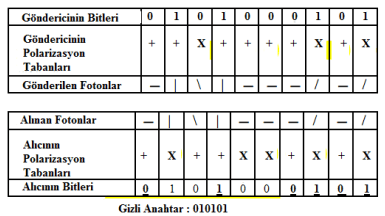
(Figure 2)
Once the protocol is completed, the message is encrypted with the message key and decrypted and read by the receiver.
Bennett, C., Brassard, G. (1984). Quantum Cryptography: Public Key Distribution and coin tossing, In Proceedings of the IEEE International Conference on Computers, Systems and Signal Processing, Bangalore, 175.
Gümüş, E. (2011). Kuantum Kriptografi ve Anahtar Dağıtım Protokolleri, Akademik Bilişim, Malatya.
Gürünlü, B. (2015). Kablosuz ağ teknolojilerine kuantum şifreleme, Master's thesis.
MONTANARO, A. (2016). Quantum Algorithms:An Oveview, NPJ Quantum Information, 2, 15023.
Toyran, M. (2006). Optik Ağlarda Kuantum Kriptografi Kullanarak Güvenli İletişim, 4. Eleco Uluslararası Elektrik ve Elektronik Mühendisliği Sempozyumu.
Toyran, M., Pedersen, Thomas B., Hasekioğlu, A.S. (2011). Bilgi Güvenliğinde Kuantum Teknikleri, IV. Ağ ve Bilgi Güvenliği Ulusal Sempozyumu Bildirileri, Ankara, Türkiye.

No Discussion Added Yet
Start discussion for "Quantum Cryptography" article
Quantum Key Distribution