


This article was automatically translated from the original Turkish version.
Name(s) | Quantum Entanglement | ||||||||
|---|---|---|---|---|---|---|---|---|---|
Area(s) | Quantum Physics / Theoretical Physics | ||||||||
First Theoretical Foundation | 1935 | ||||||||
First Experimental Validation | 1981 | ||||||||
Key Concepts | Quantum correlations Local realism Bell inequalities EPR paradox | ||||||||
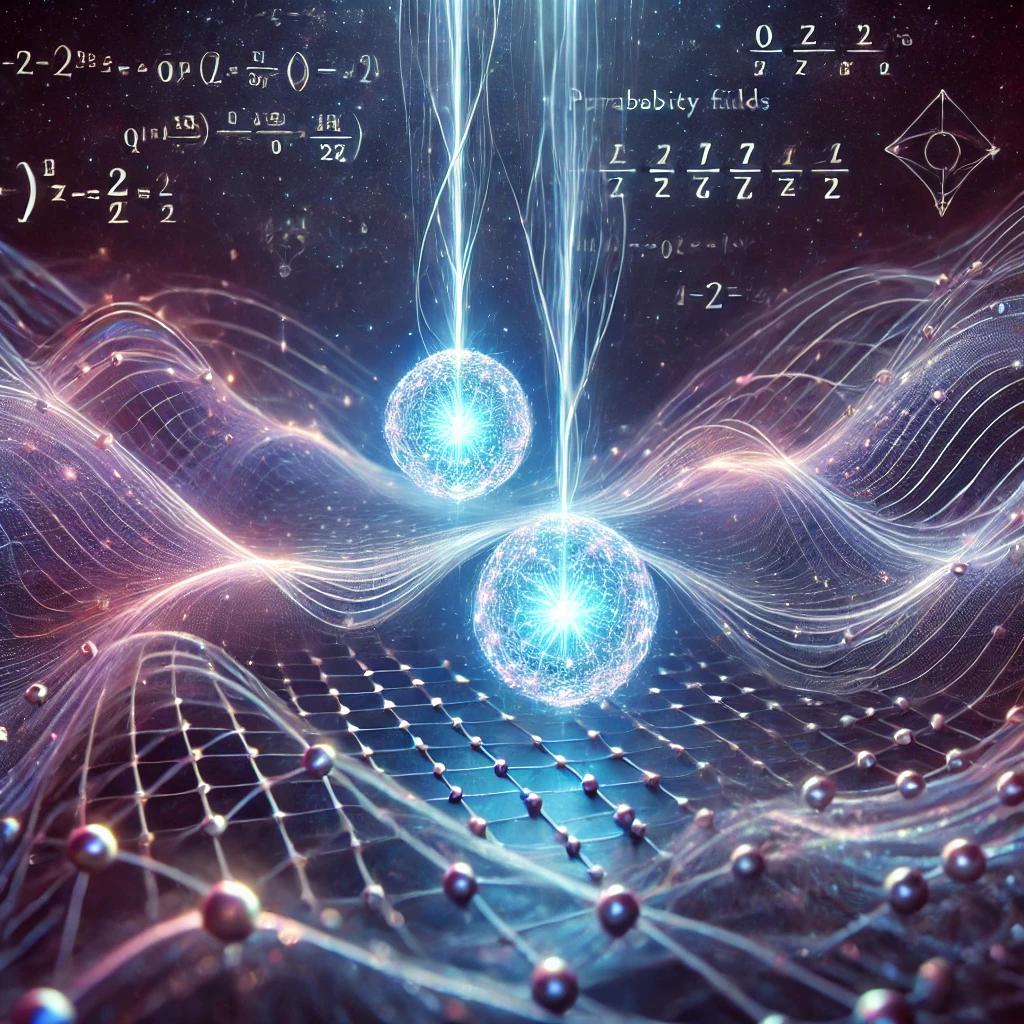
Quantum entanglement is a state in which the quantum states of two or more particles become inseparably linked such that they cannot be described independently of each other independent. In such systems, regardless of the distance between the particles, a measurement on one instantly determines the state of the other. Entanglement is one of the fundamental features that distinguish quantum mechanics radically from classical physics classical.
The concept of quantum entanglement was introduced theoretically in 1935 through the “EPR Paper” published by Albert Einstein, Boris Podolsky, and Nathan Rosen. The paper argued that quantum theory was incomplete and that a more comprehensive theory, based on the principle of local realism and involving “hidden variables,” was necessary. EPR claimed that the instantaneous influence between measurements on entangled particles constituted a “spooky action at a distance” that contradicted physical reality.
In the same year, Erwin Schrödinger examined the EPR argument and coined the term “entangled” to describe such systems. According to Schrödinger, entanglement is not a marginal aspect of quantum theory but its most distinctive feature. At this point, entanglement became central to the quantum formalism.
Quantum systems are described using state vectors. The state of a single particle is represented by a vector ∣ψ⟩ in a Hilbert space. If the state of a two-particle system can be expressed as:
∣ψ⟩ = ∣ψA⟩ ⊗ ∣ψB⟩
then the system is said to be separable. However, if the state cannot be written in this form:
∣ψ⟩ ≠ ∣ψA⟩ ⊗ ∣ψB⟩
then the state is called entangled. For example, one of the Bell states:
∣Φ⁺⟩ = 1/√2 (∣00⟩ + ∣11⟩)
is an entangled state of a two-qubit system that cannot be expressed as a product of individual particle states. A measurement on one particle in this system instantly determines the state of the other.
Entanglement is closely related to the principles of quantum measurement and superposition. Upon measurement, the system’s wave function collapses, and strongly correlated outcomes are observed between entangled particles—correlations that cannot be explained statistically by classical means.
In 1964, John S. Bell developed a mathematical framework, known as Bell inequalities, to test the assumption of local realism proposed in the EPR paper. These inequalities set upper limits on the correlations achievable by classical local theories. If a system violates a Bell inequality, it cannot be explained by classical local hidden variables.
Between 1981 and 1982, Alain Aspect and his team conducted experiments testing Bell inequalities and demonstrated that the correlations predicted by quantum theory exceed the limits allowed by classical local models.
In 2015, loophole-free Bell tests—such as the experiment by Ronald Hanson at Delft University—eliminated experimental loopholes (including detector efficiency and randomness in measurement settings), confirming the violation of Bell inequalities with greater rigor strong.
Entanglement is used to ensure security in quantum key distribution methods such as the BB84 protocol like. For instance, two users can generate a cryptographic key immune to eavesdropping by using entangled photons common.
In an experiment successfully carried out in 1997 by Anton Zeilinger’s team, the quantum state of a particle was transferred to a distant particle via a pair of entangled particles. This process process transmits quantum information, not physical matter.
Entanglement between qubits in quantum computers enables parallel execution of operations. Algorithms such as the Shor algorithm cannot function without entanglement.
Aspect, Alain, Philippe Grangier, and Gérard Roger. “Experimental Realization of Einstein-Podolsky-Rosen-Bohm Gedankenexperiment: A New Violation of Bell’s Inequalities.” *Physical Review Letters* 49, no. 2 (1982): 91–94. https://doi.org/10.1103/PhysRevLett.49.91.
Bell, John S. “On the Einstein Podolsky Rosen Paradox.” *Physics Physique Физика* 1, no. 3 (1964): 195–200. https://doi.org/10.1103/PhysicsPhysiqueFizika.1.195.
Einstein, Albert, Boris Podolsky, and Nathan Rosen. “Can Quantum-Mechanical Description of Physical Reality Be Considered Complete?” *Physical Review* 47, no. 10 (1935): 777–780. https://doi.org/10.1103/PhysRev.47.777.
Hanson, B., L. Hensen, B. Bernien, et al. “Loophole-Free Bell Inequality Violation Using Electron Spins Separated by 1.3 Kilometres.” *Nature* 526 (2015): 682–686. https://doi.org/10.1038/nature15759.
Nielsen, Michael A., and Isaac L. Chuang. *Quantum Computation and Quantum Information*. Cambridge: Cambridge University Press, 2010. https://www.cambridge.org/highereducation/books/quantum-computation-and-quantum-information/01E10196D0A682A6AEFFEA52D53BE9AE.
Schrödinger, Erwin. “Discussion of Probability Relations between Separated Systems.” *Proceedings of the Cambridge Philosophical Society* 31, no. 4 (1935): 555–563. https://doi.org/10.1017/S0305004100013554.
Zeilinger, Anton. “Experiment and the Foundations of Quantum Physics.” *Reviews of Modern Physics* 71, no. 2 (1999): S288–S297. https://doi.org/10.1103/RevModPhys.71.S288.

Name(s) | Quantum Entanglement | ||||||||
|---|---|---|---|---|---|---|---|---|---|
Area(s) | Quantum Physics / Theoretical Physics | ||||||||
First Theoretical Foundation | 1935 | ||||||||
First Experimental Validation | 1981 | ||||||||
Key Concepts | Quantum correlations Local realism Bell inequalities EPR paradox | ||||||||
No Discussion Added Yet
Start discussion for "Quantum Entanglement " article
Historical Background
Theoretical Foundations
Bell’s Theorem and Experimental Tests
Applications
Quantum Cryptography
Quantum Teleportation
Quantum Computing