


This article was automatically translated from the original Turkish version.
+1 More
Scientific Name(s) | Nyctereutes procyonoides | ||||||||
|---|---|---|---|---|---|---|---|---|---|
Family(ies) | Canidae | ||||||||
Diet(s) | Omnivore (both carnivorous and herbivorous) | ||||||||
Traditional Art | Represented by Shigaraki-yaki ceramic statues | ||||||||
Cultural Symbolism | Prosperity, luck, abundance, commercial success | ||||||||
Mythological Role | A shape-shifting, cheerful and cunning 'yokai' | ||||||||
Distinguishing Feature | The only canid species that hibernates | ||||||||
Place of Origin | East Asia (especially Japan) | ||||||||
Raccoon Dog (Nyctereutes procyonoides) is a mammal species native to East Asia, belonging to the Canidae family. It resembles a raccoon in appearance but possesses unique biological characteristics. Known in English as the "raccoon dog," this animal is taxonomically related to dogs and wolves, not to badgers or raccoons.
In Japanese cultural history and folklore, the Tanuki holds a profound place and is described with a dual identity: both as a biological creature and as a "yokai" (supernatural being). Due to its natural variations and mythological abilities of shape-shifting, it is regarded in Japan as a symbol of prosperity, joy, and transformation.
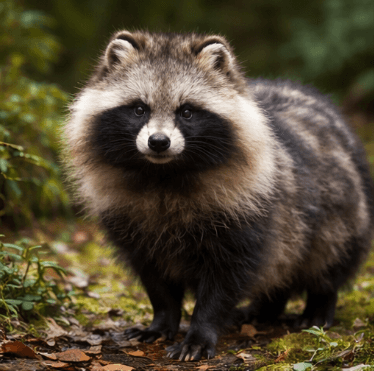
Tanuki (generated by AI)
The natural range of the Tanuki encompasses southeastern Siberia, China, northern Vietnam, Korea, and Japan. Scientific literature reveals distinct genetic and physical differences between Tanuki populations in continental Asia and Japan. Accordingly, the species is divided into subspecies: the continental Nyctereutes procyonoides procyonoides and N. p. ussuriensis, and the Japanese endemic N. p. viverrinus. Cytogenetic studies have shown that the Japanese Tanuki has a diploid chromosome number of 2n=38, while continental subspecies possess 2n=54 chromosomes. This genetic distinction, combined with the Japanese subspecies’ weaker fur insulation compared to continental populations, has fueled scientific debates regarding its classification as a separate species.
An adult Tanuki measures 50 to 68 cm in head-body length and, while similar in size to a red fox, has shorter legs and a shorter tail measuring 13 to 25 cm. Its body weight varies dramatically with seasonal cycles: while it weighs 4 to 6 kg in summer, fat accumulation before winter can increase its weight up to 10 kg. The Tanuki is evolutionarily unique among Canidae as the only species known to enter winter torpor. Additionally, its curved claws enable it to climb trees. As an omnivore, it feeds on seeds, fruits, invertebrates, and small animals, allowing it to adapt to diverse habitats.
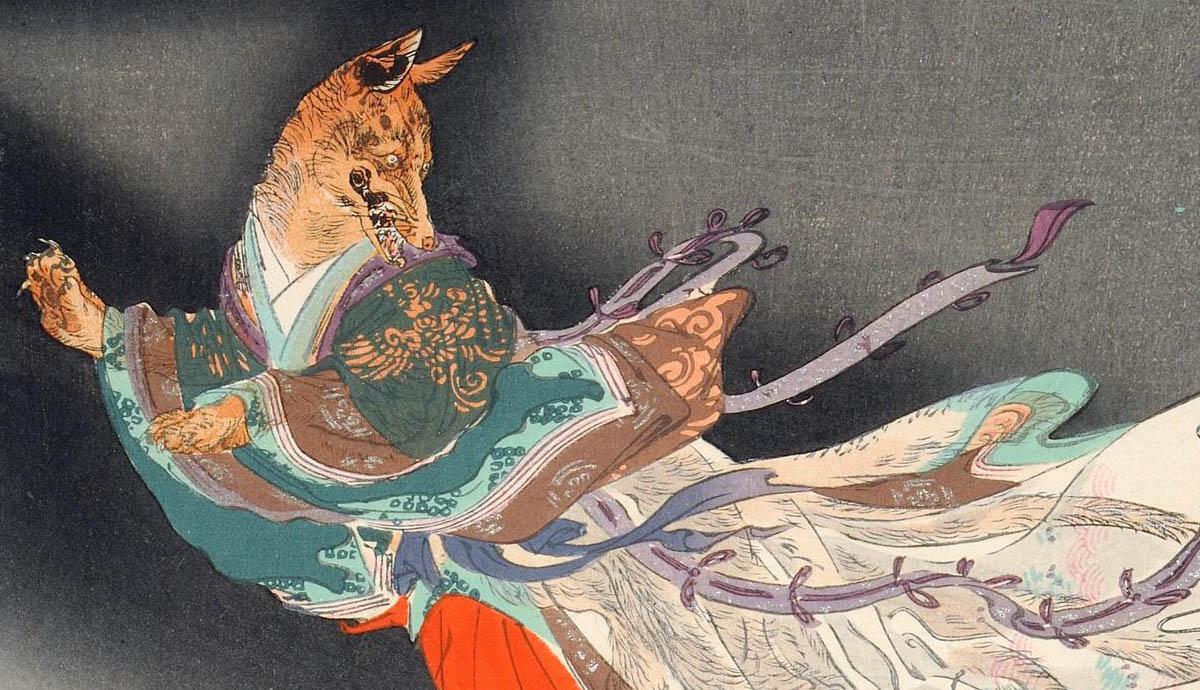
In Japanese mythology, the Tanuki belongs to the group of animals known as "Henge," believed to possess shape-shifting abilities. Folklore often compares it to the Kitsune (fox). According to legends, while the Kitsune is depicted as more intelligent, serious, and sometimes malicious in its trickery, the Tanuki is portrayed as playful, innocent, slightly foolish, and benevolent in its mischief. The Tanuki’s tricks are aimed not at harming humans but at surprising or amusing them. Transforming leaves into money or assuming the form of objects are among its most famous shape-shifting methods.
Mysterious sounds attributed to the Tanuki in mythological narratives are called "Tanuki-Bayashi." These drum-like or flute-like noises heard at night are believed to be music created by the Tanuki to deceive humans or entertain each other. Tales such as "Shibaemon Tanuki" and stories of a monk’s struggle with a Tanuki are significant narratives studied in comparative analyses of Turkish and Japanese folk traditions for their moral and cultural lessons.

Hassoengi and the Eight Lucky Symbols (generated by AI)
In Japan, ceramic Tanuki statues (Shigaraki-yaki), commonly found outside restaurants and shops, bear the eight symbols of good fortune known as "Hassoengi." Each symbol carries metaphorical meanings associated with commercial success and personal prosperity:
In modern Japan, the Tanuki has adapted successfully to urban environments. As natural habitats shrink, Tanukis increasingly enter cities, where they are often seen foraging in gardens, parks, and streets. Although sometimes regarded as a nuisance for eating cat food or rummaging through trash, their public image remains largely positive, associated with charm and cheerfulness.
The cultural influence of the Tanuki extends to culinary traditions. Dishes named "Tanuki soba" or "Tanuki udon" contain no Tanuki meat; instead, they are prepared by adding crispy tempura batter fragments (tenkasu) to the noodles. This naming is linked to the idea that the tempura bits make the dish appear richer than it is — a kind of "deception" or transformation.
Ecologically, the Raccoon Dog is not a threatened species. In fact, introduced to Europe during the Soviet era for fur trade purposes, it has successfully expanded westward and is considered an invasive species with high potential in some regions. In zoos, it is commonly exhibited for educational purposes due to its status as the only Canid known to enter winter torpor and as an example of evolutionary convergence with raccoons.
Baban, Gabriela. "Japanese Mythical Creatures: Exploring Japanese Mythology." The Collector. Accessed February 9, 2026. https://www.thecollector.com/japanese-mythical-creatures-mythology/
Ercan, Peren. "Japon Mitolojisinde Yokailer." Çanakkale Onsekiz Mart Üniversitesi Akademik Arşiv. Accessed February 9, 2026. https://acikerisim.comu.edu.tr/server/api/core/bitstreams/7fc49d80-aafe-4636-a185-61fa747db584/content
Japan House Illinois. "Tanuki: The Raccoon Dog." Accessed February 9, 2026. https://japanhouse.illinois.edu/education/insights/tanuki
Kauhala, Kaarina. "Canids: Raccoon Dog." Canid Specialist Group. Accessed February 9, 2026. https://web.archive.org/web/20080625021140/http://www.canids.org/PUBLICAT/CNDNEWS2/racoondg.htm
WAZA: World Association of Zoos and Aquariums. "Nyctereutes Procyonoides (Raccoon Dog)." Accessed February 9, 2026. https://web.archive.org/web/20150410065554/http://www.waza.org/en/zoo/visit-the-zoo/dogs-and-hyenas/nyctereutes-procyonoides

Scientific Name(s) | Nyctereutes procyonoides | ||||||||
|---|---|---|---|---|---|---|---|---|---|
Family(ies) | Canidae | ||||||||
Diet(s) | Omnivore (both carnivorous and herbivorous) | ||||||||
Traditional Art | Represented by Shigaraki-yaki ceramic statues | ||||||||
Cultural Symbolism | Prosperity, luck, abundance, commercial success | ||||||||
Mythological Role | A shape-shifting, cheerful and cunning 'yokai' | ||||||||
Distinguishing Feature | The only canid species that hibernates | ||||||||
Place of Origin | East Asia (especially Japan) | ||||||||
No Discussion Added Yet
Start discussion for "Raccoon Dog (Tanuki)" article
Biological Characteristics and Taxonomy
Place in Japanese Folklore and Henge Culture
Symbolism: Hassoengi and the Eight Lucky Symbols
Modern Life and Human Interaction