


This article was automatically translated from the original Turkish version.
+2 More
“Rage bait” is a term referring to provocative, disturbing, or aggressive content specifically designed to trigger negative emotions such as anger and outrage in online environments. Such content is produced primarily on digital platforms, especially social media, with the aim of increasing engagement (clicks, comments, shares) and driving traffic. Oxford University Press defines it as “content deliberately crafted to provoke anger or outrage, typically published online to increase traffic or interaction on a specific webpage or social media post.”【1】
While the term shares functional similarities with “clickbait,” it differs by focusing specifically on intense negative emotions like anger rather than curiosity. Over time, usage has evolved to include derivatives such as “rage-baiting” (the act of provoking anger) and in marketing contexts, “outrage-bait marketing.”【2】

Oxford University Press Selected Rage Bait as Word of the Year (Oxford University Press)
According to Oxford University Press, the term “rage bait” was first used in 2002 in a Usenet post, in the context of drivers deliberately provoking other drivers who honked their horns. It later spread through internet slang, particularly via viral posts and tweets. Over time, it evolved into an overarching concept used not merely to describe specific content but to critique the entire content ecosystem and the platforms and creators that drive it.
In its 2025 Word of the Year process, Oxford University Press shortlisted “rage bait” alongside “aura farming” and “biohack.” After evaluating public voting and linguistic data analysis, “rage bait” was declared the Word of the Year. A key justification cited was that its usage had increased approximately threefold over the previous 12 months.
Oxford’s analysis noted that the rise of “rage bait” reflects the current state of attention, engagement, and ethical debates in the digital age. When considered alongside previous Words of the Year such as “brain rot,” it provides a linguistic map for understanding social media’s impact on mental well-being and online behavior.【3】
Rage bait is closely linked to the older online practice of “trolling.” Although users known as “trolls” have long existed on internet forums and social media, the rise of short-form video platforms—particularly TikTok—has given purposeful anger-provoking tactics a distinct and recognizable format.
Some research defines “rage-baiting” as “a video specifically designed to make you angry so that you engage with it more.” In such videos, the creator’s goal is to trigger the viewer’s anger, then gain popularity through thousands or even millions of likes, comments, and shares.
Research identifies several types of trolls, including the “insult troll,” the “offended troll” (who constantly feigns offense), the “show-off troll” (who makes provocative statements on topics they know little about), and the “look at me troll” (who exhibits extreme behavior for maximum attention). Rage bait is noted to intersect with these troll typologies.【4】
Content examples include the 2019 “food vandalism” trend of opening frozen food and licking it before replacing it, eating chocolate bars “incorrectly,” deliberately mispronouncing words, videos of people being rude to restaurant staff, and staged performances in gyms or on red carpets. While a significant portion of these videos are fabricated, some viewers are unaware of their artificial nature and respond emotionally as if reacting to real events.【5】

A Template for the Rage Bait Mechanism (Generated by Artificial Intelligence)
Social media research shows that messages laden with anger and moral outrage spread faster and more widely online than other emotional content. On social networks, messages containing “anger” are shared more frequently than those containing “sadness, disgust, or joy.”
In the context of “rage bait,” these findings, combined with algorithms that reward user engagement, result in anger-inducing content being systematically advantaged. Oxford’s analysis also notes that such content is strategically employed within “rage farming” frameworks, particularly in networks of performative politics and conspiracy-based disinformation.【6】
A synthesis of psychological and media research indicates that negative emotions have strong effects on attention and memory. Users typically respond more intensely to content perceived as threatening their views or identity, leading to greater amplification of anger-laden posts through comments and shares.
Studies show that a significant portion of adolescents use social media platforms intensively and continuously. The emotional climate and interaction culture of these environments have become inseparable from young people’s daily experiences. In this context, the impact of anger-centered content on youth is of particular importance.【7】
“Rage bait” is not only a strategy employed by individual users but also by commercial brands, startups, and political actors. In digital marketing and the startup ecosystem, approaches aimed at gaining visibility and buzz through controversial or boundary-pushing campaigns fall under this category. Within this framework, messages, product placements, or slogans with the potential to provoke specific audiences are deliberately chosen, transforming anger and reaction into a planned tool for attention-grabbing.【8】
In political communication, anger-laden content has become one of the primary tools for mobilizing voter bases and deepening polarization. Such content functions as part of a visibility-driven, performative style of politics, often employing aggressive rhetoric, identity-based appeals, and crisis narratives targeting opponents.
From the perspective of the online content economy, rage bait has become a mechanism that directly benefits content creators through increased views, follower growth, advertising revenue, and brand partnerships—while simultaneously provoking user anger. Thus, rage bait can be understood as a structural element that influences both users’ emotional states and the economic dynamics of digital platforms.
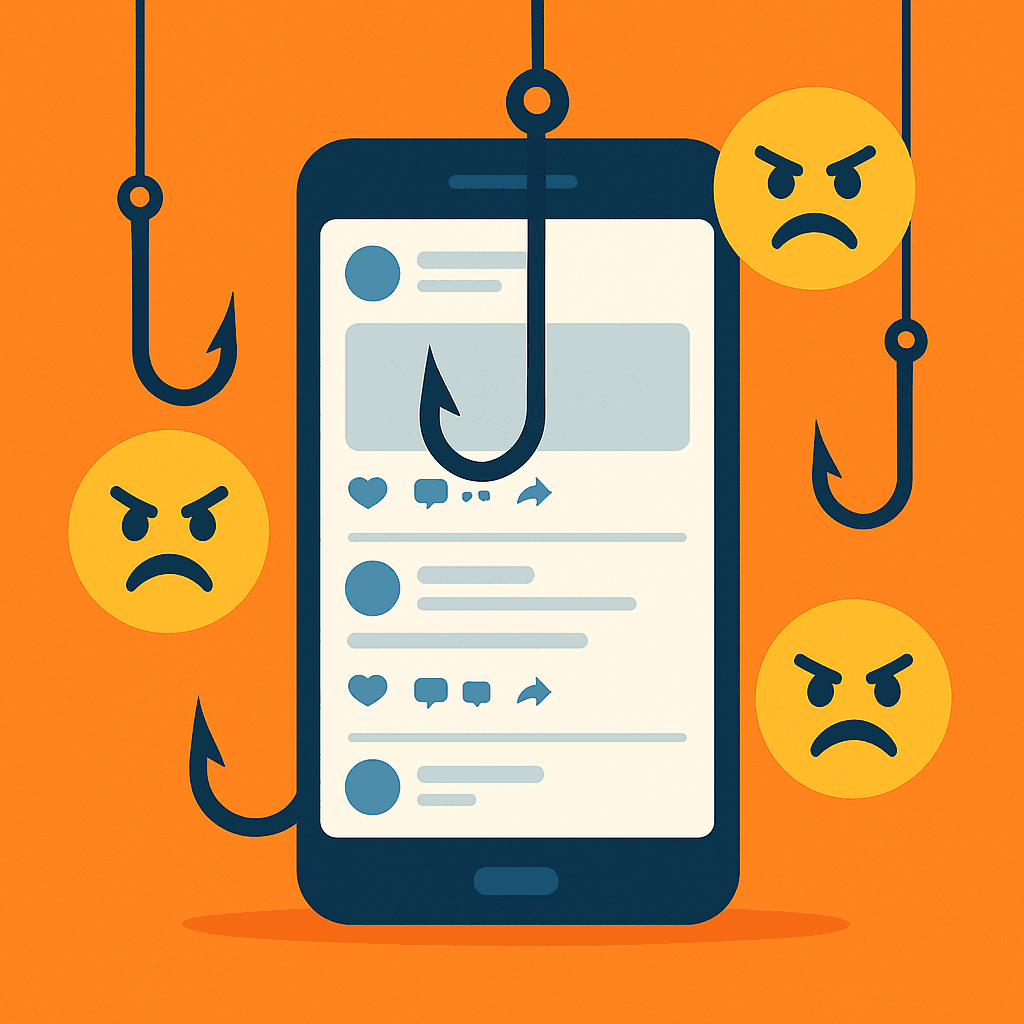
Rage Bait (Generated by Artificial Intelligence)
Major social media platforms have developed various rules and algorithmic measures to limit content designed to artificially drive user engagement. Posts containing direct calls to action such as “Share to like,” “Tag a friend,” or “Comment A or B?” are viewed as manipulative “bait” and may be demoted in content rankings.【9】
While rage bait does not always fall strictly within this narrow definition, it is associated with similar strategies aimed at manipulating engagement. When anger-based content overlaps with hate speech, harassment, disinformation, or other violations of community guidelines, it directly conflicts with platform content policies. At this point, transparent and consistent policies that restrict calls to hate and violence—and their stable enforcement—are critically important. Otherwise, anger- and hate-driven content, amplified by algorithms, can reach wider audiences and negatively shape the digital public sphere.
Repeated exposure to rage bait content and constant reactive engagement can become a systematic process that consumes users’ attention and time. Interaction with such content weakens individuals’ emotional resilience and cognitive control over time. The habit of responding quickly and automatically to anger-inducing posts may gradually lead users to become more easily provoked, more quickly fatigued, and more vulnerable in online environments.
The impact of rage bait also extends to the structure of online debates. A small but loud and aggressive group can dominate discussion agendas by producing provocative content. Due to design, algorithmic amplification, and sharing practices, such content may appear more widespread than it actually is. This environment contributes to making the overall “internet experience” feel irritating and exhausting—not only on specific topics but across the board.【10】
For young users, frequent exposure to rage bait during a period when social media is deeply integrated into daily life can intensify emotional processes such as anxiety, anger, hopelessness, burnout, and social comparison pressure. On platforms where news, entertainment, and social interaction are presented in the same stream, anger-centered content interacts with the sensitive developmental phases of adolescence, potentially generating more complex psychological outcomes.
[1]
Corp. Oxford University Press. “The Oxford Word of the Year 2025 is ‘Rage-Bait’.” Erişim: 1 Aralık 2025. https://corp.oup.com/news/the-oxford-word-of-the-year-2025-is-rage-bait/
[2]
Inc.com. Sam Blum. “The Era of Startup ‘Outrage-Bait’ Marketing Is Upon Us.” Erişim: 1 Aralık 2025. https://www.inc.com/sam-blum/the-era-of-startup-outrage-bait-marketing-is-upon-us/91270363
[3]
Corp. Oxford University Press. “The Oxford Word of the Year 2025 is ‘Rage-Bait’.” Erişim: 1 Aralık 2025. https://corp.oup.com/news/the-oxford-word-of-the-year-2025-is-rage-bait/
[4]
The Post Athens. “Rage-Baiting on TikTok and Media Literacy.” Erişim: 1 Aralık 2025.
https://www.thepostathens.com/article/2024/04/rage-baiting-tiktok-media-literacy
[5]
Maclean’s Magazine. “TikTok’s Gross Food Trend.” Erişim: 1 Aralık 2025. https://macleans.ca/society/tiktok-gross-food-trend/
[6]
Brady, William J., Julian A. Wills, John T. Jost, Joshua A. Tucker ve Jay J. Van Bavel.
“Emotion Shapes the Diffusion of Moralized Content in Social Networks.” Proceedings of the National Academy of Sciences 114, no. 28 (2017): 7313–7318.
Erişim: 1 Aralık 2025. https://www.pnas.org/doi/10.1073/pnas.1618923114
[7]
Anderson, Monica, ve Jingjing Jiang. Teens, Social Media & Technology 2018. Pew Research Center. Erişim: 1 Aralık 2025. https://www.pewresearch.org/internet/2018/05/31/teens-social-media-technology-2018/
[8]
Inc.com. Sam Blum. “The Era of Startup ‘Outrage-Bait’ Marketing Is Upon Us.” Erişim: 1 Aralık 2025. https://www.inc.com/sam-blum/the-era-of-startup-outrage-bait-marketing-is-upon-us/91270363
[9]
Meta / Facebook Business. “How Engagement Works on Facebook.” Erişim: 1 Aralık 2025. https://www.facebook.com/business/help/259911614709806?id=208060977200861
[10]
The Guardian. “Are a Few People Ruining the Internet for the Rest of Us?” Erişim: 1 Aralık 2025. https://www.theguardian.com/books/2025/jul/13/are-a-few-people-ruining-the-internet-for-the-rest-of-us

History and 2025 Oxford Word of the Year
Emergence in Digital Culture and Its Relationship to Trolling
Algorithms, Emotional Content, and Viral Dynamics
Rage Bait in Marketing, Politics, and Economics
Platform Policies and Content Moderation
Psychological Effects and User Experience