

This article was automatically translated from the original Turkish version.
+2 More
Raman Spectroscopy
Definitions | Raman Scattering, Surface-Enhanced Raman (SERS), Confocal Raman Microscopy | ||||||||
|---|---|---|---|---|---|---|---|---|---|
Applications | Biological cell analysis, Material characterization, Polymer structures, Single-molecule detection | ||||||||
Advantage(s) | Non-destructive analysis Compatible with aqueous systems Requires no sample preparation | ||||||||
Raman spectroscopy is a spectroscopic method based on light scattering, used to determine the molecular structure, chemical composition, and physical properties of materials. This technique was discovered in 1928 by Indian physicist C. V. Raman and earned him the Nobel Prize in Physics in 1930. Raman scattering arises from energy changes in photons as they interact with molecules in the sample. It has been reported that the use of Raman spectroscopy in biological analyses has increased by 30 percent over the past decade.

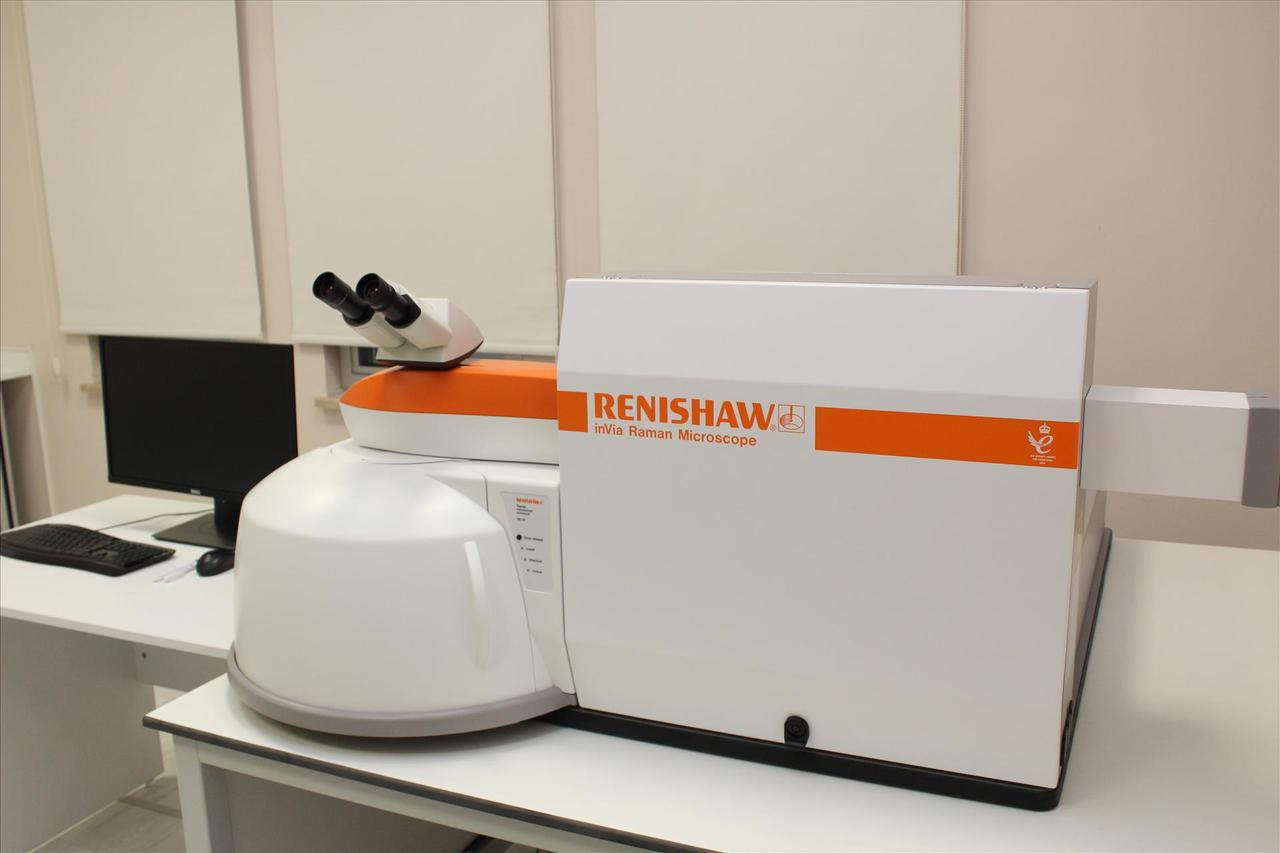
RAMAN (ARUM)
The foundation of Raman spectroscopy lies in the separation of elastically scattered (Rayleigh) and inelastically scattered (Raman) components of light emitted from a sample illuminated by monochromatic laser light. Raman scattering is associated with changes in the vibrational energy levels of molecules. Typical laser wavelengths used include 532 nm, 633 nm, and 785 nm; particularly 785 nm lasers offer the advantage of reducing fluorescent signals by up to 50 percent. Raman signals are generally weak with relative intensity levels around 10⁻⁶; therefore high-sensitivity detectors and appropriate filtering systems are required.

Three types of scattering of a molecule excited by a photon with energy E = hν. The most common transition is indicated by thick arrows.(1)

(A) Representation of spatial resolution and feature size for various Raman-based techniques. (B) Sensitivity scale of various Raman-based methods.(2)
Raman spectroscopy is a non-destructive method that requires no sample preparation and allows measurements through containers made of glass or plastic. Its compatibility with water facilitates analysis of biological samples. However, low scattering efficiency and fluorescence interference are the main limitations of this technique. To reduce fluorescence effects, longer wavelength lasers such as 785 nm can be employed, and signal enhancement by up to a factor of 10⁶ is possible using surface-enhanced techniques such as SERS (Surface-Enhanced Raman Spectroscopy).
Raman spectroscopy is used in chemistry, biology, materials science, forensic science, and cultural heritage analysis. It has diverse applications including identification of chemical compounds, characterization of polymers, monitoring of cellular biomolecules, and quality control of pharmaceutical formulations. Thanks to Surface-Enhanced Raman Spectroscopy (SERS), detection at the single-molecule level is achievable. Examples in Türkiye include polymer characterization studies conducted at the ODTÜ KÖRLS Laboratory and biological sample analyses carried out by SARGEM at Sakarya University.

Raman spectroscopy offers extensive possibilities for single-cell analysis. A high-throughput screened Raman spectroscopy system (a) enables acquisition of thousands of cells in a short time. Cells are automatically recognized in bright-field images and measured without human intervention (b). Average Raman spectra from thousands of leukocytes for three different cell types acquired with the HTS-RS system (c). Multivariate statistical analysis shows that these cells can be easily separated based on their molecular signatures (d). Raman images allow visualization of the intracellular distribution of different macromolecules (e). A Raman-based viability test can easily distinguish between live and dead cells (f). Examples obtained with low-resolution Raman spectroscopy for characterization of three different cell types demonstrate that cells can still be discriminated even with reduced spectral resolution, enabling the implementation of low-cost high-throughput systems (g).(3)
Raman spectroscopy has been adapted into various techniques to meet specific application needs. SERS (Surface-Enhanced Raman Spectroscopy) enhances Raman signals by millions of times using metal nanoparticles, enabling analysis even at extremely low concentrations. Confocal Raman microscopy provides high spatial resolution mapping of microscale regions. Time-resolved Raman spectroscopy allows investigation of the dynamics of transient molecular structures. These variations are employed in applications such as structural analysis of cancer cells or observation of protein interactions.
Arıkan, Metin. “Raman Spectroscopy and Its Applications.” *Atatürk ÜniversitesiAçık Erişim Veritabanı (AVESİS)*. Accessed July 2, 2025. https://avesis.atauni.edu.tr/yayin/cbd6a4fb-b537-447e-96a4-98833538dece/raman-spectroscopy-and-its-applications.
Barron, Andrew R. “Raman Spectroscopy.” In Physical Methods in Chemistry and Nano Science. LibreTexts Chemistry. Accessed July 2, 2025. https://chem.libretexts.org/Bookshelves/Analytical_Chemistry/Physical_Methods_in_Chemistry_and_Nano_Science_(Barron)/04%3A_Chemical_Speciation/4.03%3A_Raman_Spectroscopy.
Eskişehir Osmangazi University Research and Application Center (ARUM). "Raman Spektroskopi Analiz Birimi." arum.ogu.edu.tr. Accessed July 2, 2025. https://arum.ogu.edu.tr/Sayfa/Index/53/raman-spektroskopi-analiz-birimi.
ODTÜ Merkez Laboratory. "Kızıl Ötesi ve Raman Spektroskopi Laboratuvarı (KÖRLS)." merlab.metu.edu.tr. Accessed July 2, 2025. https://merlab.metu.edu.tr/tr/kizil-otesi-ve-raman-spektroskopi-laboratuvari-korl.
Sakarya University SARGEM. "Raman Spektrometresi." SARGEM - Sakarya Üniversitesi. Accessed July 2, 2025. https://sargem.sakarya.edu.tr/tr/icerik/26269/141384/raman-spektrometresi.
Zong, Chengbin, Qingsong Wu, Yulong Fang, Shuangming Chen, and Bing Zhao. “Surface-Enhanced Raman Spectroscopy for Bioanalysis: Reliability and Challenges.” *Analytical Chemistry* 93, no. 1 (2021): 295–302. https://doi.org/10.1021/acs.analchem.1c03235.
Öztürk, Fatma. “Raman Spektroskopisinin Temel Prensipleri ve Uygulamaları.” *World Biomedical Tech Journal* 1, no. 1 (2023): 10–17. https://dergipark.org.tr/en/pub/worlbiomedtech/issue/77249/1332034.

Raman Spectroscopy
Definitions | Raman Scattering, Surface-Enhanced Raman (SERS), Confocal Raman Microscopy | ||||||||
|---|---|---|---|---|---|---|---|---|---|
Applications | Biological cell analysis, Material characterization, Polymer structures, Single-molecule detection | ||||||||
Advantage(s) | Non-destructive analysis Compatible with aqueous systems Requires no sample preparation | ||||||||
Working Mechanism
Advantages and Limitations
Applications
Technical Variations