


This article was automatically translated from the original Turkish version.
The Random Forest (RF) algorithm, proposed by L. Breiman in 2001, has proven highly successful as a general-purpose method for classification and regression. This approach combines multiple random decision trees and aggregates their predictions by averaging, demonstrating exceptional performance in scenarios where the number of variables far exceeds the number of observations. It also exhibits flexibility in applying to large-scale problems, can be easily adapted to various specialized learning tasks, and provides measures of variable importance.
This supervised learning method draws inspiration from early work by Amit and Geman (1997), Ho (1998), and Dietterich (2000), and operates according to a simple yet effective “divide and conquer” principle. It samples subsets of the data, grows a random tree predictor on each small subset, and then combines and aggregates these predictors. The popularity of forests stems largely from their applicability to a wide range of prediction problems and their small number of tuning parameters.
As shown in Figure 1.1, RF is a model constructed by combining many decision trees. Each decision tree is trained on random subsets of the data and evaluates different features. These trees typically come together like a forest.
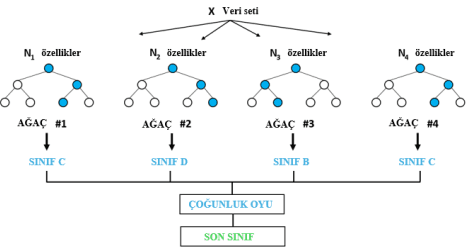
Random Forest Algorithm (MDPI)
As the number of trees in the forest increases, the generalization error of the forest often converges to a limit. The generalization error of a forest composed of decision tree classifiers depends on the strength of the individual trees and the correlation between them. The simplest RF, with random features, is constructed by selecting a random subset of input variables at each node.
When making predictions, the RF algorithm combines the predictions of each decision tree either by majority voting or by averaging. This enables RF to produce more reliable and generalized results by aggregating predictions from multiple models.
The RF algorithm can handle high-dimensional data and is even applicable in challenging settings with highly correlated predictors. It can capture nonlinear patterns of relationship between predictors and response. It does not require the user to specify an underlying model for the data. RF is a classification and regression method based on the combination of a large collection of decision trees. In particular, this method involves the union of trees constructed from a training dataset and internally validated, so that responses for future observations are inferred directly from the data. RF has become a popular analytical tool in many application areas, especially in bioinformatics. Due to its high flexibility and intuitive principle, it will continue to be important in the future. However, RF approaches still face a number of challenges. The data required for RF are obtained from experimental results, yet several questions remain.
Is it possible to exactly replicate the same forest in another application? How stable are the results obtained across different studies? How sensitive is RF to small changes in parameter values? How should we select parameter values or define candidate parameter values?
Answers to these questions have not yet been fully clarified. RF has demonstrated outstanding performance in situations where the number of variables greatly exceeds the number of observations, effectively handles complex interaction structures and highly correlated variables, and provides measures of variable importance. In addition to being easy to use, the method is commonly recognized for its accuracy and ability to cope with small sample sizes and high-dimensional feature spaces. It is also easily parallelizable, giving it potential for handling large real-world systems. The RF methodology has been successfully applied to various practical problems, including data science hackathons on air quality prediction, chemoinformatics, ecology, 3D object recognition, and bioinformatics. While Howard from Kaggle and Bowles from Biomatica (Howard and Bowles 2012) claim that decision tree ensembles, commonly known as “Random Forest,” are the most successful general-purpose algorithm of modern times, Varian, Chief Economist at Google (Varian 2014), also defends the use of RF in econometrics.
Biau, Gérard, and Erwan Scornet. "A Random Forest Guided Tour." *Test* 25 (2016): 197–227. https://doi.org/10.1007/s11749-016-0481-7.
Boulesteix, Anne-Laure, Sylvia Janitza, Jannis Kruppa, and Inke R. König. "Overview of Random Forest Methodology and Practical Guidance with Emphasis on Computational Biology and Bioinformatics." *Wiley Interdisciplinary Reviews: Data Mining and Knowledge Discovery* 2, no. 6 (2012): 493–507. https://doi.org/10.1002/widm.1072.
Breiman, Leo. "Random Forests." *Machine Learning* 45 (2001): 5–32. https://doi.org/10.1023/A:1010933404324.
MDPI. Random Forest Algorithm. A Novel Approach to Learning Models on EEG Data Using Graph Theory Features—A Comparative Study. Accessed
May 23, 2025. https://www.mdpi.com/2504-2289/5/3/39

No Discussion Added Yet
Start discussion for "Random Forest Method" article