

This article was automatically translated from the original Turkish version.
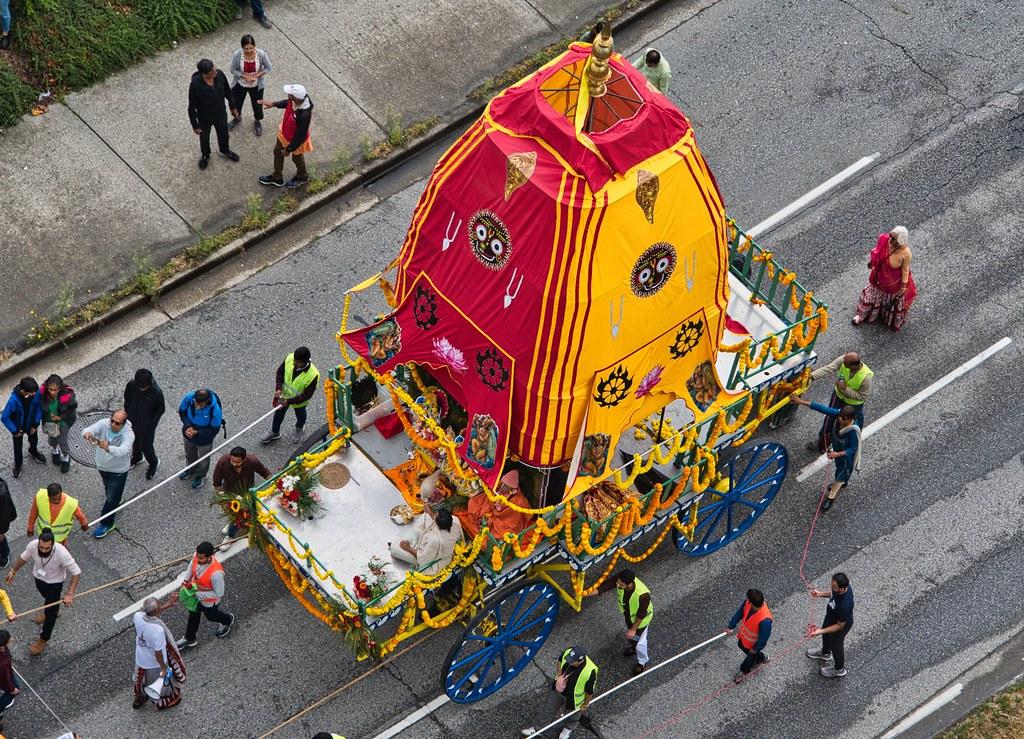
Rath Yatra is a religious festival of great significance in Hindu culture, commonly known as the “chariot procession.” Its origins trace back to the Jagannath Mandir in the city of Puri, Odisha, in eastern India. The festival involves the ceremonial transportation of the sacred wooden idols of the Hindu deities Lord Jagannath (an incarnation of Shri Krishna), his brother Balaram, and his sister Subhadra, placed on large chariots (rath), through the streets in a vibrant procession. It is observed annually on the second day of the Shukla Paksha in the Hindu month of Ashadh (Ashadh Sud Bij) and is witnessed by millions of devotees. Rath Yatra symbolizes the deities leaving their temple to mingle with the people, during which they bestow sacred blessings (darshan) upon ordinary devotees.

Rath Yatra (Pexels)
The origins of Rath Yatra are rooted in various stories from Hindu mythology and sacred texts. One of the most widely accepted legends relates to Krishna’s uncle Kansa, who sought to kill Krishna and his brother Balaram. Kansa sent Akrur to Gokul in a chariot to invite Krishna and Balaram to Mathura. After bidding farewell to the gopis of Gokul, Krishna and Balaram boarded the chariot. This day of departure is commemorated as Rath Yatra.【1】
According to another legend, Krishna took his sister Subhadra on a chariot ride around the city of Dwarka in the Saurashtra region. Additionally, after Krishna’s death, his body was said to have been carried to Jagannath Puri, where, inspired by a vision of King Indradyumna, his bones were sanctified and enshrined in wooden idols placed in the temple. These idols were crafted by the divine carpenter Vishwakarma but are renewed every twelve years in their incomplete forms.【2】
During the days of the procession, the temple doors are closed because it is believed that the deities are washed with 108 pots of water and then ritually burned. The fire of the ritual necessitates a “change of environment,” so the deities are temporarily removed from the temple and taken elsewhere—in legends, to the home of their aunt.【3】

Puri Ratha Yatra (Flickr)
Rath Yatra is not only celebrated in Jagannath Puri but also in numerous Hindu communities across India and around the world. The festival is also observed at BAPS Swaminarayan mandirs, where smaller idols are placed on chariots and paraded through the city.【4】 Devotees pray to Bhagwan Swaminarayan during the festival, seeking spiritual support for their worldly journeys.
During the festival, thousands of people pull the chariots. The construction of the chariots is carried out with great precision, taking 42 days to complete using approximately 4,000 pieces of wood, and is performed exclusively by a specific family.【5】 As the procession moves, devotees scatter rice, gulal powder, and flowers to express their love and devotion to the deities. The path of the chariots is traditionally swept clean with a golden broom by local royalty or officials. It is also customary for elephants to accompany the chariots during the procession.

Ratha Yatra Representatives (Flickr)
The original Rath Yatra in Jagannath Puri is among the largest festivals in the Hindu world. Similar rituals are observed in many locations, including Gujarat, Bengal, Odisha, Madhya Pradesh, and other regions with Hindu communities worldwide. Particularly in cities such as Ahmedabad and Surat in Gujarat, colorful and crowded processions are held, with chariots mounted on trucks and driven through the streets. In regions like Panna (Madhya Pradesh), Rath Yatra festivals dedicated to Jagannath are still conducted, preserving historical traditions.
At the end of the festival, the chariots are dismantled and used as firewood in the temple kitchen. The kitchen at the Jagannath Puri temple is one of the largest in the world, serving meals daily to tens of thousands of people. The elephants are either released into natural habitats after the festival or placed under the care of temple trusts.
However, in recent years, ethical and conservation concerns regarding the use of elephants have come to the forefront. Long train journeys undertaken to transport elephants from Assam have been protested by animal rights activists.【6】
[1]
Swaminarayan. “Ratha Yatra Festival.” Swaminarayan.org. Erişim Tarihi: 26 Kasım 2025. https://www.swaminarayan.org/festivals/rathyatra/index.htm
[2]
BBC. “Rath Yatra: The legend behind world's largest chariot festival” BBC.com. Erişim Tarihi: 26 Kasım 2025. https://www.bbc.com/news/world-asia-india-48864239
[3]
BBC. “Rath Yatra: The legend behind world's largest chariot festival” BBC.com. Erişim Tarihi: 26 Kasım 2025. https://www.bbc.com/news/world-asia-india-48864239
[4]
BAPS Swaminarayan Sanstha. “RathYatra – Annual Celebrations & Festivals.” BAPS.org. Erişim Tarihi: 26 Kasım 2025. https://www.baps.org/cultureandheritage/Traditions/AnnualCelebrationsandFestivals/RathYatra.aspx
[5]
BBC. “Rath Yatra: The legend behind world's largest chariot festival” BBC.com. Erişim Tarihi: 26 Kasım 2025. https://www.bbc.com/news/world-asia-india-48864239
[6]
BBC. “Rath Yatra: The legend behind world's largest chariot festival” BBC.com. Erişim Tarihi: 26 Kasım 2025. https://www.bbc.com/news/world-asia-india-48864239

No Discussion Added Yet
Start discussion for "Rath Yatra Festival" article
Origins and Legends
Significance and Rituals
Geographical Spread and Contemporary Celebrations
After the Festival and Contemporary Debates