This article was automatically translated from the original Turkish version.
Origin(s) | Italy | ||||||||
|---|---|---|---|---|---|---|---|---|---|
Geographical Distribution | Italy Europe Other Regions | ||||||||
Historical Period | Documented Since the Middle Ages | ||||||||
Kitchen | Italian Cuisine | ||||||||
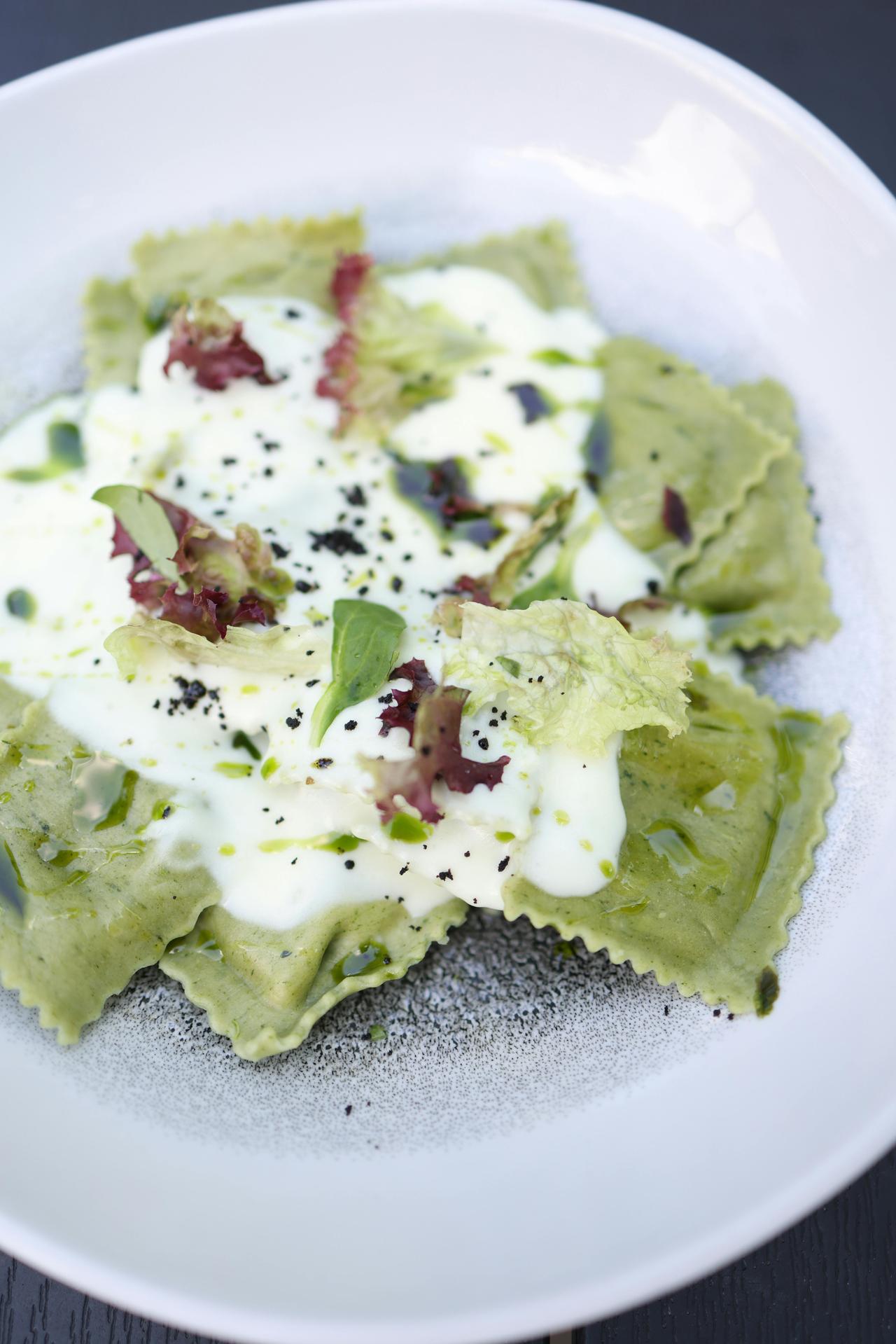
Ravioli is a type of pasta belonging to the category of stuffed pasta (pasta ripiena) in Italian cuisine, prepared by placing a filling between two layers of pasta dough. It is typically square or rectangular in shape, with the edges of the dough layers sealed to enclose the filling. Ravioli is classified as a distinct group within the taxonomy of Italian stuffed pastas due to its shape and filling structure, distinguishing it from three-dimensional, ring-shaped varieties such as tortellini.

Preparation of Ravioli (Pexels)
Scientific classification studies on the origins and development of Italian stuffed pastas reveal an evolutionary divergence based on their formal and geographical characteristics. A study grounded in phylogenetic and biogeographic analysis categorizes pasta ripiena types into two main groups: the “ravioli clade” and the “tortellini clade.” The ravioli clade encompasses forms consisting of flat layers of dough with filling placed between them.【1】
According to this classification, many varieties of stuffed pasta known today by different regional names are considered to have evolved from similar historical production techniques and subsequently diversified according to local culinary traditions. Although exceptions such as culurgiones from Sardinia exist, it is widely argued that numerous forms of stuffed pasta in Italy share a common historical origin.【2】
The fundamental structure of ravioli is based on placing a filling between two thin sheets of pasta dough and sealing the edges. This structure is the key formal characteristic that distinguishes ravioli from stuffed pastas formed by folding or rolling.
The ingredients used in the filling vary according to regional production capabilities and traditional culinary practices. Cheese, vegetable, and meat-based fillings are commonly used. Vegetable fillings such as spinach and artichoke are also widely employed in ravioli preparation. The composition of the filling influences not only the nutritional profile of the product but also its cooking behavior and textural qualities.
The ratio of dough to filling is a technical factor that determines both the shape and cooking properties of ravioli. Consequently, variations in dough thickness, filling quantity, and sealing techniques can be observed among ravioli types produced in different regions.

Pasta Dough for Ravioli (Pexels)
In the context of Italian gastronomy, ravioli manifests with diverse ingredients and flavor profiles across regional cuisines. Within the repertoire of stuffed pastas concentrated in northern Italy, ravioli and similar forms have developed distinct characteristics based on local production traditions and ingredient usage. This regional diversity underscores the richness and historical continuity of Italian cuisine.
Similar stuffed or filled dough products are not unique to Italy but are found across a broad geographical area; they exhibit technical and structural parallels with Turkish mantı and Central and Northern European dumpling varieties. In such comparative contexts, ravioli is regarded as one of the Italian representatives of the universal repertoire of filled dough traditions, yet it holds a unique position due to its distinctive form and cultural context.【3】
Boltneva, Valeria. “Plaka, Tabak, Akşam Yemeği, Yemek.” Pexels. Accessed January 28, 2026. https://www.pexels.com/tr-tr/fotograf/plaka-tabak-aksam-yemegi-yemek-17628608/
Himmel, Christian. “Tozlu Bir Yüzeyde Taze Ev Yapımı Ravioli.” Pexels. Accessed January 28, 2026. https://www.pexels.com/tr-tr/fotograf/tozlu-bir-yuzeyde-taze-ev-yapimi-ravioli-32421665/
Lacivita, Valentina, Maria Marziliano, Matteo Alessandro Del Nobile, and Amalia Conte. “Artisanal Fresh Filled Pasta with Pomegranate Peels as Natural Preservative.” *LWT* 172 (December 30, 2022): 114209. Accessed January 28, 2026. https://www.sciencedirect.com/science/article/pii/S0023643822011446
Nazari, Vazrick, Antonella Pasqualone, Andrea Pieroni, Valentina Todisco, Sofia Belardinelli, and Telmo Pievani. “Evolution of the Italian Pasta Ripiena: The First Steps Toward a Scientific Classification.” *Discover Food* 4 (2024): 57. Accessed January 28, 2026. https://link.springer.com/article/10.1007/s44187-024-00136-1
Ro, Eun Young, Geun Su Kim, Do Young Kwon, Young Min Park, Sang Woo Cho, Sang Yun Lee, Ik Hyun Yeo, and Ki Sun Yoon. “Effects of Natural Antimicrobials with Modified Atmosphere Packaging on the Growth Kinetics of Listeria Monocytogenes in Ravioli at Various Temperatures.” *Journal of Food Safety* 38, no. 1 (2018): e12392. Accessed January 28, 2026. https://onlinelibrary.wiley.com/doi/epdf/10.1111/jfs.12392
Steinberg, Adam. “Gıda, Yemek, Yiyecek – Makarna.” Pexels. Accessed January 28, 2026. https://www.pexels.com/tr-tr/fotograf/gida-yemek-yiyecek-makarna-5930586/
Suarez, Ray. “Domates Soslu ve Ispanaklı Gurme Ravioli.” Pexels. Accessed January 28, 2026. https://www.pexels.com/tr-tr/fotograf/domates-soslu-ve-ispanakli-gurme-ravioli-34565195/
Università di Padova. “Unipd Research – Investigating the Evolution of the Italian Pasta Ripena.” *Università di Padova News*, July 24, 2024. Accessed January 28, 2026. https://www.unipd.it/news/unipd-research-investigating-evolution-italian-pasta-ripena
[1]
Vazrick Nazari, Antonella Pasqualone, Andrea Pieroni, Valentina Todisco, Sofia Belardinelli ve Telmo Pievani, 2024, “Evolution of the Italian pasta ripiena: the first steps toward a scientific classification.” Discover Food 4, no. 1 (12 Temmuz 2024): makale no. 57, s.1, Son Erişim: 28 Ocak 2026, https://link.springer.com/article/10.1007/s44187-024-00136-1
[2]
A.e., s.1.
[3]
A.e., s.1.

Origin(s) | Italy | ||||||||
|---|---|---|---|---|---|---|---|---|---|
Geographical Distribution | Italy Europe Other Regions | ||||||||
Historical Period | Documented Since the Middle Ages | ||||||||
Kitchen | Italian Cuisine | ||||||||
History
Structural Features and Filling Types
Cultural and Regional Variations