

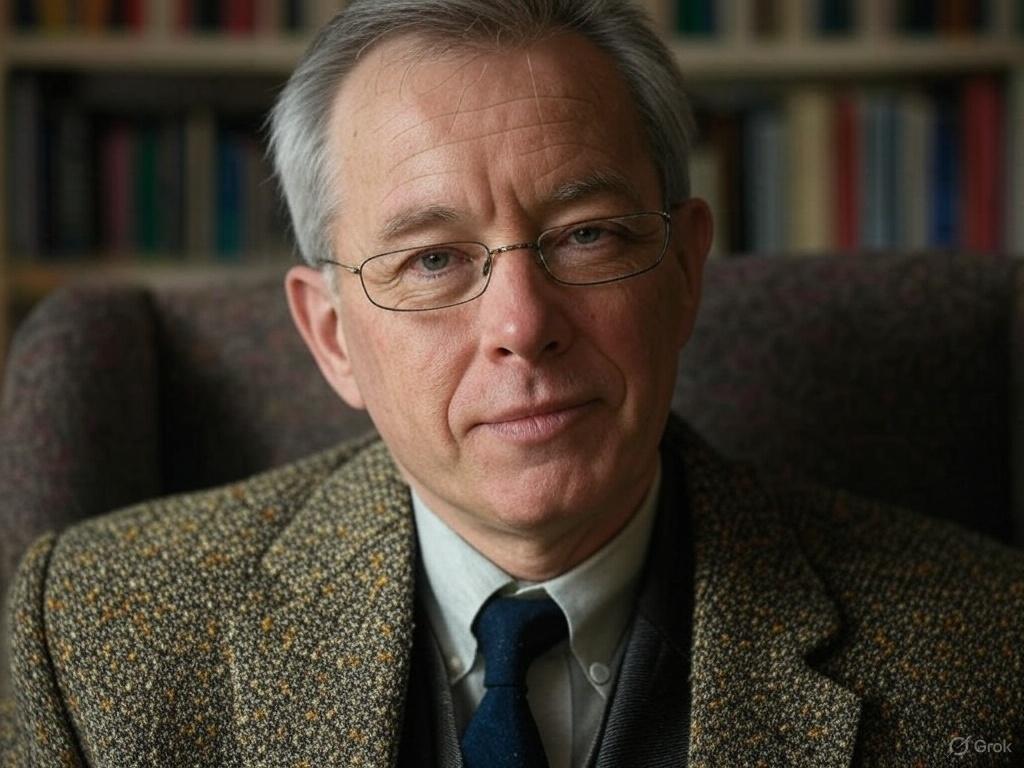

Raymond Bernard Cattell (20 March 1905, Hilltop, England – 2 February 1998, Honolulu, Hawaii) was an Anglo-American psychologist regarded as one of the founding figures of personality psychology and a pioneer in the development of intelligence and personality tests. He is best known for the “16 Personality Factor Theory (16PF)” and his distinction between fluid and crystallized intelligence. Throughout his academic career, he worked to integrate quantitative methods into scientific psychology and was among the first to systematically apply factor analysis to personality measurement.
Raymond Cattell was born in the Staffordshire region of England. Having witnessed the destructive impact of the First World War during his childhood, Cattell developed a lasting interest in understanding human behavior.
In 1924, he graduated from University College London, part of the University of London, with a bachelor's degree degree in chemistry. However, within a few years he shifted his focus to psychology and completed his doctorate in psychology at the same university in 1929. During his doctoral studies, he was influenced by Charles Spearman’s statistical methods, and his interest in factor analysis took shape during this period.
In 1937, Cattell moved to the United States. After brief appointments at Columbia University and Clark University like, he began his professorship at the University of Illinois Urbana-Champaign in 1945. There he founded the Psychological Research Center. After retiring in 1973, he continued his work in Hawaii.
One of Cattell’s most significant contributions was his effort to use factor analysis to statistically analyze personality structure. The 16 Personality Factors model he developed is regarded as one of the foundational pillars of personality psychology. In his studies on intelligence, he distinguished intelligence into fluid intelligence and crystallized intelligence. This distinction has become a critical concept in theories of cognitive development.
These works have led the scientific approach in psychology, both theoretically and methodologically.
Cattell was interested in nature walks and sail sports. He was also known to be an avid classical music enthusiast.
Cattell married twice and had four children. He collaborated with his wife Heather Birkett on numerous together scientific common work.
After officially retiring in 1973, he continued his research at an institute in Hawaii. During this period, he focused on writing about ethics, education, and religious topics.
Raymond Cattell died in Hawaii on 2 February 1998 at the age of 92.
Cattell’s 16PF test is still in use today in its original form common. His work on scientifically classifying personality traits is widely regarded as the direct precursor to the modern Five-Factor Model (Big Five).
Cattell’s personality theories have been applied across numerous fields, from education to industrial psychology, and he played a leading role in the development of psychometric methods. Among his students were prominent figures such as Hans Eysenck and John Horn.
Cattell, Raymond B. Handbook of Multivariate Experimental Psychology. Chicago: Rand McNally, 1966.
Cattell, Raymond B. Personality: A Systematic, Theoretical and Factual Study. New York: McGraw-Hill, 1950.
Cattell, Raymond B. The Description and Measurement of Personality. Yonkers-on-Hudson: World Book Company, 1946.
Cattell, Raymond B. The Scientific Analysis of Personality. Baltimore: Penguin Books, 1965.
Loehlin, John C. Latent Variable Models: An Introduction to Factor, Path, and Structural Equation Analysis. Mahwah, NJ: Lawrence Erlbaum Associates, 2004.
Ritchie, Tom. "Raymond Cattell and the Scientific Study of Personality." Journal of the History of the Behavioral Sciences 35, no. 1 (1999): 3–25.

No Discussion Added Yet
Start discussion for "Raymond Bernard Cattell" article
YOUTH AND EDUCATION
Childhood and Youth
Educational Background
CAREER AND ACHIEVEMENTS
Career Path
Key Achievements
MAJOR WORKS AND CONTRIBUTIONS
Contributions
Publications and Projects
PERSONAL LIFE
Hobbies and Interests
Private Life
LATER YEARS AND DEATH
Final Years
Death
LEGACY AND INFLUENCE
Posthumous Impact
Source of Inspiration