


This article was automatically translated from the original Turkish version.
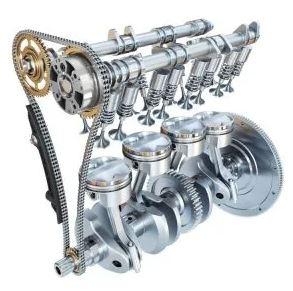
Today, they are the most widely used common. Piston-type internal combustion engines can be classified into many categories based on their characteristics (Work principles, thermodynamic cycles, mixture formation, cylinder arrangement, cooling system, lubrication system, initial movement system, and fuels like).
Piston-type internal combustion engines are classified according to thermodynamic cycles as follows:
-Otto cycle (spark-ignition ‘gasoline’ engines)
-Diesel cycle (compression-ignition ‘diesel’ engines)
-Mixed cycle
Truth in a physical medium, combustion occurs inside the engine cylinder. The heat energy released after combustion is converted into mechanical energy. During engine operation, intake, compression, power, and exhaust strokes occur. In the theoretical Otto cycle, however, a working fluid that facilitates heat transfer is assumed to exist within the cylinder. This working fluid is air, treated as an ideal gas. The air inside the cylinder is heated by an external heat source. The theoretical Otto cycle consists of two constant-volume processes and two insulated (adiabatic) processes.
The following assumptions are made for all theoretical air-standard cycles (Otto, Diesel, karma):
-The gas used in the cycle is air, assumed to be an ideal gas.
-The mass of the working gas (air) is constant and does not change throughout the cycle.
-There is no heat transfer between the system and its surroundings during compression and expansion. That is, compression and expansion processes are isentropic (adiabatic).
-The heat capacity (specific heats) of air, assumed to be an ideal gas, is considered constant and independent of temperature.
-The combustion process is replaced by heat addition from an external source, and the exhaust process is replaced by heat rejection to an external sink.
-All state changes constituting the cycle are internally reversible.
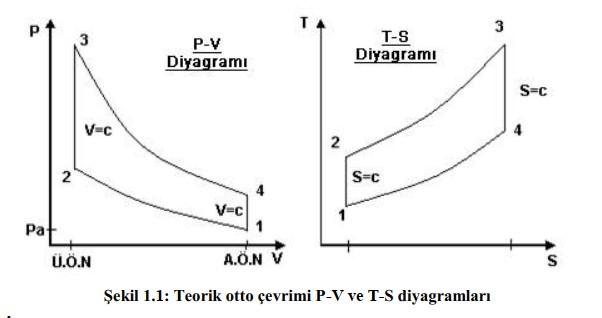
-The working fluid (ideal gas, in reality a fuel-air mixture) is compressed isentropically from point 1 to point 2.
-At the end of compression, the pressure and temperature of the working fluid increase. Heat is added at constant volume from point 2 to point 3, causing further increases in pressure and temperature.
At point 3, pressure and temperature reach their maximum values. From point 3 to point 4, the piston is pushed downward by the pressure, resulting in an isentropic expansion.
From point 4 to point 1, heat is rejected from the working fluid at constant volume, returning the system to its initial conditions at point 1 and completing the cycle.
On the T-S diagram, S represents entropy (In the universe, every system tends toward minimum energy and maximum disorder.) and entropy remains constant during an isentropic process.
The theoretical Otto cycle is a closed and reversible cycle. The cycle used in gasoline (spark-ignition) engines follows the basic logic of the theoretical Otto cycle but is an open cycle, meaning there is mass exchange with the external environment. Moreover, in reality, no cycle is perfectly reversible. In the practical Otto cycle, the fuel-air mixture drawn into the engine is not an ideal gas, so specific heats vary with temperature changes.
The theoretical Otto cycle does not consider the intake stroke because it is a closed system. The working fluid inside the system is an ideal gas, and the mass of the fluid remains constant for each cycle.
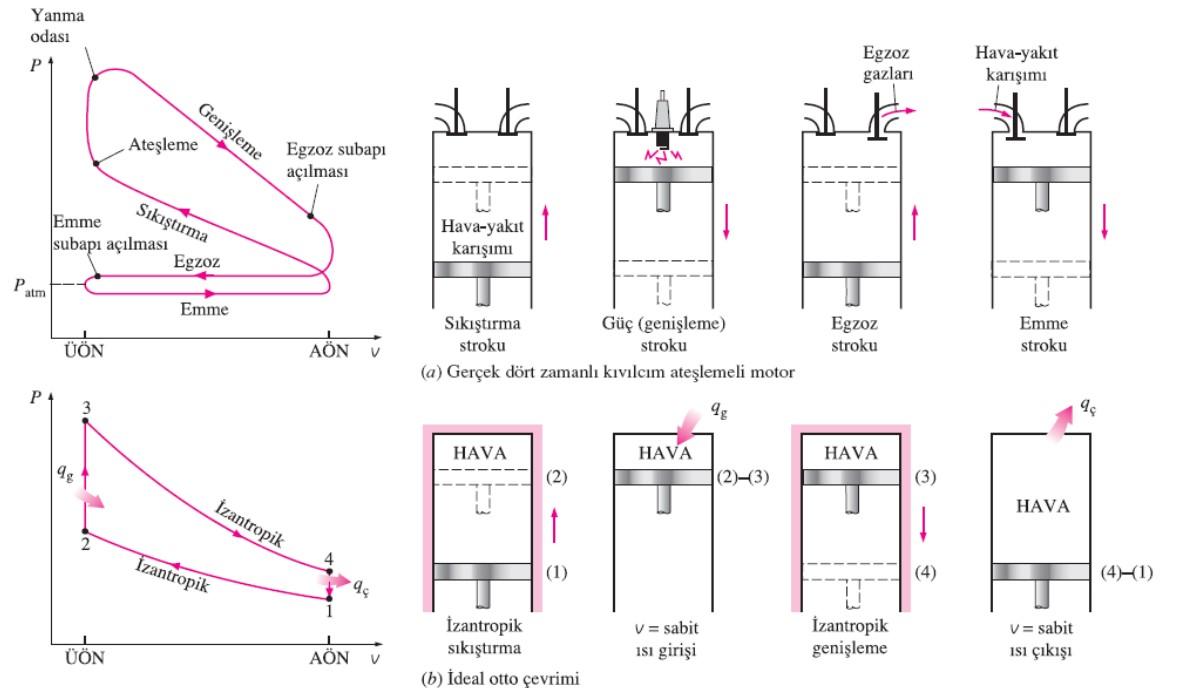
Theoretical and practical Otto cycle P-V diagrams
In the practical Otto cycle, during the intake stroke, a fuel-air mixture is drawn into the cylinder, and this mixture is not an ideal gas. Although the clearance volume, combustion chamber volume, and total volume remain constant for each cycle, varying amounts of mixture may be drawn in, and the cylinder is never completely filled with fresh mixture. That is, the ratio of the actual amount of air drawn into the cylinder to the theoretical maximum amount of air that could be drawn in never reaches 100%. This volumetric efficiency is affected by pumping losses, engine speed, duration and lift of the intake valve, timing of intake valve closure, and the amount of residual exhaust gas remaining in the cylinder.
In the theoretical Otto cycle, compression is isentropic (no heat transfer) and no mass is lost from the system during compression because the cycle is closed. Compression begins at Bottom Dead Center (BDC) and continues until Top Dead Center (TDC).
In the practical Otto cycle, heat loss occurs through the cylinder walls during compression. Compression does not begin exactly at BDC and does not end precisely at TDC because the intake and exhaust valves do not open and close exactly at dead centers. Regardless of precautions taken, some leakage always occurs during compression, reducing the mass of gas inside the cylinder.
In the theoretical cycle, heat is added at constant volume, and the piston is pushed toward BDC by the increasing pressure and temperature. This expansion is an isentropic expansion. Expansion continues without heat loss until the piston reaches BDC, maximizing the net work output. Since heat is added at constant volume, the heat addition is instantaneous, takes no time, and results in high pressure and temperature, thereby increasing efficiency.
In the practical cycle, the compressed fuel-air mixture is ignited by a spark plug, releasing heat into the system. The combustion process is completed in approximately 0.001 to 0.002 seconds. However, the fuel-air mixture does not burn completely because it is not homogeneous throughout. In some regions, oxygen required for combustion is insufficient, while in others, fuel quantity is inadequate. The chemical equation of combustion is never perfectly satisfied. In the practical cycle, since heat is not added at constant volume, the pressure and temperature values after combustion are lower than those in the theoretical cycle. Additionally, heat losses occur as the piston moves toward BDC, reducing net work. The expansion process does not continue fully to BDC. As the piston approaches BDC, the exhaust valve opens and the expulsion of burned gases begins, further reducing net work.
In the theoretical Otto cycle, heat rejection to return the system to its initial state occurs at constant volume and instantaneously. After heat rejection, the working fluid returns exactly to its initial properties.
In the practical Otto cycle, exhaust gas expulsion begins before BDC and ends after TDC. The expelled exhaust gases differ significantly from the properties of the fresh mixture drawn into the system. Their pressure and temperature are higher, and their chemical and physical properties are very different from the initial conditions.
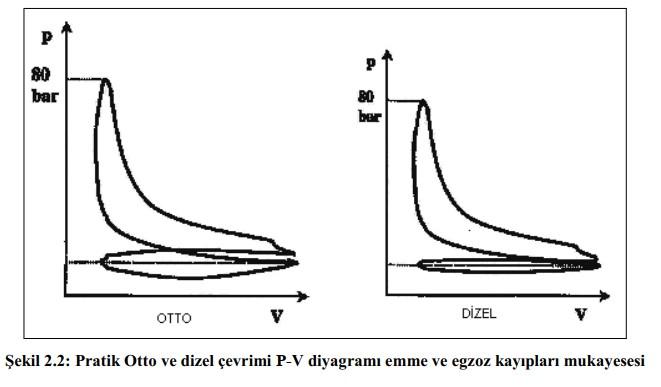
In the theoretical Diesel cycle, heat is added to the system by injecting fuel into the air drawn into the cylinder during the intake stroke, at the end of the compression stroke when the piston is at TDC. Combustion is assumed to occur at constant pressure.
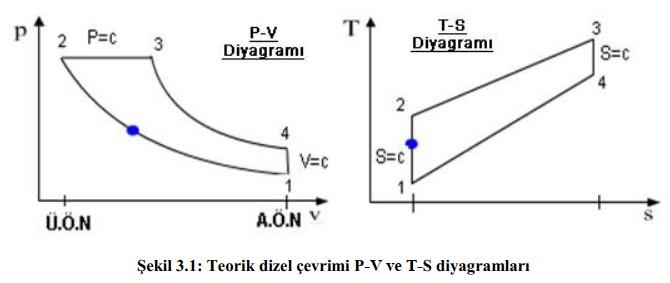
-The working fluid (ideal gas, in reality air) is compressed isentropically (insulated) from point 1 to point 2. At the end of compression, the pressure and temperature of the working fluid increase.
-From point 2 to point 3, heat is added at constant pressure to the working fluid, causing further temperature increase.
-During the 2-3 interval, expansion occurs at constant pressure, pushing the piston downward. At point 3, temperature reaches its maximum value.
-From point 3 to point 4, the piston is pushed downward by pressure, resulting in an isentropic expansion.
-From point 4 to point 1, heat is rejected from the working fluid at constant volume, returning the system to its initial conditions at point 1 and completing the cycle.
The practical Diesel cycle is not a closed or reversible cycle like the theoretical Diesel cycle. It is an open cycle involving mass exchange with the external environment. The fundamental principle of the cycle is the same as the theoretical one. We can examine the key differences between theoretical and practical Diesel cycles based on the timing of the strokes in the practical cycle.
The theoretical Diesel cycle is a closed cycle, so there is no mass exchange and therefore no intake process. The absence of intake eliminates factors such as pumping losses and volumetric efficiency.
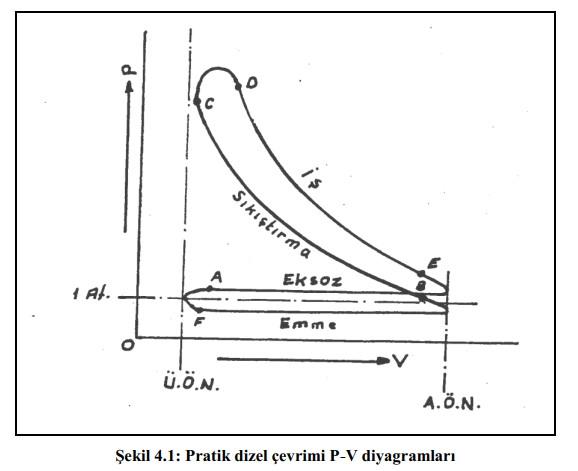
In the practical Diesel cycle, air must be drawn into the system from the external environment before compression. The amount of air drawn into the cylinders is affected by pumping losses, engine speed, duration and lift of the intake valve, timing of intake valve closure, and the amount of residual exhaust gas in the cylinder. As a result, the cylinder is never completely filled with fresh air. This condition negatively affects the efficiency of the practical Diesel cycle.
In the theoretical Diesel cycle, compression is isentropic. No mass is lost from the system during compression because the cycle is closed. Compression begins at BDC and ends at TDC.
In the practical Diesel cycle, heat losses occur during compression. These heat losses result in lower pressure and temperature at the end of compression compared to the theoretical cycle.
In the theoretical cycle, heat is added at constant pressure, pushing the piston toward BDC. After constant-pressure heat addition, expansion occurs isentropically. Expansion continues without heat loss until the piston reaches BDC, maximizing net work output.
In the practical cycle, fuel is injected by the injector into the highly compressed and heated air, and combustion releases heat into the system. The combustion process is completed within a specific time frame. The heat added increases pressure. However, in the theoretical cycle, heat addition is assumed to occur at constant pressure. The fuel-air mixture does not burn completely after ignition because it is not homogeneous; in some regions, oxygen required for combustion is insufficient, while in others, fuel quantity is inadequate. The chemical equation of combustion is never perfectly satisfied. At high temperatures, a cyclic reaction occurs between carbon monoxide and carbon dioxide. After heat is added, heat losses occur as the piston moves toward BDC, reducing net work. The expansion process does not continue fully to BDC. As the piston approaches BDC, the exhaust valve opens and the expulsion of burned gases begins, further reducing net work.
In the theoretical Diesel cycle, heat rejection to return the system to its initial state occurs at constant volume and instantaneously. After heat rejection, the working fluid returns exactly to its initial properties, preparing the system for a new cycle.
In the practical Diesel cycle, exhaust gas expulsion begins before BDC and continues until after TDC. The expelled exhaust gases differ significantly from the properties of the air drawn into the system. Their pressure and temperature are higher, and their chemical and physical properties are very different from the initial conditions.
In the theoretical mixed cycle, heat is added first at constant volume and then at constant pressure. Combustion is assumed to begin at constant volume and continue at constant pressure. The assumptions made for air-standard cycles also apply to the theoretical mixed cycle.
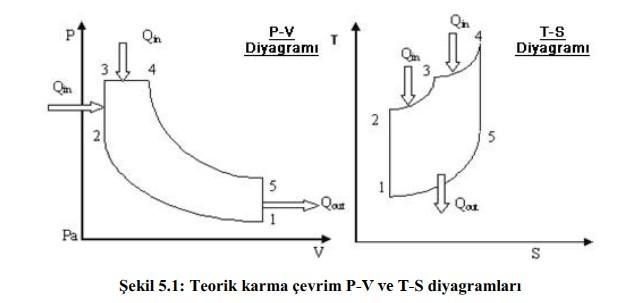
-The air, as the working fluid, is compressed isentropically from point 1 to point 2. At the end of compression, the pressure and temperature of the working fluid increase.
-From point 2 to point 3, heat is added at constant volume to the working fluid, causing further increases in temperature and pressure.
-A pressure increase occurs at constant volume between points 2 and 3. The pressure rise ratio is one of the parameters in the mixed cycle.
-From point 3 to point 4, heat is added at constant pressure, resulting in expansion at constant pressure. This constant-pressure expansion is another important parameter in the mixed cycle. The piston is pushed toward BDC by pressure. At point 4, temperature reaches its maximum value.
-From point 4 to point 5, isentropic expansion occurs, and the piston continues to be pushed toward BDC by pressure.
-At point 5, the pressure and temperature of the working fluid in the system are higher than at the initial point. To maintain isentropic behavior, heat is rejected from the working fluid at constant volume from point 5 to point 1, returning the system to its initial conditions at point 1, thus completing the cycle internally reversibly.
Since the mixed cycle is a hybrid of the Otto and Diesel cycles, the same discrepancies observed in those cycles also apply here.
In theoretical systems, heat is assumed to be added at constant volume and/or constant pressure. In reality, however, the combustion process takes a finite amount of time. During this short time interval, the piston continues to move, moving away from the point where maximum pressure is desired. This reduces power and efficiency.
a-Gasoline pumping losses
b - combustion timing losses
c - combustion timing and thermal dissociation losses
d - heat loss during expansion
e - pressure drop due to early exhaust valve opening
For maximum power and efficiency in engines, maximum pressure is desired to occur 10–15° after TDC.
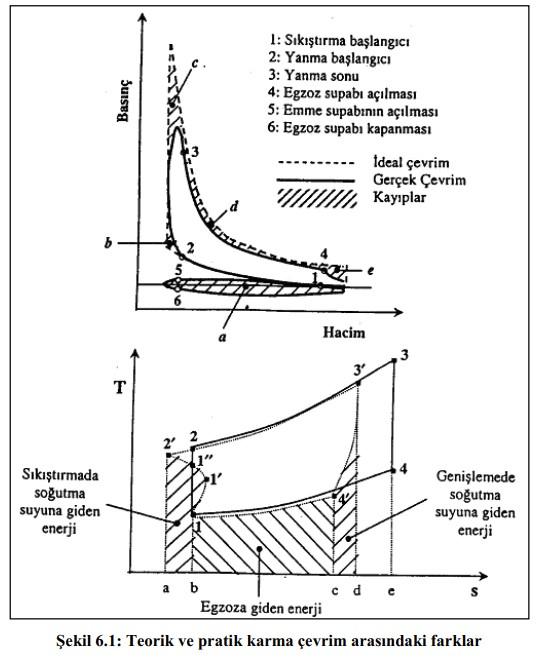
One condition for complete combustion is that the fuel-air ratio is uniform throughout the cylinder. In reality, the mixture does not achieve perfect homogeneity. This leads to incomplete combustion, resulting in lower maximum pressure and consequently reduced efficiency and power output compared to the theoretical cycle.
Gases drawn into the cylinder leak out during compression and expansion through gaps between the piston and cylinder, valves, and gaskets. These leaks reduce efficiency and power.
In theoretical cycles, specific heats are assumed constant. In reality, specific heats increase with rising temperature. Specific heat is known as the amount of heat required to raise the temperature of a unit mass by 1°C. As specific heat increases, maximum temperature decreases, reducing power and efficiency.
At the end of the exhaust stroke, not all burned gases are expelled from the cylinder. A portion remains inside, known as residual gases. These gases occupy volume and preheat the fresh charge, reducing the mass of fresh charge and thus lowering volumetric efficiency.
At high combustion temperatures, carbon dioxide absorbs heat from the surroundings to form carbon monoxide, and carbon monoxide absorbs heat to dissociate into carbon and oxygen. These reactions are reversible. This phenomenon is called thermal dissociation. Thermal dissociation prevents the complete formation of the chemical equation of combustion, resulting in lower maximum temperature and pressure. This reduction in pressure and temperature decreases power and efficiency.
Work is done to draw in the fresh fuel-air mixture or air and to expel exhaust gases. This work is called pumping work. Since energy is extracted from the system to perform this work, it reduces the power and efficiency of the cycle.
In real cycles, heat is lost to the external environment throughout the cycle. The greatest heat loss occurs when the cooling fluid or gas absorbs heat from heated engine components. Additionally, heat is rejected through the exhaust. These heat losses result in reduced efficiency and power.
Accessed November 26, 2025.
Accessed November 26, 2025.
T.C. MILLI EĞITIM BAKANLIĞI MOTORLU ARAÇLAR TEKNOLOJİSİ MOTOR ÇEVRİMLERİ VE YAKITLAR

No Discussion Added Yet
Start discussion for "Reciprocating Internal Combustion Engines (Otto, Diesel and Combined Cycle)" article
THEORETICAL OTTO CYCLE
PRACTICAL OTTO CYCLE
Intake Stroke
Compression Stroke
Ignition (Power) Stroke
Exhaust Stroke
THEORETICAL DIESEL CYCLE
PRACTICAL DIESEL CYCLE
Intake Stroke
Compression Stroke
Injection (Power) Stroke
Exhaust Stroke
THEORETICAL MIXED CYCLE
PRACTICAL MIXED CYCLE
Combustion Duration
Non-Homogeneous Mixture
Gas Leaks
Variation of Specific Heats
Effect of Residual Gases
Thermal Dissociation
Pumping Losses
Heat Losses