

This article was automatically translated from the original Turkish version.
The Reconquista (Spanish: “reconquest”) refers to the military and political processes carried out against Muslim rule in the Iberian Peninsula, resulting in the territorial expansion of Christian kingdoms. The process generally began in the early 8th century and was completed with the abolition of the Emirate of Granada in 1492.
In 711, Muslim forces under the command of Tariq ibn Ziyad crossed from North Africa into the Iberian Peninsula, defeated the Visigothic Kingdom, and quickly gained control over most of the peninsula. Political instability within the Visigothic Kingdom, including succession disputes and the weakening of central authority, played a significant role in this rapid conquest. In the face of Muslim advances, Christian communities on the peninsula initially failed to mount a unified resistance. The pursuit of regional interests by local powers delayed the formation of a common defensive front. One of the first significant resistance movements emerged in the Asturias region in the north; after the Battle of Covadonga in 722, this area became the core of Christian political continuity.
Historically, the Reconquista is divided into three main phases:
During this period, Christian kingdoms persisted around political entities such as Asturias, León, and Navarra in the northern part of the peninsula. While Muslim-controlled regions maintained strong urbanization and administrative structures, Christian forces in the north adopted a primarily defensive strategy with limited territorial gains. As political unity in Al-Andalus weakened and local emirates emerged, Christian kingdoms found it increasingly feasible to advance southward. Continuous conflicts occurred along the frontier zones, resulting in a fluctuating balance of power marked by cycles of conquest and retreat.
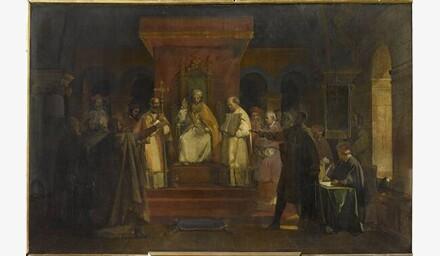
From the 11th century onward, the military and political power of Christian kingdoms increased significantly. The capture of Toledo in 1085 marked one of the pivotal turning points in this process. The conquest of Toledo was not only a strategic victory but also held great cultural and administrative significance. During this period, alliances were occasionally formed between Christian kingdoms such as Castile, Aragon, and Navarra, yet conflicts also arose due to political rivalry and disputes over territorial control. Although joint military campaigns were organized against Muslim emirates, competition over the division of conquered lands and spheres of influence periodically strained relations among the kingdoms. This demonstrates that the Reconquista was not merely a religious endeavor but a multifaceted process shaped by political and regional interests. The Battle of Las Navas de Tolosa in 1212, fought near the modern-day Jaén region of southern Spain, is widely regarded as one of the most decisive turning points of the Reconquista. In this battle, a Christian alliance led by the Kingdom of Castile and including Aragon and Navarra inflicted a crushing defeat on the Almohad Caliphate. This development significantly weakened Muslim military dominance in Al-Andalus and accelerated the Christian advance southward.
From the 13th century onward, Muslim rule was largely confined to the Emirate of Granada. This state maintained its existence for several centuries through diplomatic relations with Christian kingdoms and by paying tribute. However, the growing strength and political consolidation of Castile and Aragon increased pressure on Granada. In the late 15th century, after a series of military campaigns, the emirate was finally captured in 1492 by Ferdinand II and Isabella I, bringing the Reconquista to its conclusion.
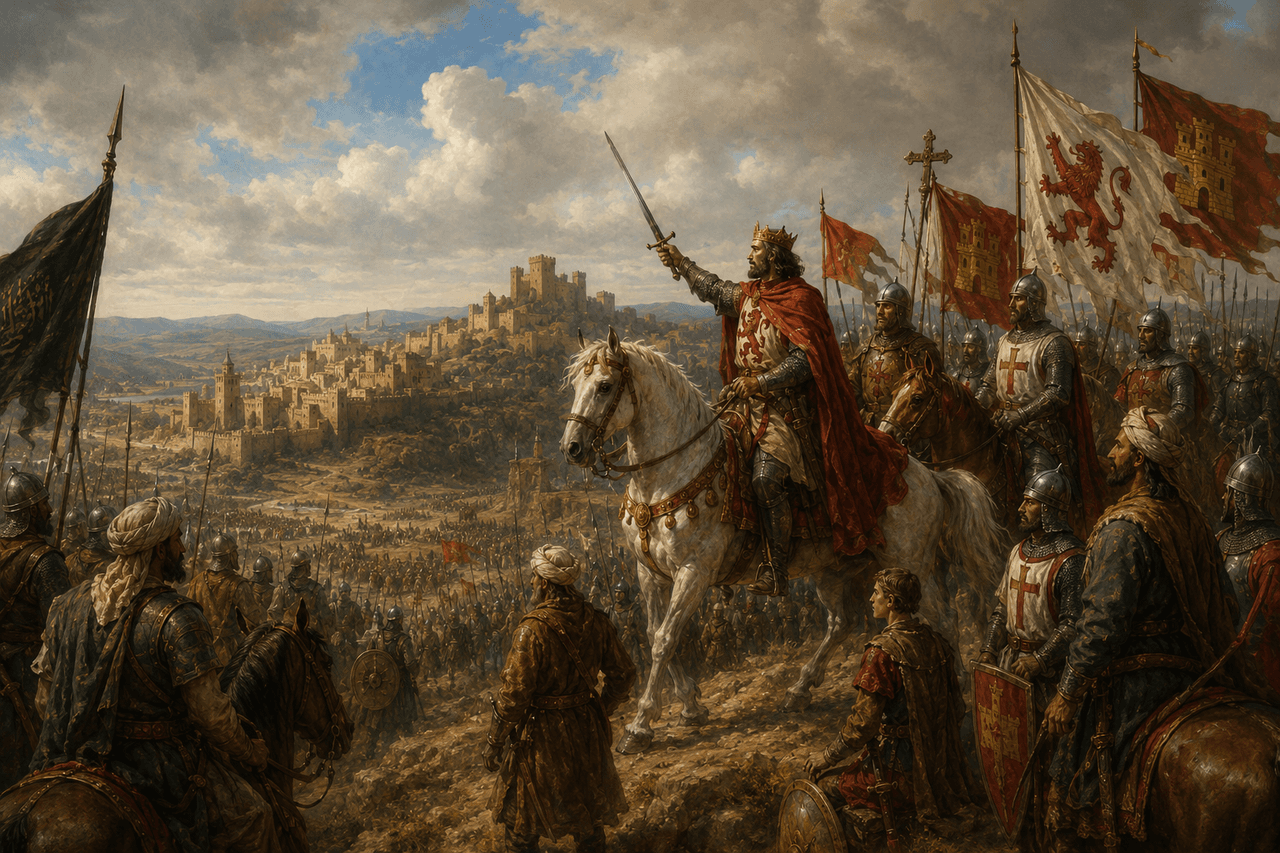
Reconquista (Generated by Artificial Intelligence.)
The Reconquista initially emerged within a framework of religious struggle, but over time it evolved into a structure dominated by political, economic, and social factors. The inability of Christian communities to respond collectively to Muslim conquests demonstrates that the Reconquista cannot be explained solely by religious motivations. Although alliances were occasionally formed among Christian kingdoms, intense competition and conflict arose over territorial gains and regional dominance. This reveals that the Reconquista was a multidimensional process shaped not only by religious elements but also by political and economic interests.
Culturally, Al-Andalus became a center where Muslims, Christians, and Jews coexisted and produced significant intellectual achievements. However, as Christian expansion progressed, this structure weakened, scholarly activity declined, and many scholars were forced to migrate to other regions. At the same time, part of the intellectual heritage produced in Al-Andalus was transmitted to Europe through translations.
In 1492, the Edict of Granada forced Jews to leave Spain; similar measures were later applied to Muslim communities. This period witnessed major population movements that transformed the demographic structure of the peninsula.
Jewish and Muslim communities expelled from Al-Andalus found new settlements, particularly within Ottoman territories, where they played active roles in trade, crafts, and intellectual life.
With the completion of the Reconquista, Christian political dominance was firmly established across the Iberian Peninsula, leading to the emergence of a more unified monarchical structure in Spain.
Simultaneously, overseas explorations indicated that Spain was entering a new phase of expansion. Moreover, the transmission of the cultural and intellectual heritage of Al-Andalus to Europe had a lasting impact on long-term intellectual development.
Château de Versailles. *Bataille de Las Navas de Tolosa, 1212*. Accessed April 20, 2026. https://collections.chateauversailles.fr/?permid=permobj_5207df6d-b23c-4f1c-a12c-0f09f579b597#/query/8c068998-2008-4289-a1b2-832c20c0f3be
Fletcher, R. A. *Moorish Spain.* Berkeley: University of California Press, 2006. https://archive.org/details/moorishspain00rich
Harvey, L. P. *Islamic Spain, 1250 to 1500.* Chicago: University of Chicago Press, 1990. https://archive.org/details/islamicspain12500000harv
Kennedy, Hugh. *Muslim Spain and Portugal: A Political History of Al-Andalus.* London: Routledge, 1996. https://ia600306.us.archive.org/22/items/muslim-spain-and-portugal-a-political-history-of-al-andalus-by-hugh-kennedy/Muslim%20Spain%20and%20Portugal%20A%20Political%20History%20of%20al-Andalus%20by%20Hugh%20Kennedy.pdf
Kılınç, Mustafa Enes. “Reconquista’nın Endülüs İlim Hayatına, Alimlere ve İlmî Seyahatlere Etkisi.” *Ortaçağ Araştırmaları Dergisi* 7, no. 2 (December 2024): 575–? (PDF). Accessed January 19, 2026. https://www.researchgate.net/publication/387412818_Reconquista'nin_Endulus_Ilim_Hayatina_Alimlere_ve_Ilmi_Seyahatlere_Etkisi
Menocal, María Rosa. *The Ornament of the World: How Muslims, Jews, and Christians Created a Culture of Tolerance in Medieval Spain.* Boston: Back Bay Books, 2002. https://www.researchgate.net/publication/259907395_The_Ornament_of_the_World_How_Muslims_Jews_and_Christians_Created_a_Culture_of_Tolerance_in_Medieval_Spain_by_MARIA_ROSA_MENOCAL
Ocak, Hasan Fehmi. “Endülüslülerin Osmanlı Ülkesi’ne Göçü ve Entegrasyonu.” *Ankara Uluslararası Sosyal Bilimler Dergisi* 1, no. 1 (June 30, 2018): 17–31. Accessed January 19, 2026. https://dergipark.org.tr/tr/download/article-file/4037498
O’Callaghan, Joseph F. *A History of Medieval Spain.* Ithaca, NY: Cornell University Press, 2003. https://archive.org/details/historyofmedieva0000ocal
Senado de España. *La rendición de Granada, 1882*, Francisco Pradilla y Ortiz. Accessed April 20, 2026. https://www.senado.es/web/conocersenado/arteypatrimonio/obrapictorica/fondohistorico/detalle/index.html?id=SENPRE_014124#
Tiryaki, Fatma Hazal. *Fifteenth-century Colonization of the Americas and the Process of Reconquista: A Millenarian Perspective*. Master's thesis, 2019. https://tez.yok.gov.tr/UlusalTezMerkezi/tezDetay.jsp?id=nEZNhGx-gQC6SezFcB0OEg&no=K8YRulciVnvtwyEaY2lrgg
Türkçelik, Evrim. *Muslim and Jewish Otherness in the Spanish Nation-Building Process Throughout the Reconquista, 1212–1614*. Master's thesis, 2003. https://etd.lib.metu.edu.tr/upload/12604945/index.pdf
Uçar, İlyas. “Reconquista: Endülüs’te Müslüman-Hıristiyan İlişkileri (Kitap Değerlendirmesi).” *Kalemname* 5, no. 9 (June 2020): 220–228. Accessed January 19, 2026. https://www.academia.edu/143946098/Reconquista_End%C3%BCl%C3%BCs_te_M%C3%BCsl%C3%BCman_H%C4%B1ristiyan_%C4%B0li%C5%9Fkileri
Şeyban, Lütfi. *Endülüs’te Murabıtlar ve Muvahhidler Dönemlerinde Müslüman-Hristiyan İlişkileri (Endülüs’ün Geri Alınışı–Reconquista 1085–1238)*. PhD thesis, 2002. https://tez.yok.gov.tr/UlusalTezMerkezi/tezDetay.jsp?id=ebLQVVa7xrRVFwvSMLRMQQ&no=7w0F97_BL9FAiwyGNT2a6g

Historical Background
Stages of the Process
1. Consolidation and Initial Expansion in the North (8th–11th Centuries)
2. Acceleration of Expansion (11th–13th Centuries)
3. The Final Phase and the Emirate of Granada (13th–15th Centuries)
Religious, Political, and Cultural Dimensions