


This article was automatically translated from the original Turkish version.
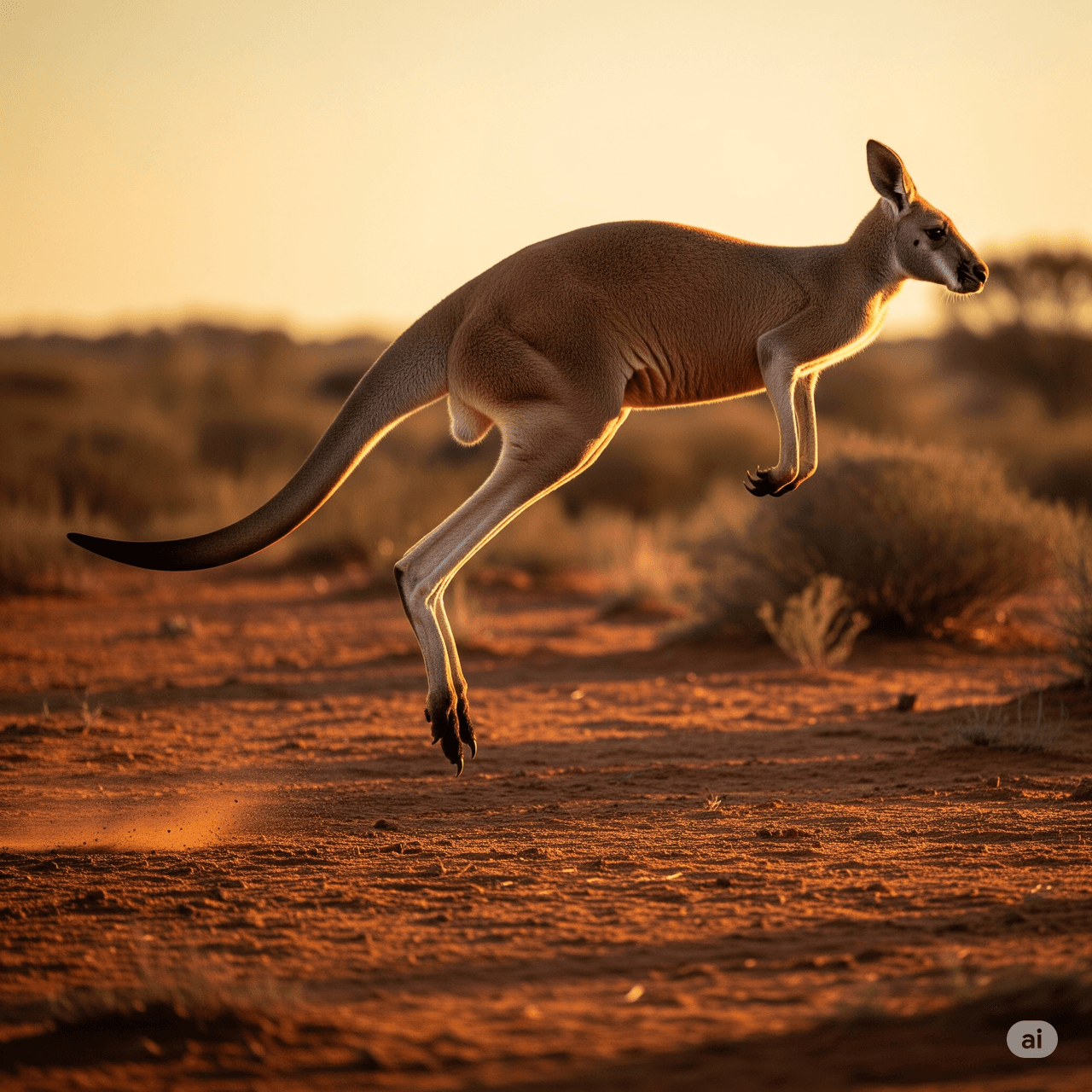
Red Kangaroo
Gender | Macropus | ||||||||
|---|---|---|---|---|---|---|---|---|---|
Specie(s) | Rufus | ||||||||
Family | Macropodidae | ||||||||
Habitat | Desert | ||||||||
Diet(s) | Herbivore | ||||||||
Activity | Nocturnal | ||||||||
Reproduction(s) | Diapos | ||||||||
Status (IUCN) | LC | ||||||||
The red kangaroo (Macropus rufus) is defined as a classic example of a life strategy adorned with morphological adaptations, thanks to comprehensive studies conducted in the fields of mammalian biology, ecology, and physiology. Today, the wide-ranging distribution of its populations reflects the species’ high adaptability to environmental variability. This adaptation encompasses a holistic system composed of elongated hind limbs, a large tail, adaptive reproductive tactics, and physiological mechanisms for thermoregulation.
The red kangaroo belongs to the order Diprotodontia and the family Macropodidae and is also referred to in current systematics as Osphranter rufus. It is the largest species within its genus and has been distinguished by its morphological characteristics since Desmarest’s 1822 description.
Adult males reach an average body length of 1.6 m and a mass of 85–90 kg, while females measure about 1.2 m and weigh around 35 kg. The pronounced size difference between the sexes is reinforced by sexual dimorphism in coat color: males exhibit a dark reddish-brown hue, while females are bluish-gray. A tendon-spring system attached to elongated metacarpal bones enhances hopping efficiency; the muscular-skeletal arrangement increases elastic energy recovery during jumping to over 60%, thereby reducing energetic costs.
Sexual selection has favored the development of well-built brachial muscles in males, optimizing their fighting ability. In females, the lighter lower limbs are interpreted as an adaptation that reduces the energetic burden of carrying and caring for offspring during pregnancy.
The species inhabits approximately 5 million km² of Australia’s arid and semi-arid interior, ranging from deserts receiving less than 250 mm of annual rainfall to semi-arid grasslands with up to 500 mm. Populations concentrated within the arid zone expand beyond eastern and western boundaries according to the availability of water sources and seasonal vegetation, resulting in a mosaic distribution pattern.
Main habitats include open plains, shrublands, and sparse tree-grass savannas. The species is notable for its tolerance of radiant heat up to 89 °C under conditions of limited shade, enabling it to forage for extended periods in open pastures without requiring midday shelter.
The red kangaroo is herbivorous and selectively consumes high-protein annual Poaceae species during brief periods of germination following rainfall. Its specialized molar dentition exhibits growth patterns that counteract rapid tooth wear caused by abrasive silica-rich plant material.
The species is predominantly crepuscular, resting in shade during the hottest hours of the day and emerging to graze in loose aggregations of over 50 individuals after sunset. Large groups optimize foraging efficiency by reducing the cost of anti-predator vigilance, even in areas with low predator pressure.

Behavior (Generated by Artificial Intelligence)
Arteriovenous anastomoses at the base of the tail and counter-current heat exchange in the nasal mucosa minimize evaporative water loss. The resting metabolic rate is 30% lower than that of placental mammals of similar mass, supporting energy conservation. During the juvenile stage, growth demands elevate metabolic rate; the ecological cost of this increase has recently been quantified.
Although mating can occur year-round, the red kangaroo exhibits pronounced “superfecundation” pulses synchronized with rainfall patterns. After a short gestation of 33 days, the female gives birth to a neonate weighing 0.8 g, which crawls into the pouch. Lactation proceeds in two phases: early milk is high in fat, while later milk is protein-rich, supporting development. Embryonic diapause enables the female to time offspring production in response to climatic fluctuations.

Reproduction (Generated by Artificial Intelligence)
Dawson, T. J., Norton, M. A., Rodoreda, S., Abbott, S. K., & McLeod, S. R. (2021). The burden of size and growth for the juveniles of large mammalian herbivores: Structural and functional constraints in the feeding biology of juveniles relative to adults in red kangaroos, Osphranter rufus. Ecology and Evolution, 11(13), 9062–9078. Accessed May 21, 2025. https://doi.org/10.1002/ece3.7750.
Freedman, C. R., Rothschild, D., Groves, C., & Newman, A. E. M. (2020). Osphranter rufus (Diprotodontia: Macropodidae). Mammalian Species, 52(998), 143–164. Accessed May 21, 2025. https://doi.org/10.1093/mspecies/seaa011.
Munn, A. J., & Dawson, T. J. (2003). Energy requirements of the red kangaroo (Macropus rufus): impacts of age, growth and body size in a large desert-dwelling herbivore. Journal of Comparative Physiology B, 173(7), 575–582. Accessed May 21, 2025. https://doi.org/10.1007/s00360-003-0367-3.
Munn, A. J., & Dawson, T. J. (2006). Forage fibre digestion, rates of feed passage and gut fill in juvenile and adult red kangaroos Macropus rufus Desmarest: why body size matters. Journal of Experimental Biology, 209(8), 1535–1547. Accessed May 21, 2025. https://doi.org/10.1242/jeb.02137.
Roberts, J. A., Coulson, G., Munn, A. J., & Kearney, M. R. (2016). A continent-wide analysis of the shade requirements of red and western grey kangaroos. Temperature, 3(2), 340–353. Accessed May 21, 2025. https://doi.org/10.1080/23328940.2016.1163452.

Red Kangaroo
Gender | Macropus | ||||||||
|---|---|---|---|---|---|---|---|---|---|
Specie(s) | Rufus | ||||||||
Family | Macropodidae | ||||||||
Habitat | Desert | ||||||||
Diet(s) | Herbivore | ||||||||
Activity | Nocturnal | ||||||||
Reproduction(s) | Diapos | ||||||||
Status (IUCN) | LC | ||||||||
No Discussion Added Yet
Start discussion for "Red Kangaroo (Macropus rufus)" article
Taxonomy and Morphology
Classification
Physical Characteristics
Sexual Dimorphism
Distribution, Habitat, and Ecology
Geographic Distribution
Habitat Preferences
Feeding Ecology
Behavior and Social Structure
Physiology and Reproduction
Physiological Adaptations
Reproductive Biology