


This article was automatically translated from the original Turkish version.
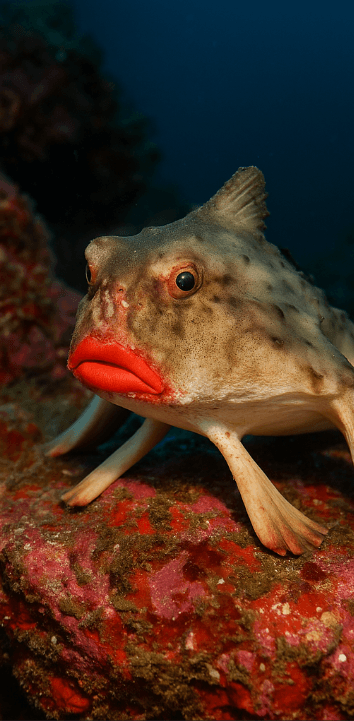
The Red-lipped Batfish (Ogcocephalus darwini) is an unusual marine species found around the Galápagos Islands and off the coast of Peru, known for walking along the seafloor and its bright red lips. This article provides detailed information on this fascinating fish, covering its physical characteristics, habitat, behavior, and interactions with humans.
The Red-lipped Batfish has a flattened, triangular body that can reach up to 40 cm in length. Its body is colored in light brown tones with a dark stripe along the back. Its most striking feature is its vivid red lips, which give the species its name and play a key role in intraspecific recognition and mate attraction during breeding seasons. Additionally, a protrusion on the top of its head called the illicium is used to lure prey.
The pectoral, pelvic, and anal fins of the batfish have evolved for “walking” along the seafloor rather than swimming. This adaptation allows the fish to move slowly and deliberately across the ocean floor. Furthermore, its body can change color to blend into its surroundings, providing protection from predators and aiding in ambushing prey.
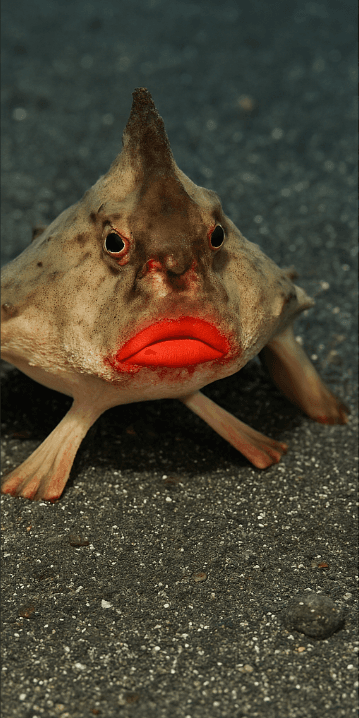
This image was generated by artificial intelligence.
The Red-lipped Batfish inhabits seafloor environments between 3 and 76 meters deep, particularly around the Galápagos Islands and off the coast of Peru. It is commonly found on sandy, muddy, or rocky substrates and prefers reef edges. Rare observations have also been recorded along the coast of California.
This species is a benthic organism that typically resides in shallow waters but can occasionally descend to deeper areas. Its habitat is often associated with coral reefs and other seafloor structures. The Red-lipped Batfish (Ogcocephalus darwini) is an unusual marine species found around the Galápagos Islands and off the coast of Peru, known for walking along the seafloor and its bright red lips. This article provides detailed information on this fascinating fish, covering its physical characteristics, habitat, behavior, and interactions with humans.
The Red-lipped Batfish is generally a solitary species. However, during breeding periods, individuals interact with others. Males perform a courtship dance by swaying their bodies and moving their heads to attract females. This behavior is crucial for capturing the female’s interest and initiating the mating process. The fish can change its color to blend into its environment, a trait used both for hunting and avoiding predators. Its method of locomotion—walking along the seafloor—is a distinctive behavioral trait that sets it apart from other fish.
The Red-lipped Batfish is carnivorous, feeding primarily on small fish, shrimp, crabs, and other benthic invertebrates. To capture prey, it uses the illicium on top of its head to lure them closer. Once the prey is within range, the fish rapidly opens its mouth to create suction, drawing in water and the prey. This “suction feeding” technique is highly effective for a slow-moving bottom-dwelling fish. It also relies on its ability to camouflage itself to ambush prey.
Information on the reproductive behavior of the Red-lipped Batfish is limited. However, it is known that females lay adhesive eggs that attach to the seafloor. Males fan the eggs with their fins to provide oxygen and protection. Detailed knowledge about larval development and growth remains scarce. Generally, juveniles begin to exhibit behaviors similar to adults once they reach a certain size. Further research is needed to better understand spawning seasons and parental care.
The Red-lipped Batfish is classified as “Least Concern” by the International Union for Conservation of Nature (IUCN). However, environmental factors such as habitat degradation, rising sea temperatures, and pollution pose potential threats to its future.
The Galápagos Islands are listed as a UNESCO World Heritage Site and are subject to strict environmental protection measures. To conserve this species, efforts must focus on reducing marine pollution, promoting sustainable fishing practices, and combating climate change.
The Red-lipped Batfish is harmless to humans and poses no direct threat. However, its unusual appearance and unique behaviors make it a subject of interest for divers and marine biologists. This species serves as an important example of the diversity and complexity of marine ecosystems.
Tourism and research activities can impact the batfish’s habitat. Therefore, sustainable tourism practices and responsible diving are essential for its conservation. Protecting this species also contributes to the broader preservation of marine biodiversity.
"Red-lipped Batfish." *Animalia.bio*. Accessed May 12, 2025. https://animalia.bio/red-lipped-batfish
"Red-lipped Batfish." Galapagos Conservation Trust. Accessed May 12, 2025. https://galapagosconservation.org.uk/species/red-lipped-batfish/
Kaustubh, Lakshmi V. V. S. S. "The Red-Lipped Batfish: The Unusual Marine Marvel of the Galápagos Islands." *GoSharpener*, December 25, 2024. https://gosharpener.com/blogs/661966/The-Red-Lipped-Batfish-The-Unusual-Marine-Marvel-of-the
Pucker Up – It's Time To Meet The Red-Lipped Batfish Of The Galápagos." IFLScience. Accessed May 12, 2025. https://www.iflscience.com/pucker-up-its-time-to-meet-the-red-lipped-batfish-of-the-galapagos-77983

Physical Characteristics
Habitat and Distribution
Behavior and Social Structure
Feeding Habits
Reproduction and Offspring
Threats and Conservation Efforts
Relationships with Humans