This article was automatically translated from the original Turkish version.
Year(s) | 1911 | ||||||||
|---|---|---|---|---|---|---|---|---|---|
Original Name(s) | The Red Studio | ||||||||
Size(s) | 181 x 219.1 cm | ||||||||
Location | USA New York Museum of Modern Art (MoMA) | ||||||||
Technique | Oil on canvas | ||||||||
Artist | Henri Matisse | ||||||||
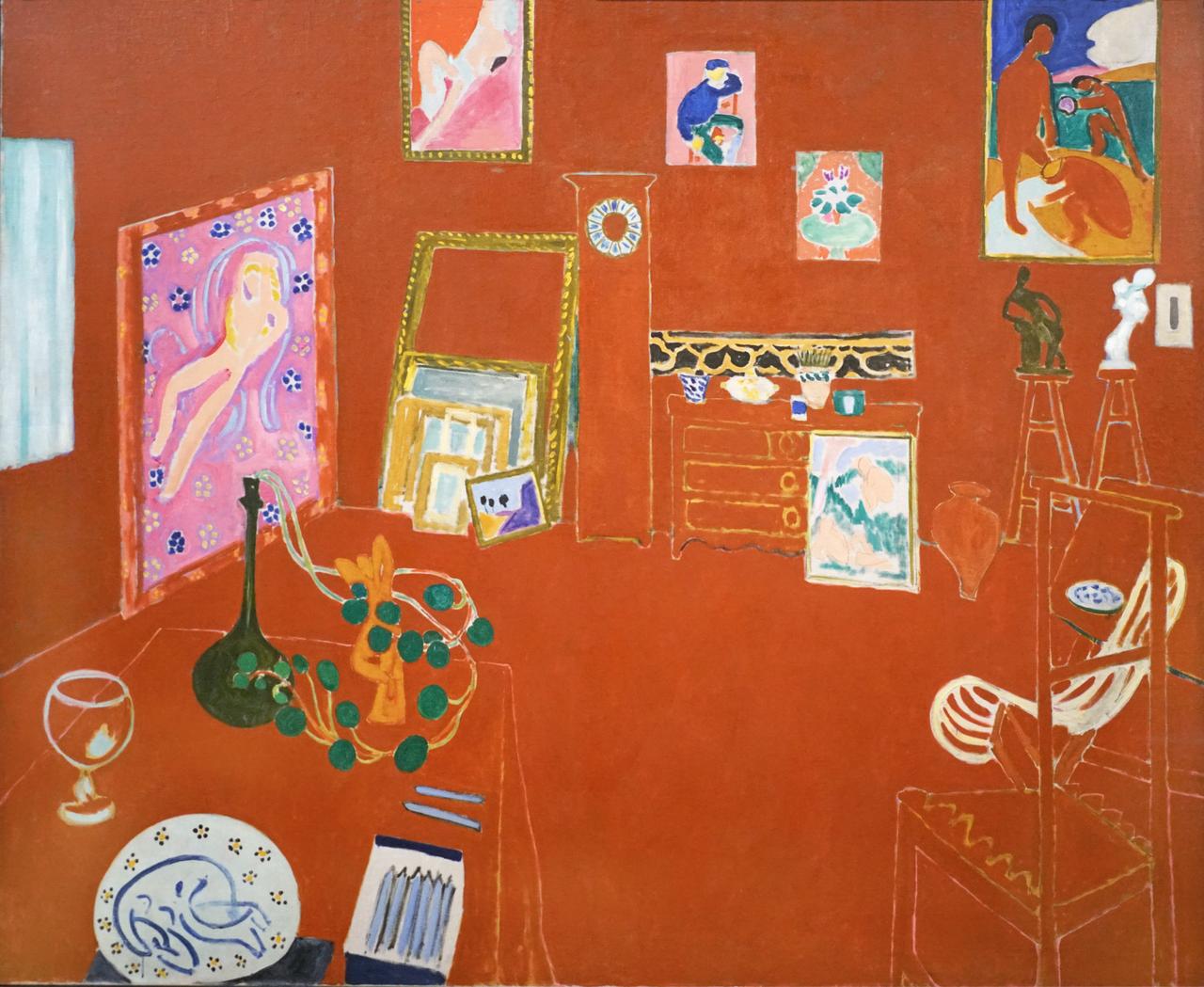
The Red Studio (Kırmızı Stüdyo) is an interior composition painted in oil on canvas by Henri Matisse in 1911. The work depicts the artist’s studio in Issy-les-Moulineaux and contains seven paintings four sculptures and a ceramic plate along with various pieces of furniture and personal objects belonging to the artist. The painting is currently held in the collection of The Museum of Modern Art in New York.
The Red Studio is one of several large-scale interior compositions that Henri Matisse created in his Issy-les-Moulineaux studio in 1911. The artist moved into this studio in 1909 and continued producing both paintings and sculptures there. The work is recorded as one of four major studio interior depictions Matisse completed in 1911.
The painting was exhibited in 1912 at the Second Post-Impressionist Exhibition at the Grafton Galleries in London and later in 1913 at the Armory Show in New York. Although unsold during its initial production period the work was purchased in 1927 by David Pax Tennant. After passing through several private collections it was acquired by The Museum of Modern Art in New York in 1948 and entered its permanent collection.
The Red Studio presents the studio space in Issy-les-Moulineaux within a broad perspective. The composition establishes a closed interior environment defined by walls a floor and furniture. It includes seven paintings four sculptures and one ceramic plate. In addition a table a chair a cabinet a large clock a window and various tools and objects belonging to the artist are incorporated into the composition.
The works depicted on the painting’s surface include Young Sailor II (1906) Le Luxe II (1907–08) Bathers (1907) Nude with White Scarf (1909) Cyclamen (1911) and Large Nude (1911). 【1】 Some of these works are now held in other museums and collections. The painting Large Nude was destroyed later at the artist’s instruction and is known today only through photographs and its depiction within The Red Studio.
The sculptures depict female figures; one is made of terracotta and the others are bronze castings. Additionally a tin-glazed ceramic plate dated 1907 (Untitled [Female Nude]) appears in the composition. These works are depicted as hung on the walls placed on furniture or positioned on the floor.
The Red Studio was executed in oil on canvas. Technical and scientific analyses have revealed that the painting’s ground layer contains zinc white (ZnO). This ground layer serves as the foundational preparation across the composition’s surface.
Pigment analysis has shown that the red surface is not applied in a single layer but contains underlying layers of blue pink and ochre tones. The final intense red layer has been identified as an iron oxide-based red earth pigment Venetian red. This red layer forms a broad surface covering the walls floor and furniture.
Technical examinations of the work employed analytical methods including MA-XRF (Macro X-Ray Fluorescence) Raman spectroscopy and SEM-EDS (Scanning Electron Microscopy with Energy Dispersive Spectroscopy). These methods enabled the determination of pigment distribution layer structure and underpainting. The investigations revealed that initial color arrangements beneath the red surface differed from the final composition and that modifications occurred during the painting’s production process.
Analyses also demonstrated that the linear contours in the composition are defined by fine brushstrokes. The edges of the table chair and other furniture are rendered with light-colored lines that clearly delineate the forms against the red background. These linear definitions allow the objects to be distinguished from the red ground.【2】
The Red Studio defines the studio space through walls and floor rendered in a unified red surface. The walls floor and furniture merge into a single red field with spatial boundaries largely delineated by fine linear contours. The edges of the table chair cabinet and clock are marked by thin light-colored lines that establish the position of objects against the red background.
Although no human figure appears directly in the composition the paintings and sculptures depicted within the space contain figurative representations. The paintings hung on the walls and the sculptures placed in the room are rendered in slightly different or more distinct tones against the red ground creating a color contrast between the figurative elements and the background.
The window opening is one of the limited areas in the composition that lies outside the dominant red surface. This section creates a distinct color field that marks the boundary of the interior space. Elements such as the clock objects on the table and the ceramic plate on the floor contribute to defining the depth and spatial arrangement of the environment.
The composition does not follow traditional linear perspective rules. There is no clear perspectival distinction between the floor and walls. The space is defined instead through color fields and contour lines.【3】
The Red Studio was exhibited in 1912 at the Second Post-Impressionist Exhibition in London and in 1913 at the Armory Show in New York. These exhibitions were among the major international events that introduced modern art to audiences in Europe and America in the early 20th century. The painting’s inclusion in these shows is documented as part of its early circulation history.
After passing through several private collections the work entered the collection of The Museum of Modern Art in 1948. Following its acquisition the painting became the subject of institutional exhibitions and research notably the comprehensive 2022 exhibition Matisse: The Red Studio which featured extensive technical and historical investigations.【4】
Abrahams, Simon. “Matisse’s Red Studio (1911).” *Academia.edu*. Accessed January 3, 2026. https://www.academia.edu/7465082/Matisses_Red_Studio_1911
Dalbera, Jean Pierre. “L'Atelier rouge de Henri Matisse (Fondation Vuitton, Paris).” Flickr. Accessed January 3, 2026. https://www.flickr.com/photos/dalbera/54661012503/
Haddad, Abed, Gianluca Pastorelli, Annette S. Ortiz Miranda, Loa Ludvigsen, Silvia A. Centeno, Isabelle Duvernois, Caroline Hoover, Michael Duffy, Anny Aviram, and Lynda Zycherman. “Exploring the Private Universe of Henri Matisse in The Red Studio.” *Heritage Science* 10, no. 1 (2022): 18–26. Accessed January 3, 2026. https://www.researchgate.net/publication/364650956
MoMA. "Matisse: The Red Studio." Museum of Modern Art. Accessed January 3, 2026. https://www.moma.org/calendar/exhibitions/5344
MoMA. “Matisse: The Red Studio – Extended Artwork Labels.” Museum of Modern Art. Accessed January 3, 2026. https://press.moma.org/wp-content/uploads/2022/04/5-Matisse_ExtendedArtworkLabels.pdf
[1]
Museum of Modern Art, “Matisse: The Red Studio – Extended Artwork Labels,” Museum of Modern Art, Access date: 3 January 2026, https://press.moma.org/wp-content/uploads/2022/04/5-Matisse_ExtendedArtworkLabels.pdf
[2]
Abed Haddad Gianluca Pastorelli Annette S. Ortiz Miranda Loa Ludvigsen Silvia A. Centeno Isabelle Duvernois Caroline Hoover Michael Duffy Anny Aviram ve Lynda Zycherman “Exploring the Private Universe of Henri Matisse in The Red Studio” Heritage Science 10 no. 1 (2022): pp. 20-26 https://www.researchgate.net/publication/364650956
[3]
A.e. p. 3
[4]
Museum of Modern Art “Matisse: The Red Studio” access date 3 January 2026 https://www.moma.org/calendar/exhibitions/5344

Year(s) | 1911 | ||||||||
|---|---|---|---|---|---|---|---|---|---|
Original Name(s) | The Red Studio | ||||||||
Size(s) | 181 x 219.1 cm | ||||||||
Location | USA New York Museum of Modern Art (MoMA) | ||||||||
Technique | Oil on canvas | ||||||||
Artist | Henri Matisse | ||||||||
No Discussion Added Yet
Start discussion for "Red Studio (Painting)" article
Historical Context
Composition and Objects
Technical Features
Figure-Ground Relationship and Spatial Construction
Place in Art History