This article was automatically translated from the original Turkish version.
Scientific Name(s) | Acrocephalus scirpaceus | ||||||||
|---|---|---|---|---|---|---|---|---|---|
Family | Sylviidae | ||||||||
Order | Passeriformes | ||||||||
Size(s) | Approximately 12 cm | ||||||||
Weight(s) | 10–13 g | ||||||||
Conservation Status | Least Concern (LC) | ||||||||
Sedge Warbler is a small, migratory bird species belonging to the family Sylviidae, commonly found in reedbed habitats. In Türkiye, this species is widespread and acts as a summer migrant, breeding in northern regions and spending the winter south of the Sahara in Africa.
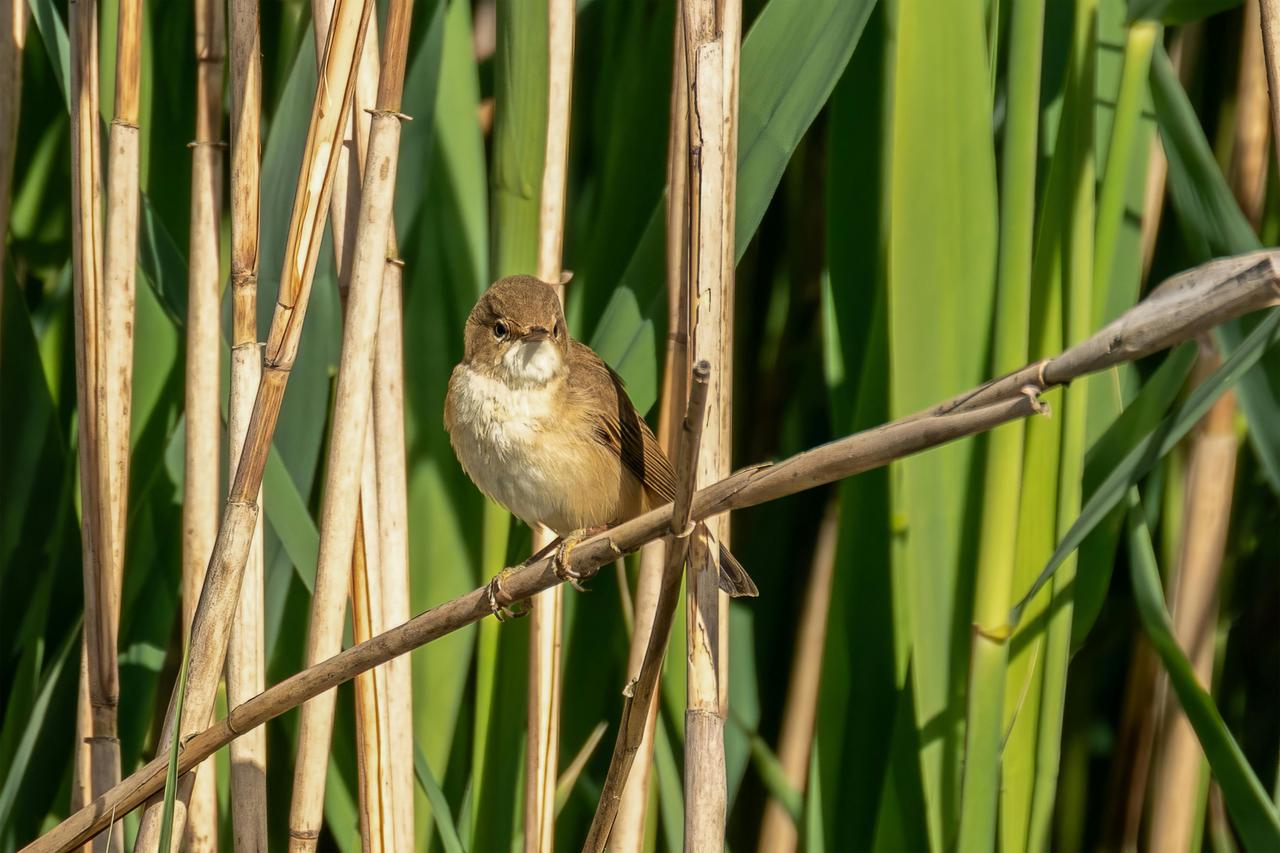
The Sedge Warbler is approximately 12 cm in length and has a slender build. Its upperparts are brown with reddish tones, while its underparts range from cream to pale yellow. The throat is white, and the undertail coverts are reddish-brown. A faint pale line extends between the eye and the base of the bill, and the eye ring is weakly defined. The legs may be light brown or bluish-grey. Adults have plumage in brown-greenish grey tones, while juveniles exhibit a more reddish-brown coloration. Females and males are visually indistinguishable. It can easily be confused with the Reed Warbler and the Garden Warbler; its song is the most distinctive feature for identification. The crown is flat, and the bill is long and slender. In juveniles, the alula feathers are darker.

Sedge Warbler (pexels)
This species primarily inhabits wetland areas such as reedbeds, marshes, lake shores, and riverbanks. It builds its nest among reeds and rushes, shaping it into a cup or cylindrical form. The nest is constructed from grass, reeds, and leaves, and lined with feathers and other soft materials.
The Sedge Warbler is observed as a summer migrant across most regions of Türkiye, with fewer breeding records in the Black Sea and Eastern Anatolia Regions. It breeds across much of Europe (excluding Scandinavia), southern Russia, the Caucasus, and Iran. It winters south of the Sahara. It typically departs its breeding grounds between late July and early September. It is estimated that approximately 5.3 to 10 million individuals migrate to Europe each year for breeding.
The breeding season lasts from late May to mid-August. Both male and female take turns incubating the eggs. The eggs are pale green with dark spots. After hatching, the chicks fledge within 10 to 14 days.
Its primary diet consists of insects, spiders, and small invertebrates, supplemented occasionally with plant material. It forages mostly among shrubs at mid-height, though it has been observed feeding on the ground on rare occasions.
Although generally described as shy, the Sedge Warbler can display curious behavior. Despite preferring concealed habitats, it is easily detected by its song.
The species is classified as Least Concern (LC) on the IUCN Red List. This classification is due to its very wide distribution, large and generally stable population size.
Ornito. "Saz Kamışçını." Ornito.org. Accessed August 16, 2025. https://ornito.org/Bird/Detail/414
Pexels. “Doğal yaşam alanında bir kamış üzerinde Avrasya kamışçını JPG.” Pexels. Accessed August 16, 2025. https://www.pexels.com/tr-tr/fotograf/dogal-yasam-alaninda-bir-kamis-uzerinde-avrasya-kamiscini-32233119/.
Pexels. “Rohrspatz JPG.” Pexels. Accessed August 16, 2025. https://www.pexels.com/tr-tr/fotograf/rohrspatz-32435800/
İzkuş. “Saz Kamışçını.” *İzmir Kuş Cenneti.* Accessed August 16, 2025. https://izmirkuscenneti.gov.tr/2022/12/02/saz-kamiscini/.

Scientific Name(s) | Acrocephalus scirpaceus | ||||||||
|---|---|---|---|---|---|---|---|---|---|
Family | Sylviidae | ||||||||
Order | Passeriformes | ||||||||
Size(s) | Approximately 12 cm | ||||||||
Weight(s) | 10–13 g | ||||||||
Conservation Status | Least Concern (LC) | ||||||||
No Discussion Added Yet
Start discussion for "Reed Warbler (Acrocephalus scirpaceus)" article
Morphological Characteristics
Habitat
Distribution and Migration
Biology and Breeding
Diet and Behavior
Conservation Status