

+1 More

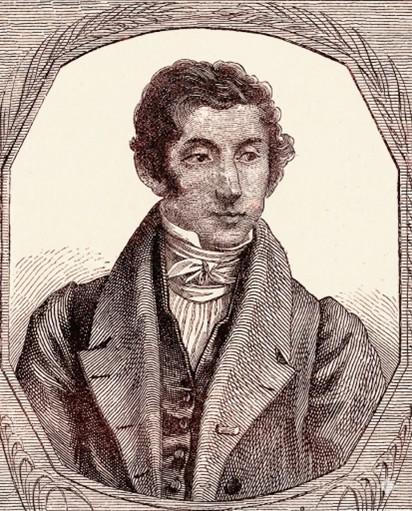
René Auguste Caillié (Yapay zeka ile oluşturulmuştur)
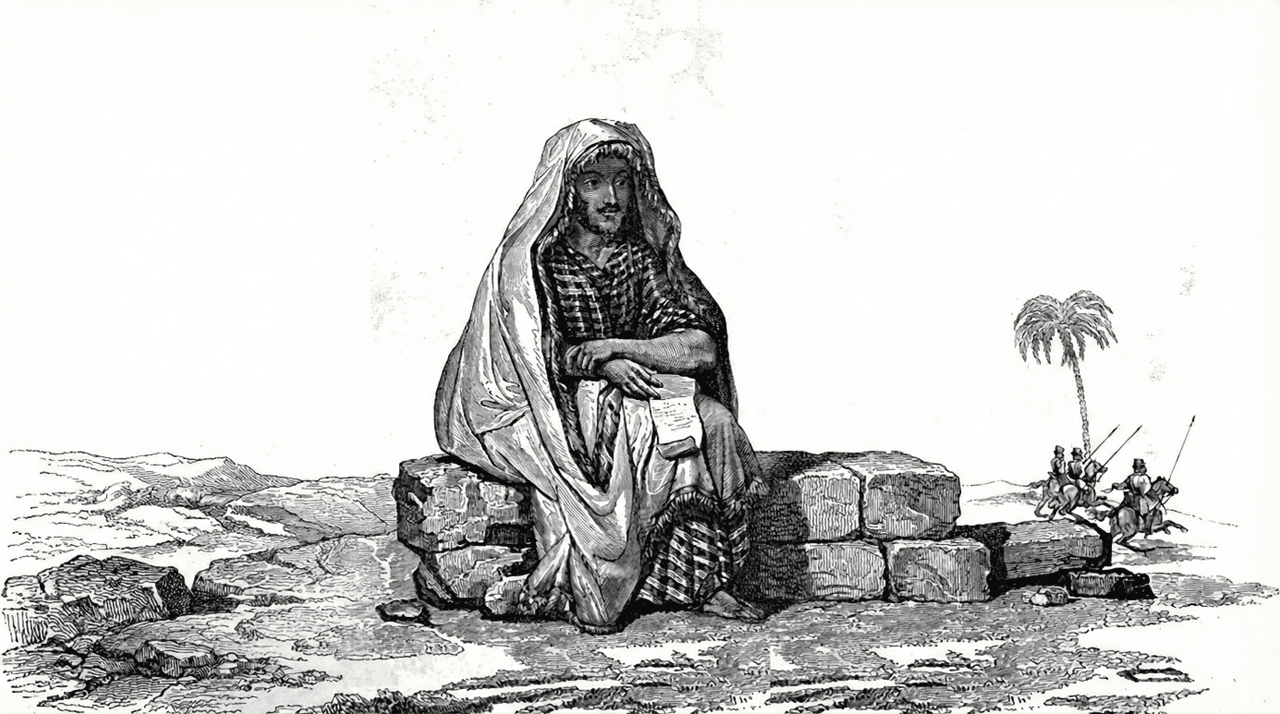
René Caillié (1799–1838) was a French explorer renowned for being one of the first Europeans to reach the interior regions of Africa in the early 19th century and return alive from the mysterious city of Timbuktu, which had remained enigmatic to Europeans at the time. Unlike other major Western expeditions of the era, Caillié traveled without military support or large caravans, blending into local communities and concealing his identity. Thanks to this strategy, he avoided the fatal fates that had befallen earlier explorers such as the Scotsman Mungo Park or Alexander Gordon Laing, and successfully provided Europe with detailed primary sources on the region’s geography, social structure, and trade routes.
René Caillié was born in 1799 in the village of Mauzé-sur-le-Mignon in western France. His childhood was marked by hardship; he lost his father in prison at the age of eight, and three years later his mother died. Raised by his grandmother and sister, Caillié’s greatest source of inspiration during childhood was Daniel Defoe’s Robinson Crusoe, which, in his own words, “ignited his imagination” and awakened in him a strong desire to undertake a great discovery. Geography books and maps, particularly those marking African regions as “desert” or “unknown,” captivated his interest.
At just 16 years old, Caillié left home with only 60 francs and boarded a ship bound for Saint-Louis in Senegal. After traveling to Dakar and then Guadeloupe, he joined a British expedition seeking to uncover the fate of Mungo Park, who had disappeared along the Niger River. However, he was forced to return to France after contracting tropical fever. In 1824, he returned to Senegal with the intention of exploring the interior of Africa. During this period, the Paris Geographical Society (Société de Géographie) announced a reward of 10,000 francs for the first European to reach Timbuktu and return with a detailed description of the city.
Knowing that previous explorers had been killed because of their Christian identities, Caillié became convinced that he could only reach his goal by assuming the identity of a Muslim. To this end, he traveled to the north of the Senegal River, within the borders of present-day Mauritania, and lived among the Brakna people (Moors) for nearly a year (eight months). During this time, he learned Arabic, memorized the rules, rituals, and prayers of Islam, and pretended to have converted to the faith.
According to the fictional life story he crafted for himself, he was a Muslim Egyptian who had been kidnapped as a child by the French, later freed by his master, and was now attempting to return home. This narrative, combined with the clothing he adopted, became the essential elements that allowed him to travel without arousing suspicion.
On 19 April 1827, Caillié set out from Kakondy in what is now Guinea. He joined a Mandingo caravan heading eastward, crossing the Upper Niger and reaching the mountainous region of Kong in present-day Côte d’Ivoire. The journey was physically grueling; in the village of Tiémé, Caillié was confined for five months due to scurvy and malaria. After recovering, he headed north and arrived in the city of Djenné.
In Djenné, Caillié boarded a large canoe bound for Timbuktu. According to his notes, these canoes were 60 to 80 tons in weight, 90 to 100 feet (approximately 27 to 30 meters) long, and 12 to 14 feet wide at their widest point. The canoes carried commercial goods such as rice, millet, honey, onions, peanuts, cola nuts, and cloth, as well as 40 to 50 enslaved people. To protect against pirate attacks, the canoes traveled in a fleet of about 40 vessels. Along the route, Caillié and his group were subjected to extortion raids by tribes known as “Soorgoos.”
Throughout the journey, Caillié never broke character as a Muslim. He secretly kept notes, usually writing them beneath a woven mat. He always carried passages from the Qur’an, planning to claim he was copying them to memorize the holy text if discovered. His diet, constrained by his limited budget (80 pounds saved for the journey and cowrie shells as currency), consisted mostly of dried fish, millet flour, honey, and a drink called “dokhnou” made from water and millet.
After a year of arduous travel, René Caillié arrived in Timbuktu on 20 April 1828. Although he felt an “inexpressible sense of satisfaction” upon entering the city, his observations did not match the European legends. Contrary to the golden, wealthy city described by earlier travelers such as Leo Africanus, Caillié described Timbuktu as “a mass of poorly constructed mud houses.” He noted the surrounding landscape as “vast, endless swamps and sandy plains” and characterized the overall view as “monotonous and barren.”
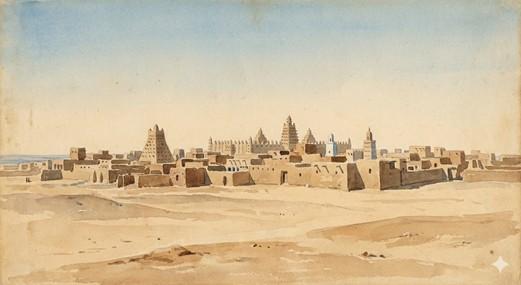
An image of the city of Timbuktu (generated by artificial intelligence.)
Caillié stayed in the city for two weeks, during which he sketched and took detailed notes. He learned that the Scottish explorer Alexander Gordon Laing had reached Timbuktu in 1826 but had been murdered on his return journey by his Muslim guide. The door of the house where Caillié stayed in Timbuktu remains a historical artifact to this day.
Fearing that returning via West Africa would raise suspicion and make it difficult to prove he had reached Timbuktu, Caillié decided to join a caravan heading north to Morocco. He crossed the Sahara Desert with a caravan of 800 camels carrying enslaved people. During this journey, he was awestruck by the Arab guides, who navigated without compasses or instruments, relying instead on natural signs such as the North Star, the color of the sand, and vegetation patterns.
After enduring extreme heat, dehydration, and harsh treatment during the desert crossing, Caillié crossed the Atlas Mountains and reached Tafilet and Fez. In Fez, he traded his camel for a donkey and arrived in Rabat with no money left. When he reached Tangier on 7 September 1828, he was secretly taken in by the French consul, washed, clothed, and arranged for his return to France.
After returning to Toulon, René Caillié received the 10,000 franc reward from the Paris Geographical Society, along with the Légion d’honneur and a pension. He published his travel notes in 1830 in two volumes under the title Travels through Central Africa to Timbuctoo; and across the Great Desert, to Morocco, performed in the years 1824-1828 (Travels from Central Africa to Timbuktu and Across the Great Desert to Morocco). He also authored another work titled Voyage d'un faux musulman à travers l'Afrique (The Journey of a False Muslim Across Africa).
Although Caillié married and settled into a quiet life, the harsh conditions of his African journey permanently damaged his health. He died in 1838 at the age of 39 from tuberculosis, contracted during his travels and which had weakened his constitution. His journey of approximately 4,500 miles mapped not only Timbuktu but also vast regions of Africa previously unknown to Europeans.

René Auguste Caillié (Yapay zeka ile oluşturulmuştur)
No Discussion Added Yet
Start discussion for "René Auguste Caillié" article
Early Life and Motivation for Exploration
Preparation and Strategy of Identity Concealment
Journey through West Africa
Travel from Guinea to Djenné
River Travel and Documentation Method
Timbuktu: Expectations and Reality
Crossing the Sahara and Return Journey
Final Years, Works, and Death