

This article was automatically translated from the original Turkish version.
+2 More
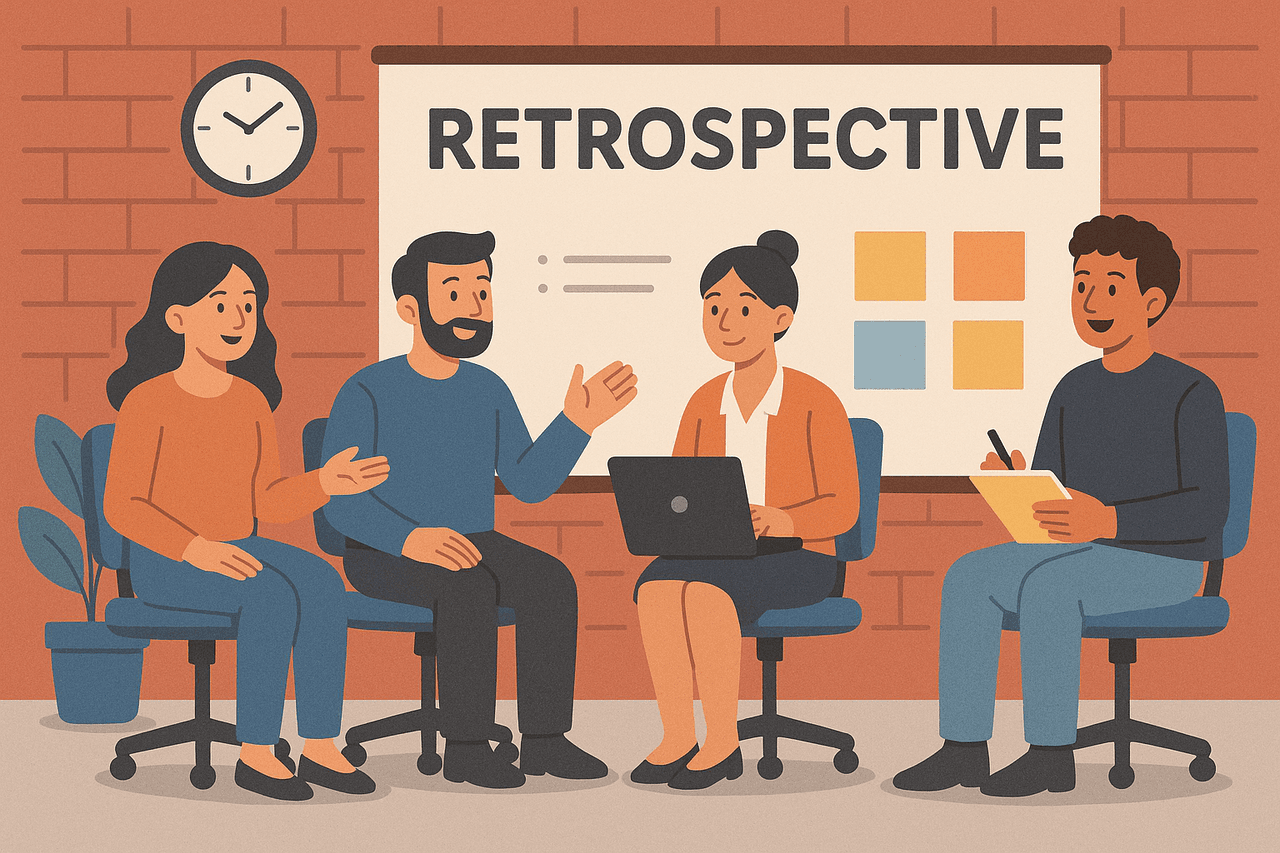
Generated with artificial intelligence.
Retrospective Meeting
Scope(s) | Continuous improvement Safe sharing Action plan Decision support Team learning Process improvement | ||||||||
|---|---|---|---|---|---|---|---|---|---|
Participant | Safe space Manager (usually absent) Product owner (optional) Scrum Master Team lead Whole team | ||||||||
Process | Improvement stories Blockers Progress toward goals What to improve What to stop What to continue | ||||||||
Outputs | Information sharing Tracking board Team commitment | ||||||||
Principles | Continuous learning Adaptability Focus on value Accountability Collaboration | ||||||||
Retrospective Meeting is an evaluation and improvement session held at the end of an iteration or project phase in software development (particularly Agile/Scrum) and project management practices. This meeting focuses on reviewing the team’s experiences from the previous period to assess and enhance processes. According to PMI’s Disciplined Agile practice, “Iteration retrospectives are a structured reflection practice that enables the team to learn from and improve their working methods based on the experiences of past iterations.” The purpose of retrospective meetings is to examine the process used by the team, strengthen team cohesion, and transfer the knowledge gained to the next iteration and, when necessary, to other teams.
This practice, which emphasizes team-based learning and continuous improvement, has also been adopted at the organizational level within PMI’s approaches supporting Agile. In the PMBOK® Guide Seventh Edition, retrospectives are addressed under the categories of “lessons learned” and continuous improvement; for example, PMBOK 7 defines retrospectives as meetings that provide the team with an opportunity to review their ways of working and enhance their processes. In this context, a retrospective is a regular evaluation activity that can be conducted not only at the end of a project but also at the end of iterations or delivery stages, aimed at improving project performance and team learning.
Retrospective meetings are typically held at the end of each iteration or project phase. According to the Disciplined Agile guide, the meeting should be scheduled “at the end of every iteration” and conducted while the experience is still fresh. For instance, in the project lifecycle example provided in PMBOK 7, retrospectives or lessons learned meetings are held at the close of each phase. These meetings are generally time-boxed; for example, a one-hour time slot is commonly recommended. In terms of participation, retrospectives include the entire project or iteration team. PMI sources emphasize that “the whole team participates in the retrospective” and “the team lead facilitates the retrospective.” The product owner may also attend, but managers and external stakeholders are typically excluded, as the goal of retrospectives is to create a safe sharing environment for the team. In these meetings, open communication and honest evaluation within the team are encouraged; issues and ideas are freely expressed among team members (a safe “safe space”). However, in certain cases, external stakeholders or managers may be invited partially or upon the team’s request.
In a retrospective meeting, the team evaluates the processes and outcomes of the completed iteration. Typically, the meeting is facilitated by a moderator (team lead or Scrum Master) and revolves around questions such as “What should we continue doing?”, “What should we stop doing?”, and “What should we do more or less of?”. The team discusses how well they achieved their iteration goals, their successes, the obstacles they encountered, and areas requiring improvement. As an output, the meeting usually results in action items or “improvement stories” to be implemented in the next iteration. According to PMI’s Disciplined Agile practice, “The retrospective should conclude with one to three stories that reflect the team’s collective commitment to a few critical process improvements.” Thus, the team identifies the most important improvements and commits to them collectively. These actions should be visible; some teams track them on a separate improvement board, while others monitor them on their regular work board.
Retrospective meetings instill in the team a habit of learning and continuous development. Through regular retrospectives, team members systematically focus on improving processes and develop a stronger sense of ownership over them. Additionally, external barriers or dependencies are identified and, when necessary, escalated to upper management. Particularly within the Agile/Scrum framework, the retrospective is part of the continuous improvement (Kaizen) culture. Known in Scrum as the Sprint Retrospective, this meeting focuses on what worked well during the sprint and what could be improved, thereby increasing efficiency and quality in subsequent sprints. Thus, retrospectives serve as regular evaluations that complement planning, execution, and control in project management processes, aimed at enhancing team performance on an iteration-by-iteration basis.
According to PMI standards, retrospectives are evaluated as part of project learning and knowledge sharing mechanisms. In the PMBOK® Guide Seventh Edition, the Project Work performance domain includes activities such as “enabling project learning and knowledge transfer.” In this context, retrospective meetings provide an opportunity to review and adapt the project process. The guide states, “Retrospectives or lessons learned. These meetings give the project team an opportunity to review their ways of working and propose changes to improve processes and efficiency.” This summarizes the purpose of retrospectives from the PMBOK perspective. Furthermore, PMBOK 7 defines a retrospective as “a regularly scheduled workshop in which participants examine their work and outcomes to improve processes and deliverables.” It views retrospectives as part of ongoing activities aimed at enhancing process and product quality through repeated, structured sessions. PMI considers retrospectives within the scope of “lessons learned” and recognizes them as an important technique for improving team performance.
In PMBOK 7, the performance domains associated with retrospectives are primarily the Team Performance Domain and the Project Work Performance Domain. The Team Performance Domain encompasses environmental and cultural factors aimed at creating a high-performing team. Retrospectives contribute to this domain by promoting open communication, shared learning, and continuous growth within the team. The Project Work Performance Domain focuses on the effective management of project processes; here, retrospectives serve as a tool for reviewing and adapting processes. Additionally, retrospectives are also considered within the context of the Uncertainty Performance Domain: PMBOK 7 notes that retrospectives can be used to identify risks and threats, recognize opportunities, and find ways to improve processes. This enables the reduction of emerging risks and the transfer of best practices from one project to others.
From the perspective of PMBOK 7 principles, the practice of retrospectives directly aligns with several principles. For example, the principle of “Make the Project Team Collaborative” emphasizes collaboration, knowledge sharing, and continuous team learning. Retrospectives support the implementation of these principles by enabling team members to share experiences and make collective improvement decisions. Similarly, the importance of retrospectives can be highlighted under principles such as “Stewardship” and “Focus on Values”, as these meetings provide a continuous feedback mechanism aimed at ensuring alignment with project objectives and maximizing value creation. Within the PMBOK 7 context, retrospectives serve modern project management approaches requiring systems thinking and adaptability and are recognized as an aligned practice consistent with performance domains and principles.
Project Management Institute. "Secrets to Running Project Status Meetings That Work!" *PMI Learning Library*. Accessed June 28, 2025. https://www.pmi.org/learning/library/secrets-running-project-status-meetings-7009.
Project Management Institute. A Guide to the Project Management Body of Knowledge (PMBOK® Guide) – Seventh Edition. Newtown Square, PA: Project Management Institute, 2021.
Project Management Institute. “Practice: Iteration Retrospective.” *Disciplined Agile*. Accessed June 28, 2025. https://www.pmi.org/disciplined-agile/product-owner/practice-iteration-retrospective.

Generated with artificial intelligence.
Retrospective Meeting
Scope(s) | Continuous improvement Safe sharing Action plan Decision support Team learning Process improvement | ||||||||
|---|---|---|---|---|---|---|---|---|---|
Participant | Safe space Manager (usually absent) Product owner (optional) Scrum Master Team lead Whole team | ||||||||
Process | Improvement stories Blockers Progress toward goals What to improve What to stop What to continue | ||||||||
Outputs | Information sharing Tracking board Team commitment | ||||||||
Principles | Continuous learning Adaptability Focus on value Accountability Collaboration | ||||||||
No Discussion Added Yet
Start discussion for "Retrospective Meeting" article
Scheduling and Participants
Process and Outputs
PMBOK® and PMI Perspective