


This article was automatically translated from the original Turkish version.
+2 More
Echo chamber effect describes the phenomenon in which individuals are exposed primarily to information and opinions that align with their own thoughts, beliefs, and values. This effect is associated with a reduced likelihood of encountering differing perspectives and the reinforcement of similar ideas through repetition.
Although partially observable in traditional communication environments, the echo chamber effect has become more prominent with the development of algorithmic structures in digital media and social networks. It is a significant area of study in communication research due to its role in homogenizing the content individuals encounter and reducing informational diversity.
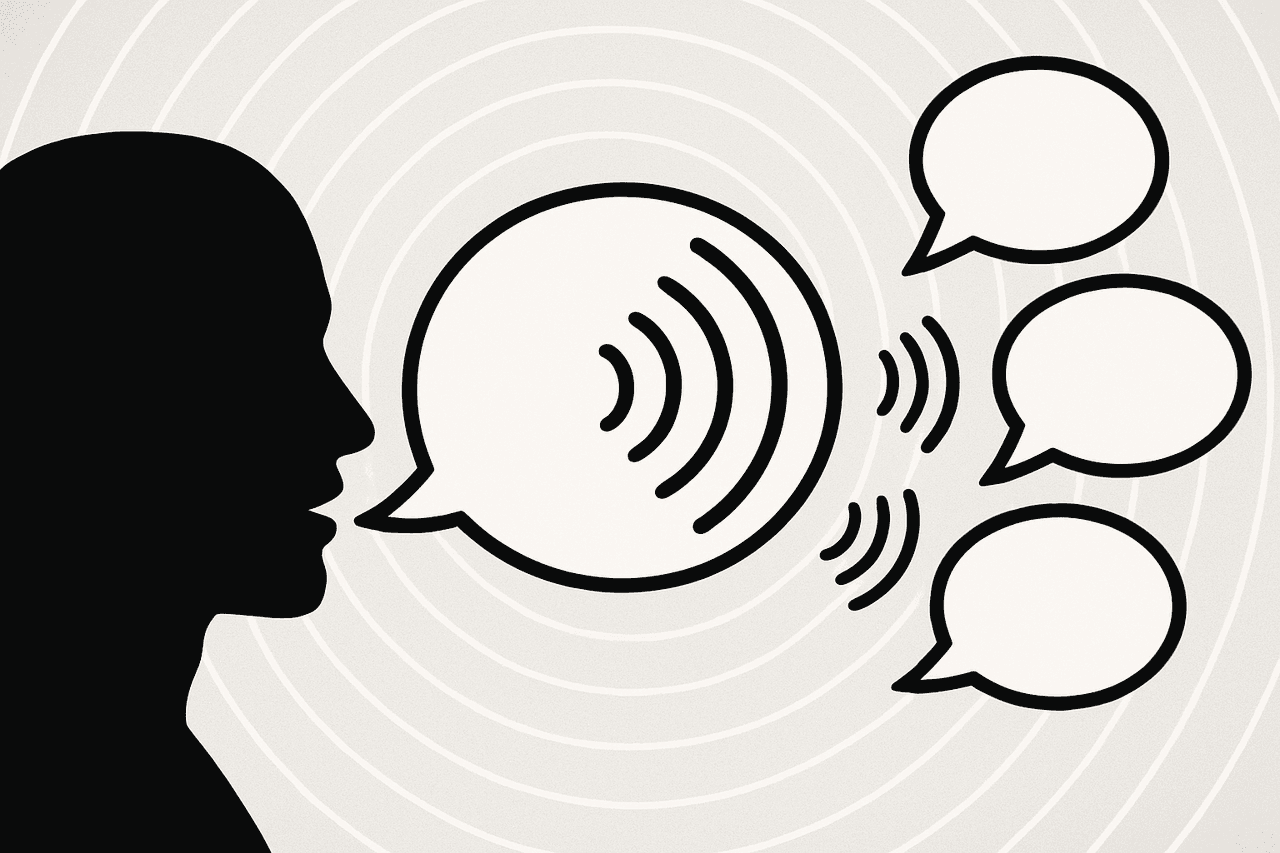
Echo Chamber Effect (Generated by Artificial Intelligence.)
The echo chamber effect is linked in communication science to selective exposure, group interaction, and digital network theories. Individuals tend to gravitate toward information sources that align with their views. When this tendency combines with algorithms on digital platforms that rank content based on user behavior, similar ideas become more visible.
This phenomenon is often discussed alongside the concepts of filter bubble and ciberbalkanization. A filter bubble refers to the condition in which users are surrounded by content selected for them by algorithms, leading to a loss of exposure to perspectives that differ from their own. Ciberbalkanization denotes the clustering of user communities within themselves, weakening communication and interaction links with other groups.
These three concepts serve as complementary terms for explaining the structural shaping of information flow within the digital media ecosystem.
The echo chamber effect is a process that operates at technical, cognitive, and social levels.
These stages reveal how the echo chamber effect is shaped at both individual and societal levels.
Social media and digital news platforms are the most prominent arenas where the echo chamber effect can be observed. Algorithms used in these environments create personalized feeds centered on user preferences.
When users interact online with others who share similar views, their likelihood of encountering opposing opinions diminishes. This form of interaction concentrates information sharing around specific themes. A large proportion of users on social media platforms acquire news and current information exclusively from their own networks. As a result, informational diversity is constrained by the internal dynamics of the network structure.
Some academic studies have found that personalized content positions users into ideologically homogeneous groups, while others suggest that algorithmic influence may be limited. These findings indicate that the echo chamber effect manifests at varying levels across different social and cultural contexts.
In the era referred to as the 【1】 post-truth period, the production and circulation of information are shaped more by frequency of sharing and emotional resonance than by factual accuracy. In this context, the echo chamber effect creates a structure conducive to the spread of information independent of truth criteria.
Social media platforms determine the visibility of information through algorithms based on user interactions. In this system, content with strong emotional appeal is shared more widely. As a result, certain ideas reach broader digital audiences while access to alternative viewpoints may be restricted.
Within the communication structure of the post-truth era, the echo chamber effect is defined as a factor that increases the speed of information circulation while reducing its diversity. This dynamic is significant for understanding the formal and technical dimensions of information access in digital societies.
In the functioning of the echo chamber effect, not only algorithms but also individuals’ cognitive tendencies play a decisive role. The human inclination to favor information that supports one’s views combines with algorithmic structures in digital environments to create a stronger feedback loop.
In this process, individuals interact more frequently with users holding similar opinions. Their social environment becomes composed of ideologically similar individuals, reducing the visibility of alternative perspectives. Consequently, the online public sphere acquires a thematic limitation and partially loses its pluralistic character.
National and international research on the echo chamber effect has examined digital media users’ patterns of information access from various angles. Findings indicate that personalized content systems and user preferences are key determinants of information flow direction.
Some studies have shown that the echo chamber effect reinforces users’ attitudes on political or social issues, while others suggest that algorithmic influence may be limited. Nevertheless, the nature of recommendation systems offered by different social media platforms is regarded as a factor determining the extent of this effect.
Due to the constantly evolving nature of digital media environments, the scope of the echo chamber effect is inherently dynamic. Research in this context demonstrates that the phenomenon is shaped by the interaction between technical infrastructure, user behavior, and social context.
The echo chamber effect is a multidimensional phenomenon extending from individual information acquisition processes to societal communication networks. The personalized nature of digital media technologies directly influences how individuals access information. In this process, the similarity of content individuals encounter increases while the visibility of differing viewpoints decreases.
Anadolu Ajansı. “Yankı Odası Etkisi Nedir?” Anadolu Ajansı Teyit Hattı. Accessed October 20, 2025. https://www.aa.com.tr/tr/teyithatti/teyit-sozlugu/yanki-odasi-etkisi-nedir/1814956
Anakız Ertürk, Hülya. "Yeni Medya Ekseninde İdeolojiyi Anlamak: Filtre Balonları ve Yankı Odaları." *Niğde Ömer Halisdemir Üniversitesi İletişim Fakültesi Akademik Dergisi* 1, no. 2 (2022): 137–159. Accessed October 20, 2025. https://dergipark.org.tr/tr/pub/nohuifad/issue/79878/1361906
Gümüş, Selime. “Hakikat Sonrası Çağda Sosyal Ağların Yankı Odası Etkisi.” *A’dan Z’ye İletişim Çalışmaları - 5*, edited by Nilüfer Sezer and Hasan Çiftçi, Ankara: İKSAD Publishing House, 2022, pp. 553–580. Accessed October 20, 2025. https://www.researchgate.net/publication/367091778_HAKIKAT_SONRASI_CAGDA_SOSYAL_AGLARIN_YANKI_ODASI_ETKISI
Narin, Bilge. “Kişiselleştirilmiş Haber Akışlarının Toplumsal Etkileri: Filtre Balonu, Yankı Odası ve Siberbalkanizasyon.” *Selçuk İletişim* 11, no. 2 (2018): 232–251. Accessed October 20, 2025. https://doi.org/10.18094/josc.340471
Oxford Languages. "Word of the Year 2016 - Post-Truth." Oxford Languages. Accessed October 20, 2025. https://languages.oup.com/word-of-the-year/2016/
Song, Xiaolei, Guo, Siliang, and Gao, Yichang. “Personality Traits and Their Influence on Echo Chamber Formation in Social Media: A Comparative Study of Twitter and Weibo.” *Frontiers in Psychology*. Accessed October 20, 2025. https://doi.org/10.3389/fpsyg.2024.1323117
Varol, Sibel Fügan. “Yankı Odası: Kavramsal Bir Çerçeve.” *The Journal of Academic Social Science Studies* 15, no. 91 (2022): 457–474. Accessed October 20, 2025. https://jasstudies.com/?mod=makale_tr_ozet&makale_id=63626
[1]
Hakikat Sonrası Çağ: İlk olarak Steve Tesich tarafından 1992’de tanımlanan ve Oxford Dictionaries tarafından 2016’da “post-truth” olarak kavramsallaştırılan; olgusal gerçeklerin, kamuoyunu etkilemede duyguların ve kişisel inançların gerisine düştüğü dönemdir. (Oxford Languages. "Word of the Year 2016 - Post-Truth." Oxford Languages. Erişim Tarihi 20 Ekim 2025. https://languages.oup.com/word-of-the-year/2016/)

No Discussion Added Yet
Start discussion for "Reverberation Effect" article
Theoretical Foundations and Conceptual Relationships
Formation Mechanism
Echo Chamber Effect in Digital Environments
The Post-Truth Era and Information Structure
Social and Cognitive Dynamics
Evaluation of Research Findings