


This article was automatically translated from the original Turkish version.
+1 More
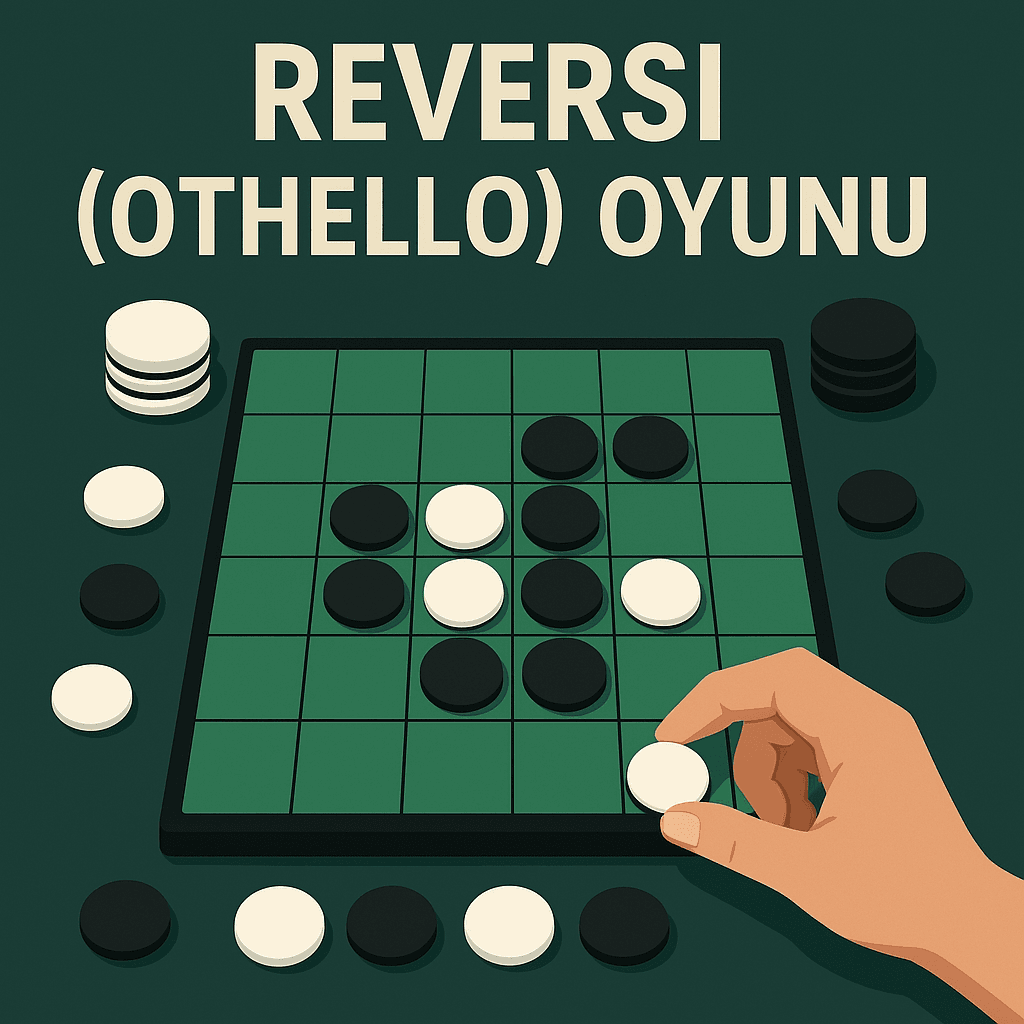
A Reversi Board Generated by AI
Fatherland | England | ||||||||
|---|---|---|---|---|---|---|---|---|---|
Architect(s) | Goro Hasegawa (Founder of Modern Halma) | ||||||||
Reversi, also known as Othello, is a two-player strategic classical board game that appeals to players of all ages. Despite its simple rules that allow it to be learned quickly, its strategic depth makes it a sustained tool for mental development. This contest played with black and white pieces on a grid is significant not only for individual only competition but also for algorithmic thinking and artificial intelligence research. Official tournaments held worldwide and organized federation structures have granted this game a unique place among traditional board games.

AI-generated family playing Reversi
Although the foundations of Reversi date back to the 19th century, the Othello version was developed in 1971 by Japanese game designer Goro Hasegawa. The first official Othello tournament was held in 1973 in Japan, followed by the first World Othello Championship (WOC) in Tokyo in 1977 with participation from five countries. The champion of this inaugural tournament was Japanese player Hiroshi Inoue.
Over time, interest in the WOC grew, and from 1987 onward, each country was allowed to send three players. That same year, the first World Team Championship was organized, promoting not only individual competition but also row country representation. In 2004, each country was granted the right to send one female player, and from 2016, quotas were introduced for young players. These developments have transformed Othello into an inclusive platform across both gender and age lines.
The World Othello Federation (WOF) was established in 2005 in Iceland with participation from 22 countries, and by 2016 approximately 70 countries had joined this structure. The federation is responsible for standardizing game rules, organizing tournaments, and promoting Othello culture worldwide.
Reversi is played on an 8x8 square board using double-sided black and white pieces. Each player, in turn, places a piece such that they trap and flip the opponent’s pieces between their own. This flipping can occur horizontally, vertical or diagonally. If a player cannot make a valid move, the turn passes to the opponent. The game ends when the board is completely filled or neither player has a legal move. The player with the most pieces of their color on the board at the end wins.
Despite its superficially simple rules, Reversi’s strategic dimension is highly complex. Especially in the opening stages, flipping many pieces does not always provide an advantage; in fact, such moves can grant the opponent positional superiority. Corners are the most valuable areas on the board because once occupied, they cannot be flipped. Therefore, players must develop strategies aimed at securing control of the corners.
In addition, control of edge pieces, mid-game strategies, and tactical considerations such as “mobility”—increasing one’s own number of possible moves while reducing the opponent’s—determine the game’s progression. Furthermore, the “parity” strategy, which involves the count of remaining empty squares being odd or even, is critical for players seeking to retain the advantage of the final move.
Reversi is one of the classic test games frequently used in artificial intelligence research. Search algorithms (Minimax, alpha-beta pruning) and game theory approaches have been successfully applied to this game. In recent years, software using deep learning and probabilistic computation methods have demonstrated highly successful performance against human players. This highlights that Reversi is not merely an entertaining game but also serves as a practical laboratory for artificial intelligence development.
The positive cognitive effects of Reversi on individuals are multifaceted. It can be used in schools to support the development of logical thinking, planning, patience, and attention. Played within families or school settings, it helps children develop problem-solving skills while serving as a mental exercise for adults. At the same time, thanks to international organizations, it has become a social vehicle that encourages cross-cultural interaction and friendly competition.
Reversi is a universal game that combines accessibility through its simplicity with mental depth through its strategic structure. Throughout its Historical development, it has gained acceptance across diverse geographies and evolved over time into an institutionalized structure recognized worldwide. Beyond being an engaging arena for strategic thinkers, it makes meaningful contributions in numerous fields such as artificial intelligence development, education, and social interaction. Reversi is the universal language of the mind and strategy.
Kuru, İrfan. “İki Kişilik Reversi Oyununda Ağaç Yapısı ve Yapay Zekâ Kullanımı.” *Journal of the Faculty of Engineering and Architecture of Gazi University* 32, no. 1 (2017): 201–210. Accessed April 9, 2025. https://dergipark.org.tr/tr/download/article-file/397430.
World Othello Federation. "About the World Othello Federation." Accessed April 9, 2025. https://www.worldothello.org/about.
World Othello Federation. "World Othello Championship." Accessed April 9, 2025. https://www.worldothello.org/about/tournaments/world-othello-championship.

A Reversi Board Generated by AI
Fatherland | England | ||||||||
|---|---|---|---|---|---|---|---|---|---|
Architect(s) | Goro Hasegawa (Founder of Modern Halma) | ||||||||
No Discussion Added Yet
Start discussion for "Reversi (Othello) Intelligence Game" article
Historical Development of Reversi
Game Rules
Strategic Depth
Reversi and Artificial Intelligence
Educational and Social Value