


This article was automatically translated from the original Turkish version.
+2 More
RFID (Radio Frequency Identification)
Name(s) | RFID Technology | ||||||||
|---|---|---|---|---|---|---|---|---|---|
Expansion | Radio Frequency Identification (Radio Frequency Identification) | ||||||||
Type(s) | Wireless communication and automatic identification technology | ||||||||
Component(s) | Tag Antenna Reader | ||||||||
Application Area(s) | IoT systems Livestock Education Security Healthcare Retail Logistics | ||||||||
Advantage(s) | No line of sight required High data capacity Multi-tag support Contactless reading | ||||||||
Similar Technologies | Barcode, NFC, Bluetooth | ||||||||
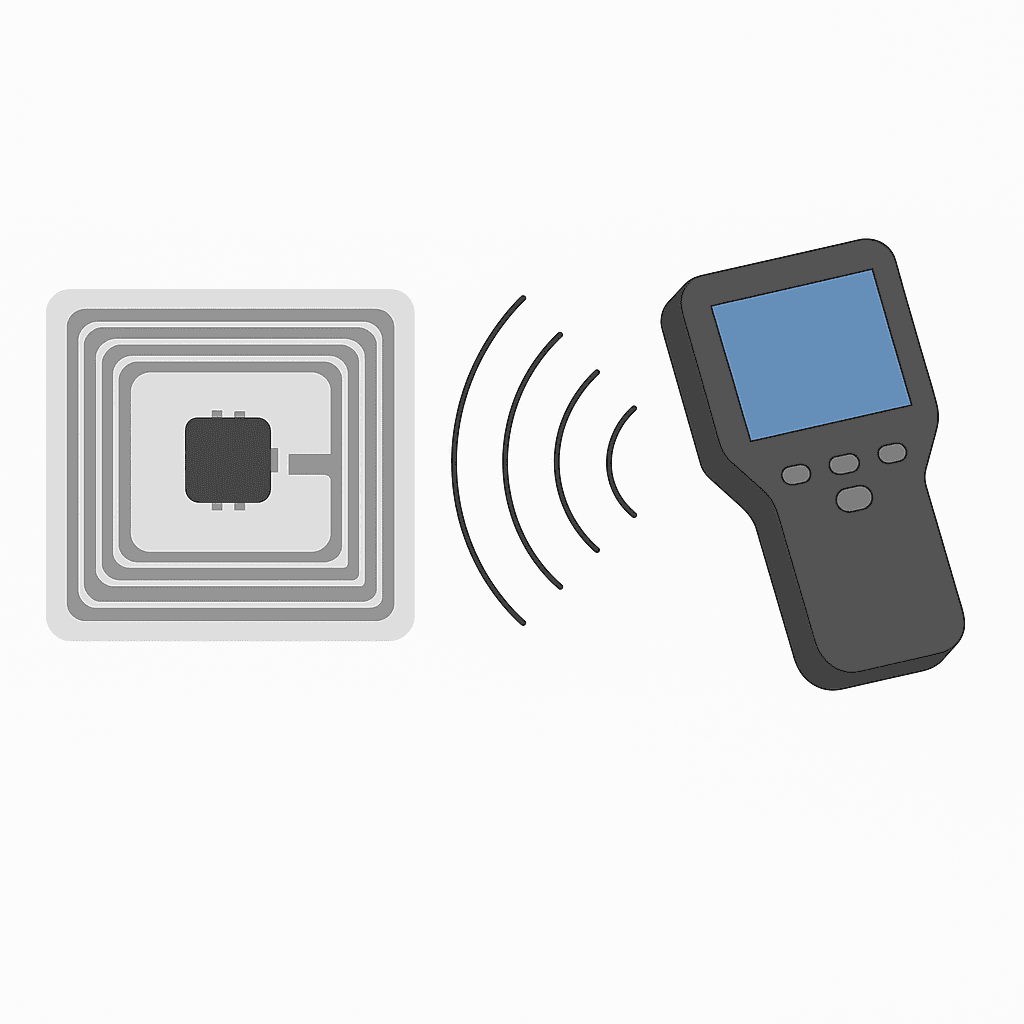
RFID (Radio Frequency Identification – Radio Frequency Identification) is an automatic identification system that enables the wireless identification and tracking of objects. The system primarily consists of a tag, a reader, and an antenna. RFID tags carry identification information assigned to a specific object. This information is read contactlessly by readers via radio frequency signals. Electromagnetic waves emitted by the reader are transmitted to the tag through the antenna, activating the circuits within the tag, which then modulate and transmit the information back to the reader.

RFID tag (Generated by Artificial Intelligence.)
The foundations of RFID technology are rooted in the IFF (Identification Friend or Foe) systems used during World War II in the 1940s. These systems enabled military aircraft to be identified as friendly or hostile via radio signals. The IFF system pioneered the communication architecture of RFID and established the fundamental principle of tag-antenna-reader interaction.
Tag: RFID tags consist of a microchip and an antenna. The microchip stores identification information while the antenna facilitates signal reception and transmission. Tags are classified into passive, semi-passive, and active based on their energy sources. Passive tags derive all their energy from the reader, whereas active tags have their own batteries and can transmit data over longer distances.
Reader: RFID readers are devices that emit signals to collect data from tags and transfer this data into a digital environment. They operate on the backscatter principle. Readers can function across frequency bands ranging from 125 kHz to 2.4 GHz, including LF, HF, UHF, SHF, and UWB.
Antenna: The RFID antenna is responsible not only for data transmission but also for transferring energy to the tag. Passive RFID tags begin operation by receiving electromagnetic energy from the reader via the antenna. Antennas come in planar or circular radiation patterns and are selected based on characteristics such as frequency band, gain, and polarization.
In RFID systems, energy and data transfer between the tag and the reader is achieved through “coupling.” Electromagnetic coupling typically operates in the UHF band and enables fast data transmission over long distances. Magnetic coupling, on the other hand, is used in LF and HF frequency bands, offering shorter range but more secure communication. It is particularly preferred in building access systems and animal tagging applications.
Most RFID systems, particularly passive ones, have vulnerabilities in data transmission. Threats include eavesdropping, alteration, or replay of transmitted signals over the air. Therefore, reader authentication methods and encryption protocols must be employed. Although the EPC Gen2 standard provides basic regulations, advanced applications are recommended to use hash algorithms and mutual authentication protocols.

Visual of RFID Card Application (pexels)
RFID technology has a broad range of applications across various sectors. In the supply chain and logistics industry, it enables real-time inventory monitoring, automated shipment control, and improved efficiency in distribution processes. In the healthcare sector, applications include patient wristband identification, tracking of medical equipment, and monitoring sterilization procedures.
In livestock management, microchips implanted in pets and tracking systems for large animals enable data-driven animal management. In library and archive systems, RFID facilitates book location tracking and automates borrowing processes. In the retail sector, it is used to implement cashierless checkout systems and prevent product loss. Finally, in defense and military applications, RFID is utilized for critical tasks such as equipment identification and efficient field logistics management.
RFID systems provide an advanced communication infrastructure for the digital identification, tracking, and management of physical objects. Through radio frequency-based data transfer, contactless, rapid, and multi-item identification becomes possible.
This system, which integrates core components such as the antenna, reader, and tag, can be adapted to various usage scenarios depending on frequency types and coupling methods. Identifying security vulnerabilities and supporting them with protocols further enhances the importance of RFID technology for secure data transmission. With all these features, RFID holds a unique position among wireless communication technologies.
Abawajy, Jemal H., Mohammed A. Hammoudeh, and Rania Kora. “The RFID Technology and Its Applications: A Review.” *International Journal of Electronics* 2, no. 3 (2012): 109–120. Accessed May 15, 2025. https://www.researchgate.net/publication/232575248_THE_RFID_TECHNOLOGY_AND_ITS_APPLICATIONS_A_REVIEW
Plank, Susanne. “RFID JPG.” Pexels. Accessed May 15, 2025. https://www.pexels.com/tr-tr/fotograf/adam-el-duvar-teknoloji-13657444/
Yeşilyurt, Zinnur., Dal, Tuğba., and Işıker, Ömer. “RFID Teknolojisi.” Slideshare Sunumu. Accessed May 15, 2025. https://www.slideshare.net/slideshow/rfid-teknolojisi/43603186.
Çiftçibaşı, Emre. “RFID Sistemlerde Güvenlik Açıkları ve Çözüm Yolları.” *Elektrik Mühendisliği Dergisi*, no. 437 (2009): 91–92. Accessed May 15, 2025. https://www.emo.org.tr/ekler/148ec96d4e6054d_ek.pdf?dergi=4
Çıbuk, M., and F. Maraşlı. “RFID Teknolojisi ve Kullanım Alanları.” *Bitlis Eren Üniversitesi Fen Bilimleri Dergisi* 4, no. 2 (2015). Accessed May 15, 2025. https://dergipark.org.tr/tr/download/article-file/230815
Üstündağ, Alp, and Mehmet Tanyaş. “RFID Yatırımlarını Etkileyen Faktörler Üzerine Bir Çalışma.” İTÜ Dergisi 8, no. 4 (2009): 83–84. Accessed May 15, 2025. https://www.rfid.itu.edu.tr/arastirma/RFID-yatirim.pdf

RFID (Radio Frequency Identification)
Name(s) | RFID Technology | ||||||||
|---|---|---|---|---|---|---|---|---|---|
Expansion | Radio Frequency Identification (Radio Frequency Identification) | ||||||||
Type(s) | Wireless communication and automatic identification technology | ||||||||
Component(s) | Tag Antenna Reader | ||||||||
Application Area(s) | IoT systems Livestock Education Security Healthcare Retail Logistics | ||||||||
Advantage(s) | No line of sight required High data capacity Multi-tag support Contactless reading | ||||||||
Similar Technologies | Barcode, NFC, Bluetooth | ||||||||
No Discussion Added Yet
Start discussion for "RFID (Radio Frequency Identification System)" article
Historical Development and the IFF System
Components of the RFID System
Coupling Mechanisms
Tags According to Frequency Types
Security Structures and Access Control in RFID Systems
Applications of RFID