
This article was automatically translated from the original Turkish version.
+1 More
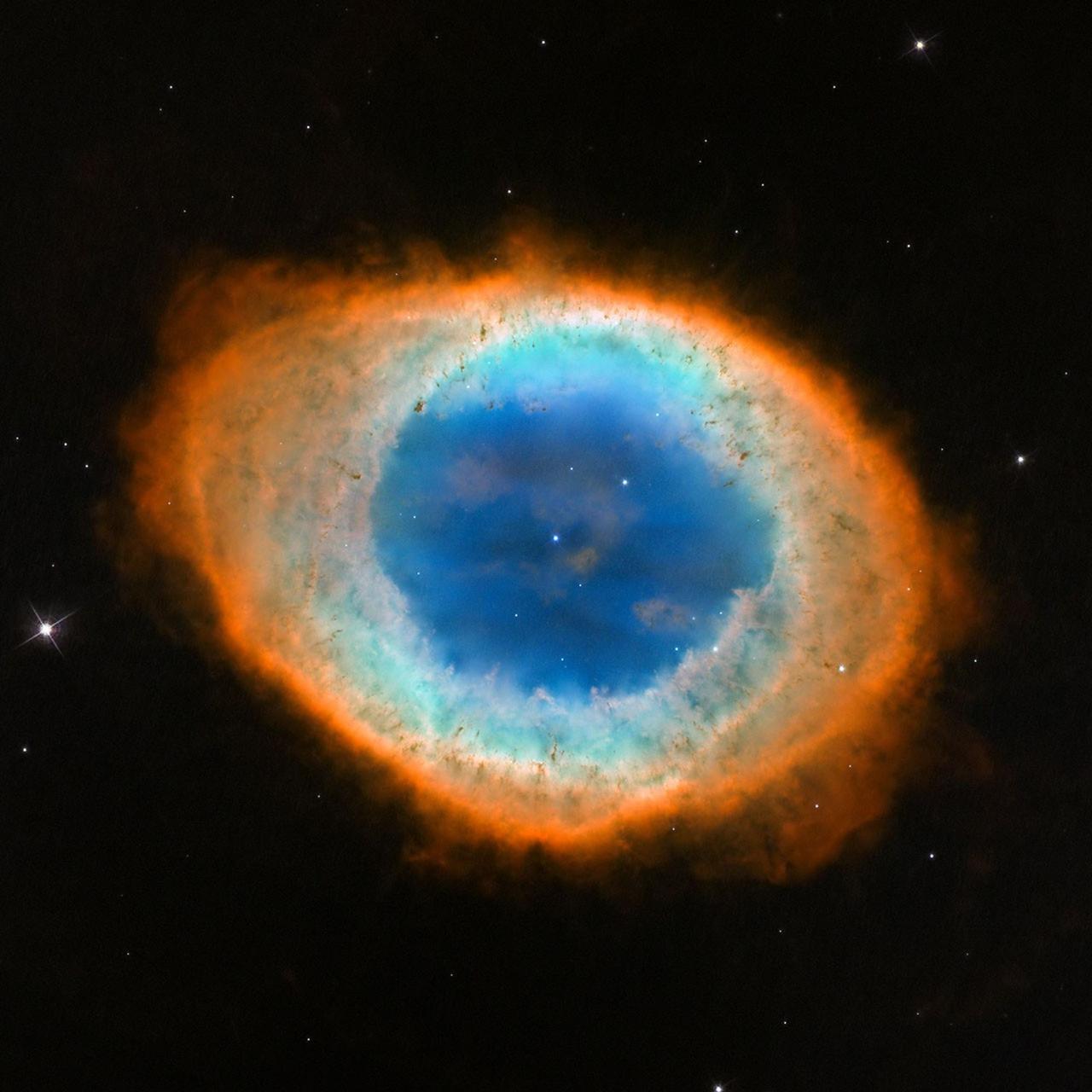
The Ring Nebula (NGC 6720), is a small planetary nebula. This object, listed in the Messier catalog as M57, is located in the direction of the Lyra constellation and lies approximately 2,300 light-years from Earth. Due to its visual appearance, this structure is sometimes referred to in some sources as the "Diamond Ring Nebula," although this name is not commonly used in astronomical literature.
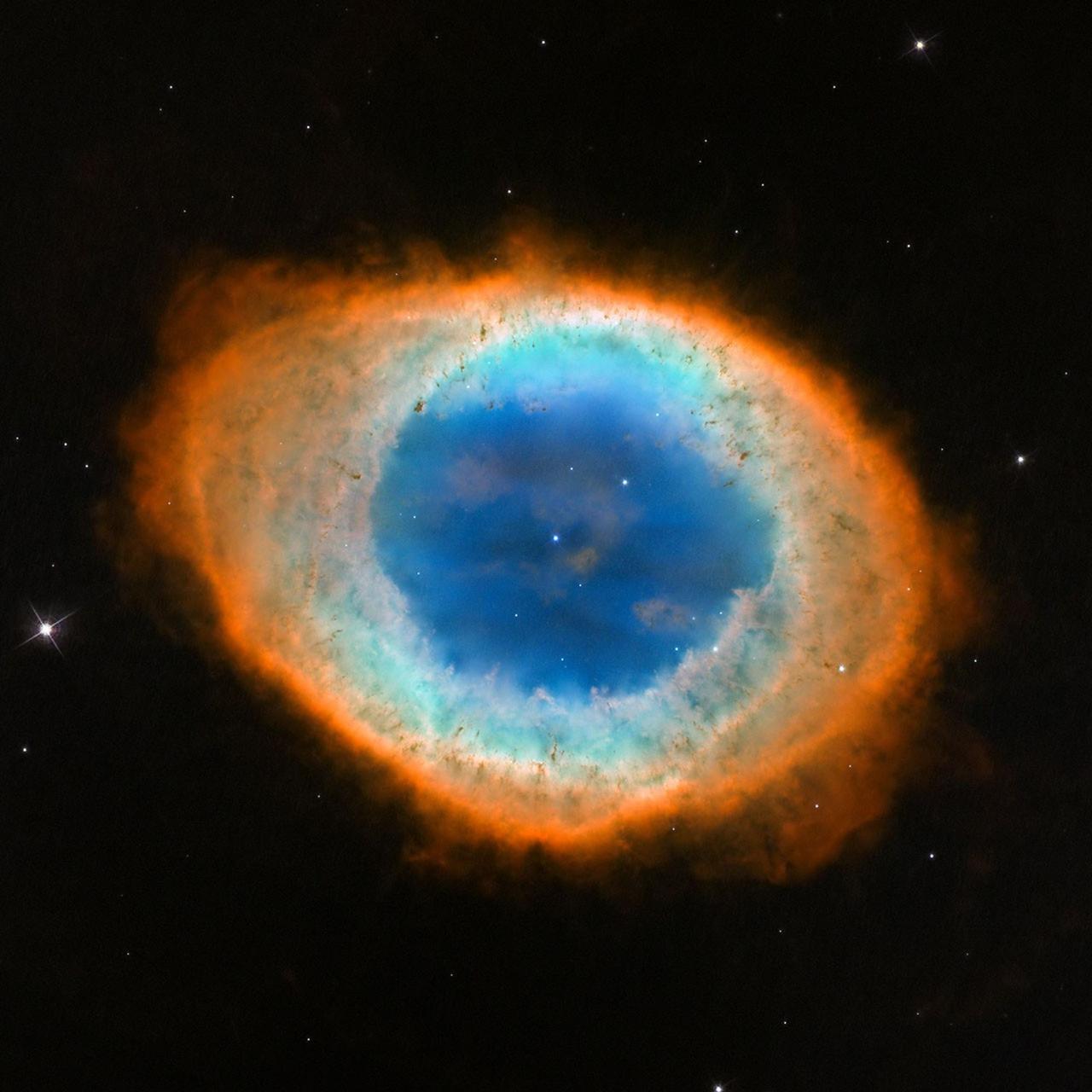
The Ring Nebula (NASA)
NGC 6720 formed when a medium-mass star (with a mass between approximately 1 and 8 solar masses) ejected its outer layers during the final stages of its evolution, following the asymptotic giant branch (AGB) phase. During this process, the star sheds its outer envelope due to thermal pulses occurring between its helium and carbon layers, leaving behind a hot, dense core at its center. This core now constitutes the white dwarf located at the center of the present-day Ring Nebula.
The visual appearance of NGC 6720 as a ring is a projection effect of its three-dimensional structure. In reality, the nebula consists of a puffed toroidal (hollow spherical shell) envelope surrounded by low-density ionized gas. The bright inner ring structure is prominently defined by emission lines from ionized oxygen ([O III]), hydrogen (Hα), and nitrogen ([N II]).
The faint, nearly spherical region surrounding the inner structure is composed of expanded plasma and material carried by stellar winds. This outer region has been ionized over time by ultraviolet radiation emitted from the central star.
NGC 6720 is a nebula exhibiting narrow emission lines originating from various ionized atoms within the nebula. The most commonly observed lines include:
These lines are used to determine the temperature, density, and ionization structure of the nebula. The electron temperature is typically around 10,000 K, while the electron density within the nebula is on the order of several thousand per cm³.
The star at the center of the Ring Nebula is now a white dwarf that can no longer sustain fusion reactions and has lost the majority of its original mass. This object has a surface temperature of approximately 100,000 K and serves as the primary energy source, emitting high-energy photons that continue to ionize the surrounding gas. The mass of this star is estimated at about 0.6 M☉, and it is believed to have originally had a mass of approximately 1–2 M☉. Its luminosity is predominantly in the ultraviolet range and appears faint in the visible spectrum.
NGC 6720 can be observed by amateur astronomers using small telescopes. Although it appears visually as a bright ring, high-resolution images obtained by professional telescopes, particularly the Hubble Space Telescope (HST), have revealed irregular filaments, ionized gas knots, and symmetry breaks within the nebula’s center.
In addition, infrared and X-ray observations have uncovered previously unseen details of its structure. Observatories such as Spitzer and Chandra have provided detailed images of the hot gas structures and shock regions within the central area of the Ring Nebula.
The expansion velocity of the nebula is typically in the range of 20–30 km/s. Considering this velocity and its current angular size, the formation of the Ring Nebula is estimated to have begun approximately 6,000 years ago. This period represents the time since the star began ejecting its outer layers.
NGC 6720 is a classic example of a planetary nebula formed during the late evolutionary phase of a medium-mass star. Its ring-like structure, emission lines from ionized gas, and the hot white dwarf at its center exemplify the typical characteristics of such objects. The effect of its three-dimensional geometry on its apparent shape provides an important observational case study. Furthermore, its chemical composition offers valuable data on the enrichment process of the interstellar medium in the universe.
ESA/Hubble. “NGC 6720.” Accessed July 10, 2025. https://esahubble.org/images/opo9738c18/.
NASA. “Hubble Captures a Ring.” *NASA Science*. Accessed July 10, 2025. https://science.nasa.gov/asset/hubble/hubble-captures-a-ring/.
NASA. “The Ring Nebula (M57).” *NASA Science*. Accessed July 10, 2025. https://science.nasa.gov/asset/hubble/the-ring-nebula-m57/.

No Discussion Added Yet
Start discussion for "Ring Nebula (NGC 6720)" article
Defining Characteristics and Observational Parameters
Formation Process and Evolutionary Stage
Structural Features and Geometry
Spectroscopic Properties and Chemical Composition
Central Star and White Dwarf
Observation and Imaging
Expansion Velocity and Age Estimation